Equipment · Legs
Leg Extensions and Hamstring Curls: Isolating Your Quads and Hamstrings
Why leg extensions and hamstring curls belong in your leg training: quad and hamstring isolation, seated vs lying curls, and the machines at Inception Gym Christchurch.
By Inception Gym · 30 May 2026
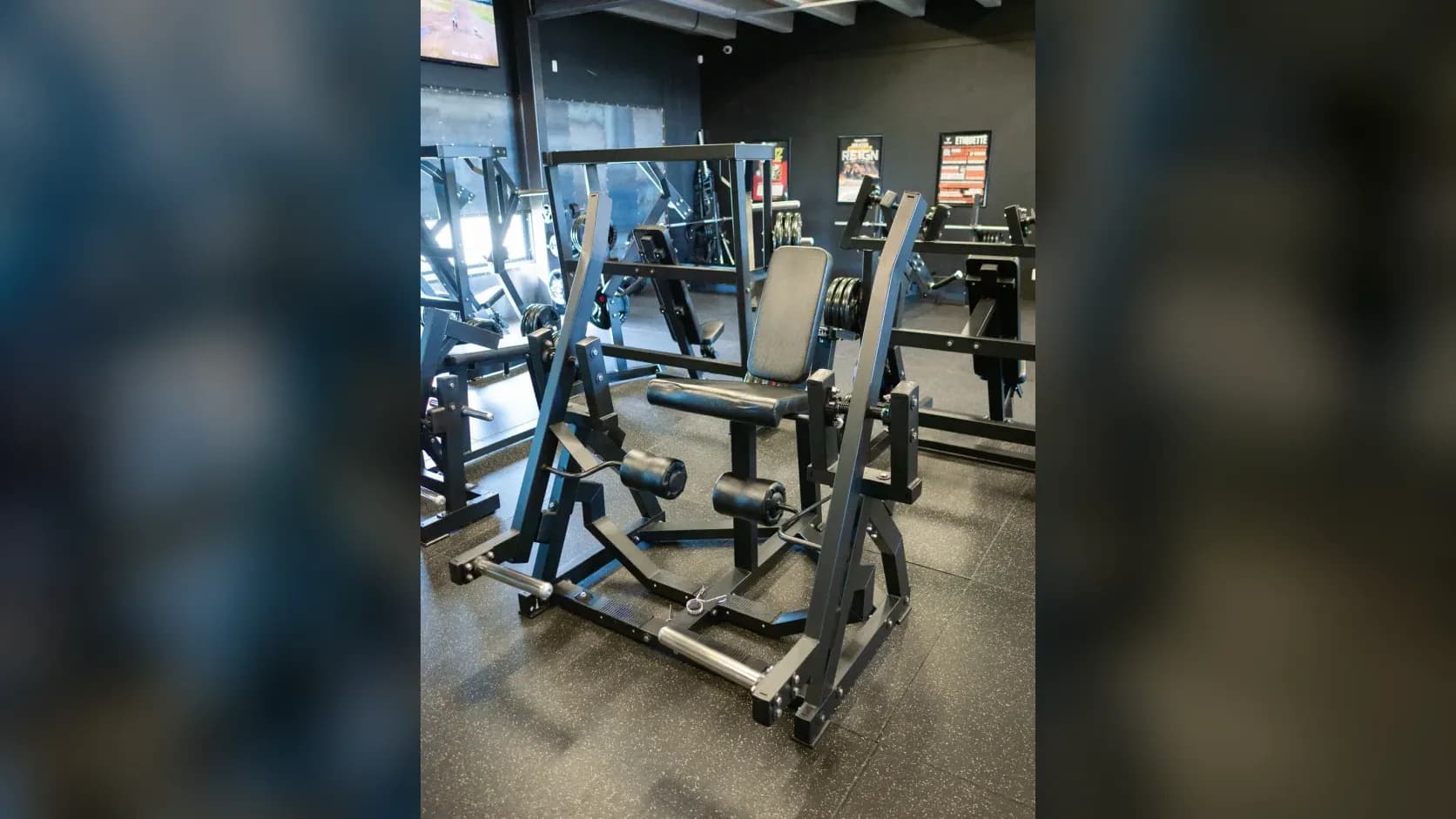
Leg extensions and hamstring curls are the two most direct tools for building the front and back of your thighs. The leg extension isolates the quadriceps through knee extension. The hamstring curl isolates the hamstrings through knee flexion. Neither replaces squats, leg presses or hinges, but both hit fibres and positions that compound lifts leave undertrained, which is exactly why serious leg programmes keep them in.
This guide covers the physiology behind both movements, the difference between seated and lying hamstring curls (and why it matters more than most people realise), technique, programming, and the four machines that cover this work at Inception Gym.
Why isolation work for legs at all
Compound lifts are the backbone of lower body training. Squats, hack squats, leg presses and deadlift variations load multiple joints at once and let you move serious weight. If you are comparing your compound options, the hack squat vs leg press comparison covers that decision in detail.
But compound lifts have two structural gaps that isolation work fills.
First, in a multi-joint lift the weakest link sets the limit. In a squat, your set often ends because your lower back, hips or general fatigue give out before the quads have been pushed anywhere near their limit. An isolation exercise removes those limits: the target muscle is the only thing doing the work, so it is the thing that reaches failure.
Second, two of the key thigh muscles are biarticular: they cross both the hip and the knee, and compound lifts train them poorly. The rectus femoris (the middle quad muscle) and most of the hamstring group behave very differently in single-joint work than they do in squats and hinges. More on that below.
The result is that leg extension and leg curl work complements compound training rather than competing with it. The complete leg day guide shows how the pieces fit together in a full session.
The leg extension: quad isolation
The quadriceps are four muscles: the vastus lateralis, vastus medialis and vastus intermedius, which cross only the knee, and the rectus femoris, which crosses both the knee and the hip.
All four extend the knee, and the leg extension is pure knee extension under load. That makes it the one exercise where every quad muscle works with nothing else limiting the set. No balance demand, no lower back involvement, no cardiovascular ceiling. Just knee extension against resistance from full flexion to full lockout.
The rectus femoris is the interesting case. Because it also flexes the hip, it is put in a mechanically compromised position during squats and leg presses: as the knee bends, the hip bends too, so the muscle shortens at one end while lengthening at the other and never gets a strong stimulus. Research on quad growth consistently shows the rectus femoris responding far better to leg extensions than to squatting patterns. If your quads look underdeveloped down the middle of the thigh despite years of squatting, this is usually why.
The leg extension also loads the quads hardest near full knee extension, the position where squats and presses are easiest. Pairing the two means the quads get trained hard through the entire strength curve.
Technique on the leg extension
- Set the seat so your knee joint lines up with the machine's pivot point. Misalignment shifts stress into the knee rather than the muscle.
- Set the ankle pad just above the foot, on the lower shin.
- Extend to full lockout and squeeze. The top of the movement is where quad activation peaks; cutting it short wastes the exercise's main advantage.
- Lower under control, around 2 to 3 seconds, through the full available range. Do not let the stack slam down.
- Keep your hips on the seat. Hiking the hips to swing extra reps takes tension off the quads.
The hamstring curl: knee flexion under load
The hamstrings are three muscles: the biceps femoris, semitendinosus and semimembranosus. Like the rectus femoris, most of the group is biarticular, crossing both the hip and the knee. They extend the hip and flex the knee.
Hinge movements such as Romanian deadlifts train the hamstrings hard as hip extensors, but the knee flexion function barely gets touched by compound work. Squats and leg presses give the hamstrings very little stimulus at all, because hip and knee extend together and the muscle stays at roughly constant length. If your leg training is squats and presses only, your hamstrings are being left behind, and the imbalance shows up in both physique and knee stability.
Leg curls load knee flexion directly. That trains the hamstrings in the function compound lifts miss, and it is the only common way to hit the short head of the biceps femoris, which crosses the knee only and gets nothing from hip hinging.
Seated vs lying curls: the position of the hip changes the result
Both seated and lying (prone) curls are knee flexion. The difference is what the hip is doing, and because the hamstrings cross the hip, that difference is significant.
In a lying curl, the hip is extended (straight). The hamstrings are relatively shortened at the hip end, so the muscle works through knee flexion from a moderate overall length.
In a seated curl, the hip is flexed to roughly 90 degrees. That stretches the hamstrings at the hip end before the set even starts, so every rep of knee flexion happens with the muscle at a longer overall length.
That distinction matters because of one of the better-supported findings in recent hypertrophy research: muscles tend to grow more when they are trained at longer lengths. A study directly comparing the two machines found meaningfully greater hamstring growth from seated curls than from lying curls over the same training period, with the biggest differences in the biarticular hamstring muscles, the ones the seated position stretches. The broader principle, that training a muscle in a lengthened position drives strong growth, holds across muscle groups; the hypertrophy training guide covers it in more depth.
The practical takeaway: if you only do one curl variation, make it seated. The lying curl still earns its place, though. It feels different, it lets some lifters get a harder peak contraction, and rotating both variations covers the hamstrings from more than one angle. This is not a case of one machine being wrong, just one having the edge as a default.
Technique on the curl
- Seated: thigh pad locked down firmly, back against the pad, curl through the fullest range the machine allows and control the return. Do not let the hips rise off the seat as fatigue builds.
- Lying: hips stay pressed into the bench throughout. Lifting the hips as you curl shortens the hamstrings at the hip and turns the exercise into momentum.
- On both, the eccentric matters. A controlled 2 to 3 second lowering phase, especially into the stretched position, is where much of the growth stimulus lives.
The setup at Inception Gym
Inception Gym carries both plate-loaded and pin-loaded options for each movement:
- A plate-loaded leg extension for heavy, low-rep quad work with small, precise plate increments.
- A plate-loaded lying hamstring curl for prone knee flexion with the same loading precision.
- A pin-loaded seated leg extension for fast stack changes, ideal for higher-rep sets and drop sets.
- Pin-loaded seated and prone hamstring curls, giving you the lengthened-position seated curl and the lying variation on the same floor.
Having all four means you never have to compromise the movement to suit the equipment. The full inventory, 92 machines with 43 plate-loaded, is listed on the equipment page, and members mention the machine depth constantly across the gym's 1,078+ five-star Google reviews.
Programming leg extensions and curls
Both movements slot in after your compound work, when the target muscles are pre-fatigued but the exercises' low stability demands mean quality reps are still available.
A practical structure:
- Leg extensions: 3 to 4 sets of 10 to 15 reps, taken close to failure. Because the exercise is joint-friendly at moderate loads and low in systemic fatigue, pushing hard is sustainable.
- Seated hamstring curls: 3 to 4 sets of 8 to 12 reps as your primary curl, with emphasis on the stretched position.
- Lying curls: rotate in as a second variation, 2 to 3 sets of 12 to 15 reps, or alternate blocks between the two.
Once or twice per week for each movement is plenty for most lifters when it sits alongside squatting and hinging. Progress the same way as anything else: add reps within the range, then add load.
Two common mistakes to avoid. First, loading so heavy that range shortens; partial leg extensions and half curls sacrifice the lengthened and shortened positions that make these exercises worthwhile. Second, treating them as a warm-up afterthought and never pushing sets near failure. Isolation work only builds muscle when it is trained with the same intent as the big lifts.
Direct work for the muscles compound lifts miss
Leg extensions and hamstring curls are not accessories to tick off. They are the only common exercises that fully train the rectus femoris and the knee flexion function of the hamstrings, and the seated curl in particular takes advantage of lengthened-position training that research links to strong growth.
Train them through a full range, control the eccentric, take sets close to failure, and pair them with your compound work rather than instead of it. Your quads and hamstrings will respond in ways squatting alone never produces.
---
The plate-loaded leg extension, plate-loaded lying curl and pin-loaded seated extension and curl machines are part of the 92-piece floor at Inception Gym, Tower Junction, Addington. [View all equipment](/facilities/equipment) or [start with a free trial](/memberships/free-trial) and test them yourself.