Equipment · Legs
Hack Squat vs Leg Press: Which Builds Bigger Legs?
Hack squat hits the quads harder; leg press loads heavier and reaches the glutes. How each machine works, which to choose, and how to programme both at Inception Gym Christchurch.
By Inception Gym · 21 February 2026
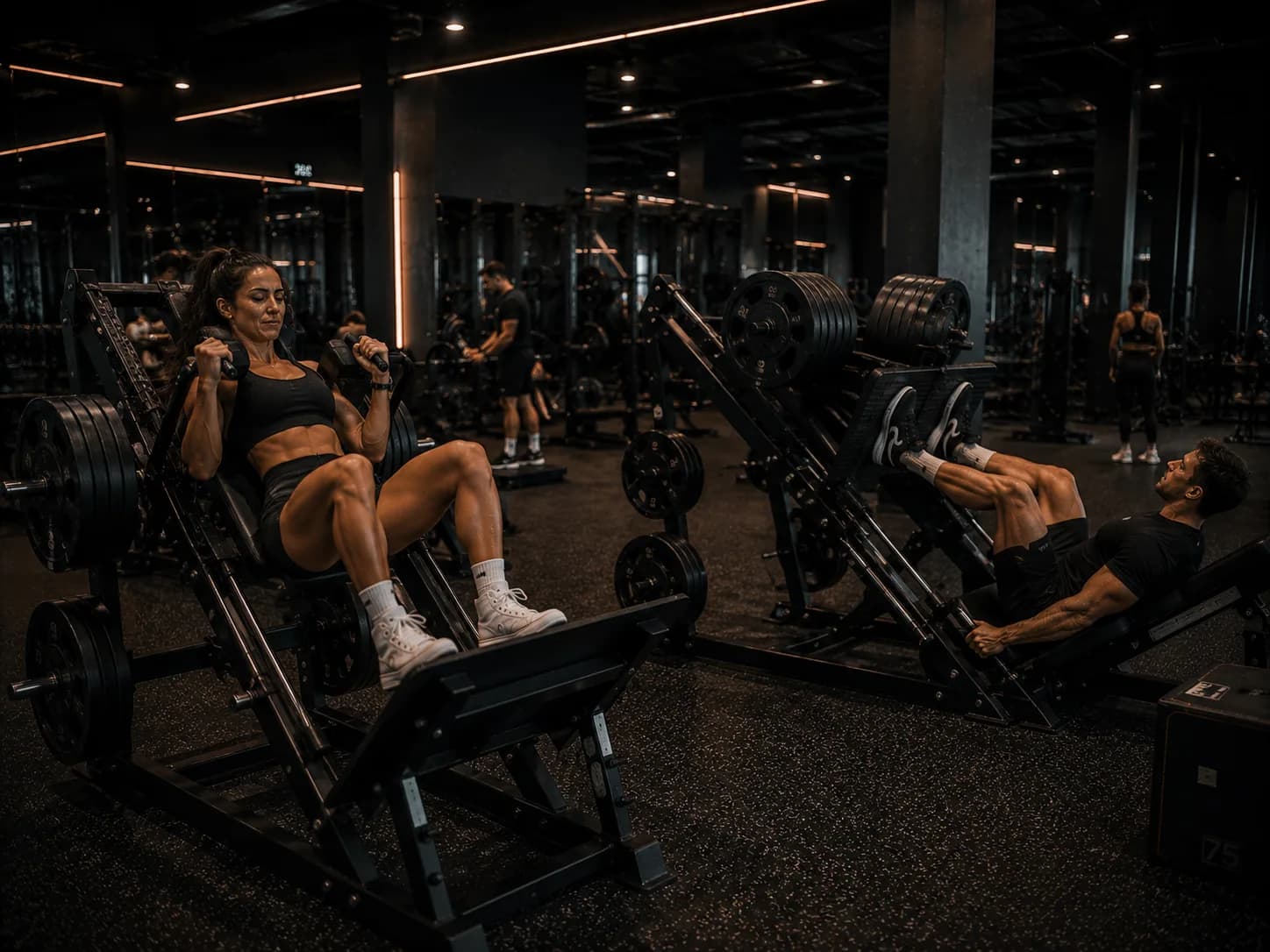
The debate that divides leg day
Ask any serious gym member whether they prefer the hack squat or the leg press and you will get a strong opinion. Both are leg-day staples. Both allow heavy loading. Yet they feel completely different and belong in different roles within a programme.
The short answer: the hack squat delivers more direct quad stimulus per set, while the leg press allows heavier total loading and, with foot placement changes, better glute development. For bigger legs overall, use both in the same programme. The longer answer requires understanding what each machine does to your muscles, and how to combine them.
At Inception Gym Christchurch we run the full selection: plate-loaded hack squat, multiple leg press stations, a pendulum squat, and a belt squat. This guide explains why you need all of them.
What is the hack squat?
The hack squat puts you on an inclined platform with your back against a padded backrest and your feet on a foot plate in front of you. You squat by bending the knees while the machine guides you along a fixed track.
The inclined position and forward foot placement are the defining features. Because your torso is fixed against the backrest and your feet sit in front of your hips, the movement forces a deep knee bend with significant forward knee travel. That loads the quadriceps through a large range of motion.
Key characteristics:
- More upright torso than a free squat
- Feet ahead of the hips, increasing knee travel
- Fixed track guides the movement path
- Plate-loaded, so there is no stack ceiling
- Very high quad demand
What is the leg press?
The leg press puts you seated or reclined with your back flat against a backrest and your feet on a foot plate that moves away from you. You press by extending the knees and hips together, pushing the plate away.
The reclined body position changes the biomechanics compared to the hack squat. Your torso sits at an angle, typically 45 to 60 degrees, which shifts work between the hip and knee extensors and spreads load across the quads and glutes.
Key characteristics:
- Reclined body position, typically 45 to 60 degrees
- Both knee extension and hip extension involved
- Foot placement has a major effect on muscle targeting
- Plate-loaded, allowing very heavy loading
- More glute involvement than the hack squat
- Less knee travel than the hack squat
Biomechanical differences
Knee flexion and quad loading
The hack squat requires more knee flexion to reach a full range of motion because the foot is positioned forward. More knee flexion means more quad stretch and loading through a longer range. Training through a long range, particularly in the stretched position, drives hypertrophy.
The leg press also lets you go deep, but the reclined position means your torso moves backwards as the knees come towards your chest, which shifts load to the glutes and hamstrings rather than concentrating it in the quads.
Result: the hack squat produces more direct quad stimulus per set than an equivalent leg press set.
Hip extension and glute involvement
On the leg press, the hip extends as you press the plate away. With a higher foot placement, hip extension is more pronounced and the glutes are recruited harder. On a 45-degree leg press with feet high and wide, you get significant glute loading.
On the hack squat, the torso is fixed against the backrest and hip extension is minimal. The glutes contribute, but the quad does most of the work.
Result: the leg press, with foot placement variation, gives you better access to glute development.
Lower back involvement
Free squatting uses the lower back as a stabiliser. Both the hack squat and the leg press reduce lower back involvement because the backrest supports the torso. That is both a safety feature and a training advantage; you can train the quads and glutes to near-failure without lumbar fatigue cutting the session short.
Result: both machines protect the lower back, which makes them useful for members with lumbar sensitivities or during phases of high leg volume.
Patellofemoral (knee) loading
The hack squat puts more compression between the kneecap and femur because of the greater knee flexion and forward knee travel. For most healthy knees that is not a problem. For people with anterior knee pain, patellar tendinopathy or patellofemoral syndrome, the hack squat may need to be limited in range or volume.
The leg press is generally better tolerated with knee issues because the mechanics allow a less compressive pattern, though heavy leg press is not without knee loading.
Result: for knee-sensitive lifters, the leg press is usually the safer primary quad exercise.
Foot placement
Foot placement changes which muscles do the work.
Leg press foot placement
Low placement (toes near the bottom of the plate): more knee travel, higher quad emphasis, less hip extension. Closest to the hack squat position.
High placement (feet near the top of the plate): more hip extension, more glute and hamstring involvement, less direct quad loading.
Narrow stance: more outer quad (vastus lateralis), less adductor involvement.
Wide stance, toes turned out: more inner thigh (adductor) and glute involvement, less outer quad.
Recommendation: use a medium-height placement for balanced quad and glute work. Use a high placement for glute emphasis. Use a low placement when you want to mimic hack squat mechanics.
Hack squat foot placement
The hack squat foot plate is typically smaller and offers less variation than the leg press. A shoulder-width placement loads the full quad evenly. A slightly wider stance targets the inner quad and adductors. A narrow stance shifts work to the outer quad.
Pendulum squat and belt squat: why Inception has all four
Inception's leg machine selection goes beyond the standard hack squat and leg press. We also run a pendulum squat and a belt squat.
Pendulum squat
The pendulum squat uses a cam mechanism that increases resistance at the bottom of the movement, where the quad is under the greatest stretch. That matches the ideal resistance profile for hypertrophy: more load at longer muscle lengths.
The feel is different from both the hack squat and leg press. Many lifters find the pendulum squat produces a quad sensation neither alternative replicates.
Best use: primary quad hypertrophy work, 10 to 15 reps per set.
Belt squat
The belt squat loads the hips through a belt rather than the shoulders, taking axial loading off the spine. This lets you load the lower body heavily without spinal compression.
Best use: members with back issues, spinal sensitivities, or during phases of high leg volume where extra spinal loading from barbell work is not appropriate.
How to use both machines in your programme
Option 1: hack squat primary, leg press secondary
Hit the hack squat first while you are fresh for maximum quad loading. Follow with leg press at a different foot placement to bring in the glutes.
Session structure:
- Hack squat: 4 sets of 8 to 10 reps (quad focus)
- Leg press: 3 sets of 12 to 15 reps (higher foot placement, glute emphasis)
- Leg extension: 3 sets of 15 reps (quad isolation)
Option 2: leg press primary, hack squat secondary
Begin with heavy leg press for strength and volume. Add the hack squat for targeted quad work.
Session structure:
- Leg press: 4 sets of 10 to 15 reps
- Hack squat: 3 sets of 10 to 12 reps
- Lying leg curl: 4 sets of 10 reps (hamstring balance)
Option 3: rotating sessions
Alternate your primary quad machine each leg session. Week one the hack squat leads, week two the leg press leads. Rotate the pendulum squat in as a third option. That prevents adaptation and applies each machine's stimulus.
The principle that matters most
The hack squat versus leg press debate matters less than the principle underneath both: progressive overload. Both machines let you add load over time. Both let you train close to failure safely.
The member who consistently adds load to their leg press over six months will build more leg mass than the member who picks the theoretically superior machine but trains it inconsistently.
Choose the machines that work for your body. Train them hard. Add load over time.
Fuelling your leg training
Leg sessions are among the most metabolically demanding training you can do. Recovery from heavy hack squat and leg press work needs protein and carbohydrate.
The on-site Supplement Solutions store stocks the Inception Labs range at member pricing year-round. Creatine monohydrate (Creapure-sourced, $50 at member pricing) has strong evidence for improving performance on squat and press movements. Collagen Whey Protein ($89 at member pricing) supports recovery and joint health, both relevant for heavy leg training.
For a personalised nutrition protocol around leg training recovery and growth, Inception Nutrition provides PhD-led coaching built on your body composition data and goals.
See the full leg machine selection
The full leg machine lineup at Inception Gym includes the hack squat, multiple leg press stations, pendulum squat, belt squat, multiple leg curl options, leg extension, hip thrust, and more. See the complete inventory on our equipment page.
If you want to try all of them before joining, our free trial gives you 24 hours of full access. If you are ready, explore our membership options and start building better legs.