Training · Legs
The Complete Leg Day Guide: Machines, Exercises, and Programming
Leg day done right: the 20+ leg machines at Inception Gym Christchurch, how to target quads, hamstrings, and glutes, and how to programme for real results.
By Inception Gym · 6 June 2026
Why leg training is non-negotiable
Leg day has its reputation for a reason. The legs hold the largest muscles in the body: the quadriceps (four muscles), the hamstrings (three muscles), the glutes (three muscles), the calves and the adductors. Training them is metabolically demanding and physically uncomfortable.
It is also the session that produces the strongest results. Compound leg training drives systemic anabolic responses, builds the foundation of athletic performance, and protects the knees, hips and lower back from injury. Done properly, the legs account for a significant proportion of overall muscle mass.
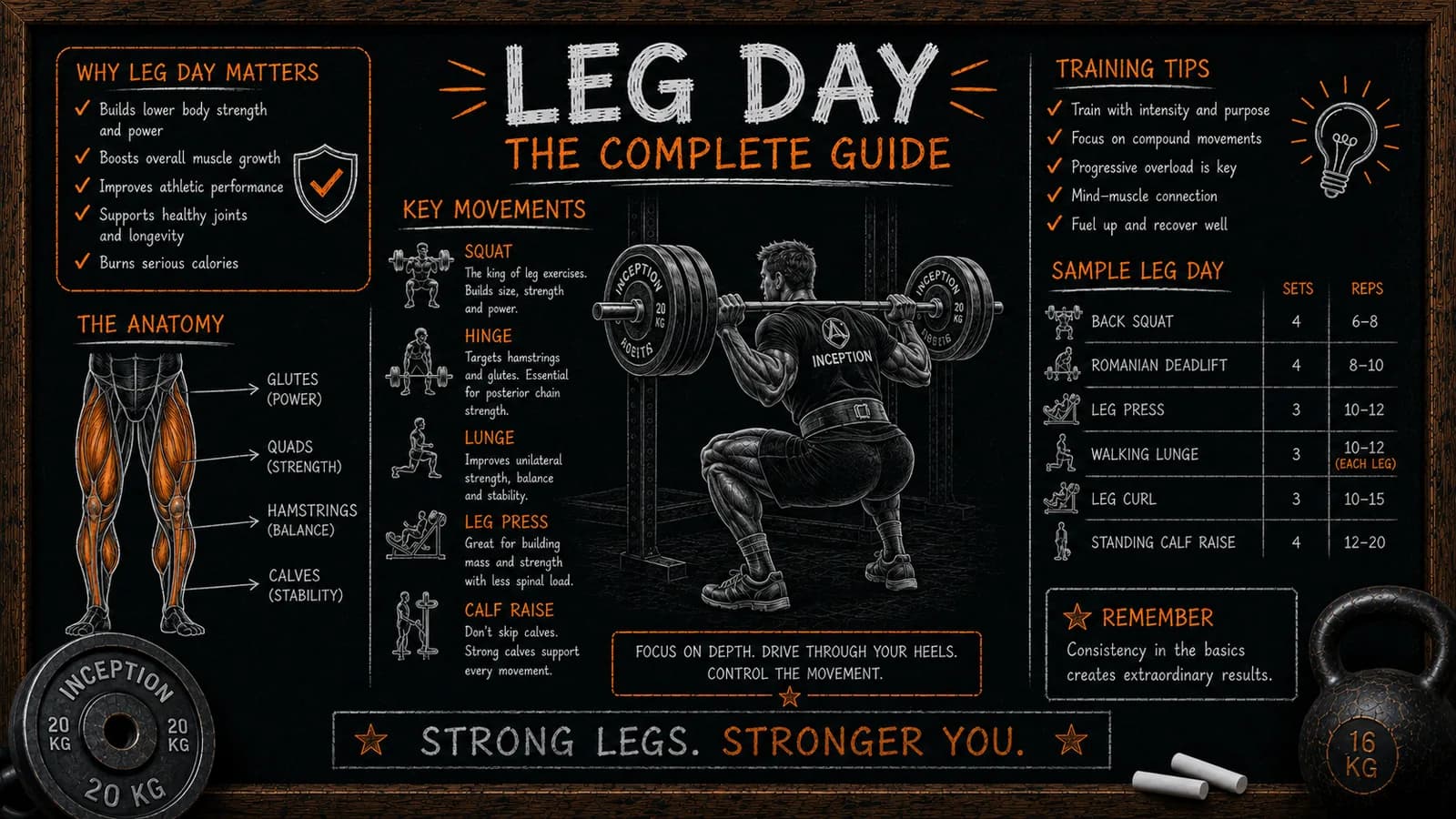
The short version: build each leg day around a quad-dominant press, a hamstring curl or hinge, glute isolation and calf work, and train legs twice a week so you can rotate the emphasis. At Inception Gym Christchurch we have over 20 leg-specific machines, part of a 92-piece floor with 43 plate-loaded machines, spanning quad, hamstring, glute, calf and adductor work. This guide covers what each does and how to build a leg programme that produces results.
Leg anatomy
Quadriceps
The front of the thigh has four muscles: rectus femoris, vastus lateralis, vastus medialis and vastus intermedius. Together they extend the knee and produce most of the pushing force in squatting movements.
The vastus medialis (the teardrop above the inner knee) is often undertrained and responds well to deeper ranges of motion and leg extensions.
Hamstrings
The back of the thigh has three muscles: biceps femoris (long and short head), semitendinosus and semimembranosus. They flex the knee and extend the hip. Most leg programmes run quad-dominant, which leaves the hamstrings weak and increases injury risk.
Hamstrings respond strongly to loading at long muscle lengths. Leg curl machines that load the hamstring when the hip is extended (the lying leg curl) are more effective than those that shorten the hip angle.
Glutes
The glute complex (gluteus maximus, medius, minimus) is the most powerful muscle group in the body. The gluteus maximus is the primary hip extensor. The medius and minimus handle hip abduction and stabilisation.
Glute development needs hip extension under load (squats, leg press, hip thrust) and abduction exercises (cable kickbacks, abductor machine).
Calves
The gastrocnemius and soleus make up the calf. The gastrocnemius crosses both the knee and ankle and is best trained with the knee extended (standing calf raises). The soleus sits beneath and is best targeted with the knee bent (seated calf raises).
Quad-focused machines
Leg press (plate-loaded and pin-loaded)
The leg press is the workhorse of quad training. It allows heavy bilateral loading with minimal lower back involvement compared to free weight squatting, making it accessible for most training ages and suitable for very high loading.
What it targets: quads primarily. Foot placement shifts the balance of quad vs glute/hamstring: lower placement increases quad focus, higher placement recruits more glutes and hamstrings.
How to use it: set the seat back so your knees reach about 90 degrees at the bottom. Keep your lower back pressed against the pad throughout. Do not bounce at the bottom. Control the descent, press through the full range, and do not lock out with a snapping motion.
Programming note: 3 to 4 sets of 8 to 20 reps. The leg press responds well to higher rep ranges. Sets of 20 reps with a challenging weight are brutally effective for both hypertrophy and mental fortitude.
Plate-loaded hack squat
The hack squat is one of the best quad machines available. It puts the body on an incline with feet forward, increasing knee travel over the toes and loading the quad through a deep range of motion.
What it targets: quads, with particular emphasis on the vastus medialis. The hack squat loads the quads more directly than the leg press because the torso is more upright relative to the movement.
How to use it: feet shoulder-width apart, mid-way up the platform. Back flat against the pad. Descend to at least 90 degrees, deeper if your mobility allows. Drive through the whole foot, not just the balls.
Programming note: 3 to 4 sets of 8 to 12 reps. Often a revelation for lifters who have never used one.
Pendulum squat
A specialty machine that mimics a free squat arc while providing more stability. As the weight increases, the pendulum action loads the bottom of the movement harder, where the quad is under the greatest stretch.
What it targets: quads, with a deep stretch emphasis from the cam action at the bottom.
Programming note: good as a second quad exercise after leg press or hack squat. 3 sets of 10 to 15 reps.
Belt squat
The belt squat loads the lower body through a belt around the hips rather than through the shoulders, taking axial loading off the spine. That makes it invaluable for lifters with back injuries or those who want heavy lower body training without spinal compression.
What it targets: quads and glutes. Foot placement and torso angle shift the emphasis.
Programming note: good for high volume work or as a primary quad exercise for those avoiding spinal loading.
Leg extension machine
The leg extension is an isolation exercise for the quads and the only machine that trains the rectus femoris in its role as a hip flexor as well as a knee extensor. The old "leg extensions wreck knees" myth is wrong; the exercise is safe and effective when performed through a full, controlled range.
What it targets: all four heads of the quadriceps.
Programming note: works as a final quad exercise for a pump and burn. 3 sets of 12 to 20 reps. Do not rush. The quad squeeze at the top of each rep is where peak contraction lands.
Hamstring machines
Lying leg curl
The gold standard hamstring isolation exercise. The prone position means the hip is extended when the exercise begins, putting the hamstrings under a stretch. Training at long lengths produces superior hypertrophy.
What it targets: hamstrings, particularly the biceps femoris long head.
How to use it: pad just above the heel. Hip flat against the bench. Curl the pad toward your glutes through the full range. Control the eccentric over 2 to 3 seconds. Do not let your hips rise off the bench.
Programming note: 3 to 4 sets of 10 to 15 reps. A staple of every leg day.
Seated leg curl
The seated leg curl puts the hip at about 90 degrees of flexion, which changes the hamstring stretch. Research suggests seated leg curls may preferentially target the semitendinosus and inner hamstrings.
Programming note: worth including alongside the lying leg curl. 3 sets of 12 to 15 reps.
Romanian deadlift (Smith machine or free weights)
Not a machine exercise per se, but the Romanian deadlift trains the hamstrings through hip extension with a stretched position, targeting them differently from leg curls. The Smith machine provides a guided option.
Glute machines
Hip thrust machine
The hip thrust is arguably the most effective glute exercise available. The machine version removes the need for a bench and barbell setup and allows heavier loading with less setup time.
What it targets: gluteus maximus primarily, with hamstring contribution.
How to use it: drive through the heels, not the toes. Squeeze the glutes hard at the top of each rep. Do not hyperextend the lower back.
Programming note: 3 to 4 sets of 10 to 15 reps. Essential for anyone prioritising glute development.
Cable kickback / glute machine
The cable kickback or dedicated glute kickback machine trains the gluteus maximus through hip extension in an isolated, one-leg-at-a-time pattern.
Programming note: works at the end of a leg session. 3 sets of 15 to 20 reps per side.
Abductor machine
The abductor machine targets the gluteus medius and minimus, which handle hip abduction and pelvic stability. Often skipped by male members, but important for both aesthetics and injury prevention.
Programming note: 3 sets of 15 to 20 reps. Slot in at the end of any leg session.
Calf machines
Standing calf raise
Targets the gastrocnemius (the visible calf muscle) because the knee is extended during the movement.
How to use it: full range of motion is essential. Lower the heel below the platform level for a full stretch, then rise onto the balls of your feet for a full contraction. Pause at the top.
Programming note: calves respond well to higher rep ranges and slow, controlled movement. 4 sets of 15 to 25 reps.
Seated calf raise
The seated version targets the soleus because the bent knee shortens the gastrocnemius and shifts work to the deeper calf muscle.
Programming note: 3 to 4 sets of 15 to 20 reps. Include both standing and seated for complete calf development.
Programming a complete leg session
Effective leg training covers all three planes: quad-dominant pressing, hamstring-dominant hip hinging or curling, and glute isolation.
Sample session (quad and hamstring balanced):
- Leg press: 4 sets of 10 to 15 reps
- Lying leg curl: 4 sets of 10 to 12 reps
- Hack squat: 3 sets of 8 to 10 reps
- Seated leg curl: 3 sets of 12 to 15 reps
- Leg extension: 3 sets of 15 reps
- Standing calf raise: 4 sets of 20 reps
Sample session (glute emphasis):
- Hip thrust machine: 4 sets of 10 to 12 reps
- Romanian deadlift (Smith machine): 3 sets of 10 reps
- Pendulum squat: 3 sets of 12 reps
- Lying leg curl: 3 sets of 12 reps
- Cable kickback: 3 sets of 15 reps per side
- Seated calf raise: 3 sets of 20 reps
Training legs twice per week lets you rotate emphasis: one session prioritises quads and calves, the other hamstrings and glutes.
Common leg training mistakes
Skipping the hamstrings. Most gym members do far more quad work than hamstring work. That imbalance impairs performance and increases injury risk. For every set of quad-dominant work, include at least one set of hamstring-specific work.
Not going deep enough. Partial range on squats and leg press reduces the stimulus to the quads and glutes. Descend to at least parallel, ideally below.
Neglecting the calves. Calves often get treated as an afterthought. Train them with the same intent you bring to quads and hamstrings.
Training too light out of discomfort. Leg training at full effort is uncomfortable. That discomfort is the signal training is working. Use it.
Nutrition for leg day
Leg training burns more energy than most other sessions. Carbohydrate intake before and after training supports performance and recovery. Protein supports muscle repair and growth.
The on-site Supplement Solutions store stocks Inception Labs creatine monohydrate, which has strong evidence for improving leg press and squat performance. Member pricing of up to 40% off applies year-round.
For a personalised nutrition plan around your leg training and goals, Inception Nutrition provides PhD-led coaching built on your body composition data and training programme.
Start with a free trial
The leg machine selection at Inception Gym is best understood in person. Book a free trial and use the full range, including the pendulum squat and belt squat that most Christchurch gyms do not have.
View our full membership options to find the plan that works for your goals and timeline.