Training · Programming
Hypertrophy Training: The Science of Building Muscle Size
Learn the evidence-based principles of hypertrophy training: rep ranges, volume, rest periods, and progressive overload. Build muscle size the right way.
By Inception Gym · 16 August 2025
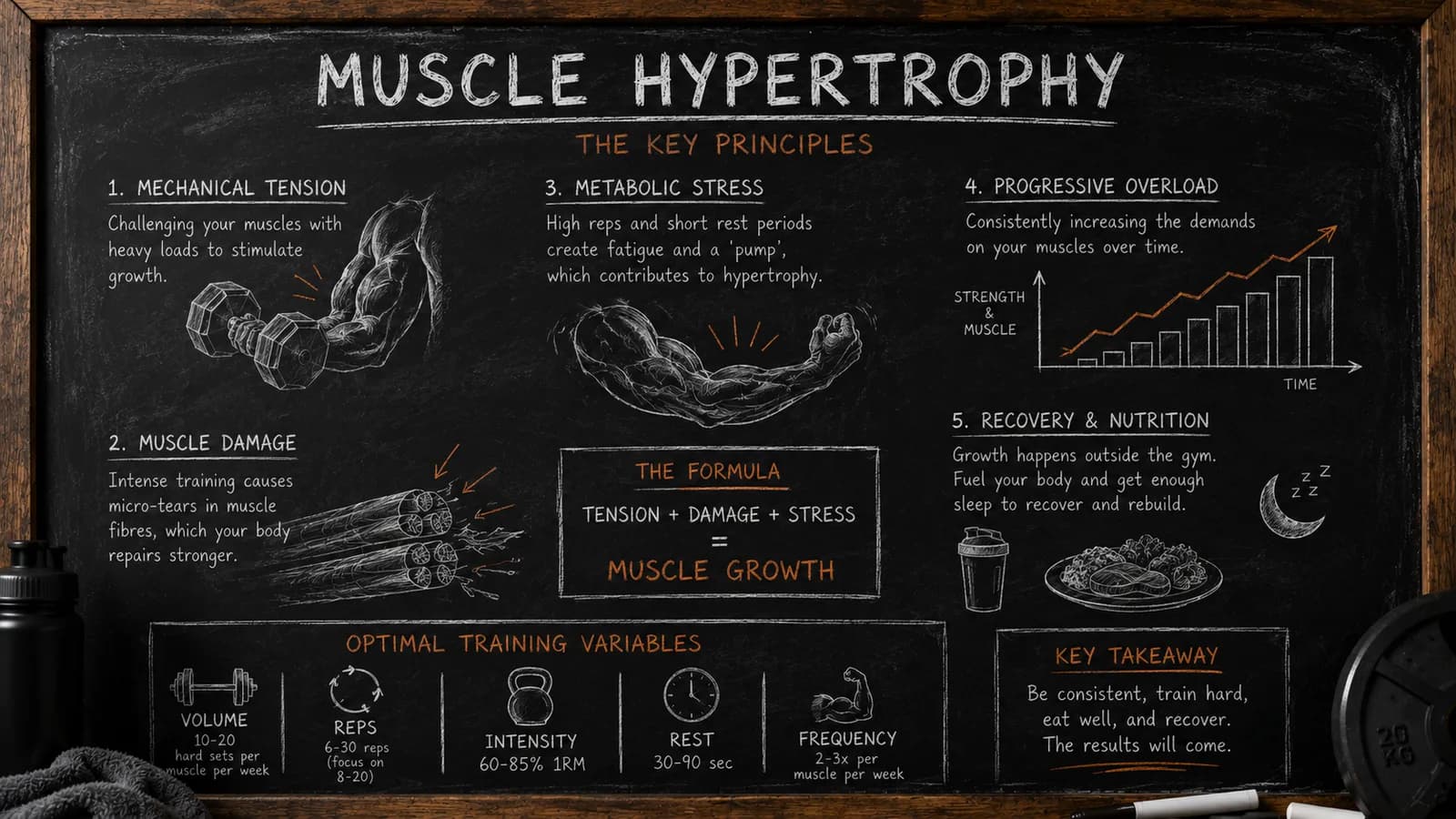
Hypertrophy, the scientific term for an increase in muscle cell size, is the goal behind most gym programmes whether people label it that way or not. Building visible muscle, improving body composition, filling out a shirt: these are all hypertrophy goals. Despite being one of the most studied topics in exercise science, many gym-goers still train in ways that leave most of their potential untapped.
The short answer: take roughly 10 to 20 hard sets per muscle group per week, spread across 2 to 3 sessions, using rep ranges from 5 to 30 taken within a few reps of failure, rest 1 to 3 minutes between sets depending on the exercise, and add load or reps over time. The rest of this guide explains why each of those numbers matters, how to structure the work, and why equipment variety matters more than most people realise.
What hypertrophy actually is
Skeletal muscle grows through damage, inflammation, repair and adaptation. When you lift weights you create mechanical tension in muscle fibres. That tension, particularly during the eccentric (lowering) phase, causes micro-disruption to the muscle cell architecture. Your body repairs and reinforces those fibres, and over time the fibres increase in cross-sectional area.
There are two primary types:
Myofibrillar hypertrophy is an increase in the contractile proteins actin and myosin within muscle fibres. It tends to produce denser, harder-looking muscle and goes with higher strength.
Sarcoplasmic hypertrophy is an increase in the fluid and energy-storage components around the myofibrils. It produces more volume and size without a proportional gain in strength.
In practice both happen at once, but training variables influence which is emphasised.
The four pillars
1. Mechanical tension
Mechanical tension is the primary driver of muscle growth. It is created when a muscle produces force against resistance. What matters is not the absolute weight on the bar but the degree to which the muscle is producing near-maximal effort.
Research shows sets taken close to muscular failure, within 0 to 5 reps of the point where you cannot complete another rep with good form, produce the strongest hypertrophic signal. You do not need to train to absolute failure every set, but you need to get close enough that the high-threshold motor units are recruited.
That is why warm-up sets do not build much muscle. Lifting 20kg for 15 easy reps when you could do 50kg for 15 hard reps does not create meaningful tension in your largest fibres.
2. Metabolic stress
Metabolic stress is the accumulation of metabolites like lactate, hydrogen ions and phosphate within muscle cells during high-rep, short-rest training. That is the burning sensation and pump of higher-rep work. There is evidence metabolic stress contributes to hypertrophy through cell swelling and hormonal responses.
The classic "pump" training of bodybuilders is not bro science. It produces a real stimulus, particularly when used inside a broader programme rather than as the only mode.
3. Muscle damage
Eccentric contractions, particularly when the muscle is stretched under load, produce micro-damage that triggers a repair and growth response. Exercises that load the muscle in a lengthened position (incline curls, Romanian deadlifts, deep squats) tend to produce more damage and more growth than those that load only the shortened position.
That is also why novel exercises produce disproportionate soreness: your muscles have not adapted the protective mechanisms for that specific movement yet. Rotating exercises periodically keeps this stimulus active.
4. Progressive overload
None of the above drives long-term growth without progressive overload. Muscles adapt to a given stimulus within weeks. If the stimulus does not climb over time, adaptation stops.
Progressive overload does not have to mean adding weight every session. It can mean:
- More reps with the same weight
- More sets at the same weight and reps
- The same work done with better technique (more tension on the target muscle)
- Shorter rest periods with the same load
- Greater range of motion
Track your training. Without data you cannot know whether you are progressing.
Rep ranges
For years the gym world ran on a simple rule: 1 to 5 reps builds strength, 6 to 12 builds muscle, 15+ builds endurance. The research has complicated that picture.
Current evidence suggests a wide range of rep counts, roughly 5 to 30 per set, can produce meaningful hypertrophy when sets are taken close to failure. The key variable is effort, not the number on the rep counter.
That said, different rep ranges have practical differences:
Lower rep ranges (5 to 8): allow heavier loading, which may favour myofibrillar hypertrophy and also build strength. They need longer rest and produce less metabolic stress.
Moderate rep ranges (8 to 15): the traditional hypertrophy sweet spot. A reasonable balance of mechanical tension, metabolic stress and manageable fatigue. Good for most exercises and most people.
Higher rep ranges (15 to 30): produce significant metabolic stress and work well for isolation exercises, exercises where heavy loading risks technique breakdown, and joint-friendly training for older lifters or those managing injuries.
The most robust hypertrophy programmes use all three ranges across different exercises and phases. A facility with 71 machine variants like Inception Gym gives you the equipment variety to do this properly.
Volume: sets per muscle per week
Volume, measured as sets per muscle group per week, is one of the most researched variables in hypertrophy. The dose-response relationship is well established up to a point, after which additional volume produces diminishing returns or regression from accumulated fatigue.
Volume recommendations
For intermediate lifters (6 to 24 months of consistent training), this is a reasonable framework:
| Muscle Group | Minimum Effective Volume | Optimal Range | Maximum Recoverable Volume | |---|---|---|---| | Quads | 8 sets/week | 12-18 sets/week | 20+ sets/week | | Hamstrings | 6 sets/week | 10-16 sets/week | 18+ sets/week | | Chest | 8 sets/week | 12-18 sets/week | 22+ sets/week | | Back | 10 sets/week | 14-20 sets/week | 25+ sets/week | | Shoulders | 8 sets/week | 12-18 sets/week | 22+ sets/week | | Biceps | 6 sets/week | 10-14 sets/week | 20+ sets/week | | Triceps | 6 sets/week | 10-16 sets/week | 20+ sets/week |
These ranges are starting points, not prescriptions. Genetics, training history, recovery capacity and nutrition all shift where you sit within or outside them.
Frequency
For a given volume target, spreading sets across 2 to 3 sessions per week per muscle group appears to work better than hitting that volume in a single session. Three sets of chest work on each of three days is likely more effective than nine sets in a single session, all else equal.
That favours splits with more frequent muscle group exposure: upper/lower, push/pull/legs, or full-body sessions, rather than the classic one-muscle-per-day bro split.
Rest periods
Rest influences recovery between sets and therefore the quality of subsequent sets. It also influences the metabolic stress component.
Heavy compound work (5 to 8 reps): 2 to 3 minutes of rest allows ATP and creatine phosphate replenishment so you maintain force output in the next set.
Moderate mixed work (8 to 15 reps): 90 seconds to 2 minutes balances recovery with time efficiency. You keep some metabolic stress while still being able to lift close to your previous set.
High-rep isolation work (15 to 30 reps): 60 to 90 seconds. Load is lower, recovery is faster, and keeping some accumulated metabolite effect is part of the goal.
Cutting rest on compound lifts to "make training more intense" is counterproductive for hypertrophy. You lift less total volume because each set degrades. Keeping rest appropriate to the exercise type produces more total work and a stronger growth stimulus.
Exercise selection
One of the most underappreciated factors in long-term hypertrophy is exercise variety. Each exercise loads a muscle at a different joint angle, through a different range of motion, with a different resistance curve. Those variations stimulate different regions of the muscle and different motor unit pools.
A person who only ever squats will develop their quads in a specific pattern. Adding leg press, hack squats, Bulgarian split squats and leg extensions targets overlapping but distinct regions, producing more complete development.
That is why equipment access matters. At Inception Gym the 92-piece equipment inventory covers every major muscle group with multiple loading options, from cables and pulleys to plate-loaded and pin-loaded machines to free weights. You are not limited to one movement pattern per muscle group.
Back development, for example, can come from cable rows, machine rows, seated cable pulldowns, lat pulldown machines, single-arm rows and face pulls. Each one stimulates the back differently. Cycling through them across a programme, rather than running the same three exercises indefinitely, keeps the stimulus fresh and produces more complete development.
Tracking progress with body composition scans
Progressive overload in the gym is only part of the picture. Knowing whether your training is translating into muscle gain needs objective measurement. The scale alone is unreliable; you can gain muscle while the scale stays still (as fat is lost) or while it goes up (as both muscle and fat increase).
Body composition scans give you the data you need. As an Inception member you get complimentary body composition scans that show your lean mass and fat mass separately. Tracking these every 6 to 8 weeks gives you a clear picture of whether your training and nutrition are working.
If your lean mass is not increasing despite consistent training, that is almost certainly a nutrition problem. Adequate protein and sufficient total calories are non-negotiable. For a personalised approach built around your scan data, Inception Nutrition provides PhD-led coaching that takes your composition results and builds a plan around your specific goal.
Sample hypertrophy block
A simple 4-week hypertrophy block for an intermediate lifter:
Weeks 1-2: 3 sets per exercise, moderate load (10-12 reps), 90 seconds rest, focus on technique and feeling the target muscle. Week 3: 4 sets per exercise, same load, shorter rest (75 seconds), add one additional exercise per session. Week 4 (deload): 2 sets per exercise, 60% of previous load, full rest, focus on quality and recovery.
After the deload, start the next block with slightly heavier loads across the board.
This mesocycle structure lets you accumulate volume, reach a peak stimulus, then recover before starting the next block from a higher baseline. Over multiple cycles the overload compounds.
The bottom line
Hypertrophy training is not complicated, but it needs consistent application of a small number of principles: sufficient volume close to failure, a variety of rep ranges, appropriate rest, regular progressive overload, and exercise variety to hit muscles from multiple angles.
The equipment you train with either enables or limits what is possible.
---
Ready to train smarter? [View our membership options](/memberships/options) or [book a free trial](/memberships/free-trial) to use the full equipment range at Inception Gym Christchurch.