Equipment · Back
Hyperextensions: Building a Bulletproof Lower Back and Posterior Chain
How the hyperextension and Roman chair build lower-back endurance, stronger glutes and hamstrings, and resilience. Technique and programming at Inception Gym Christchurch.
By Inception Gym · 27 June 2026
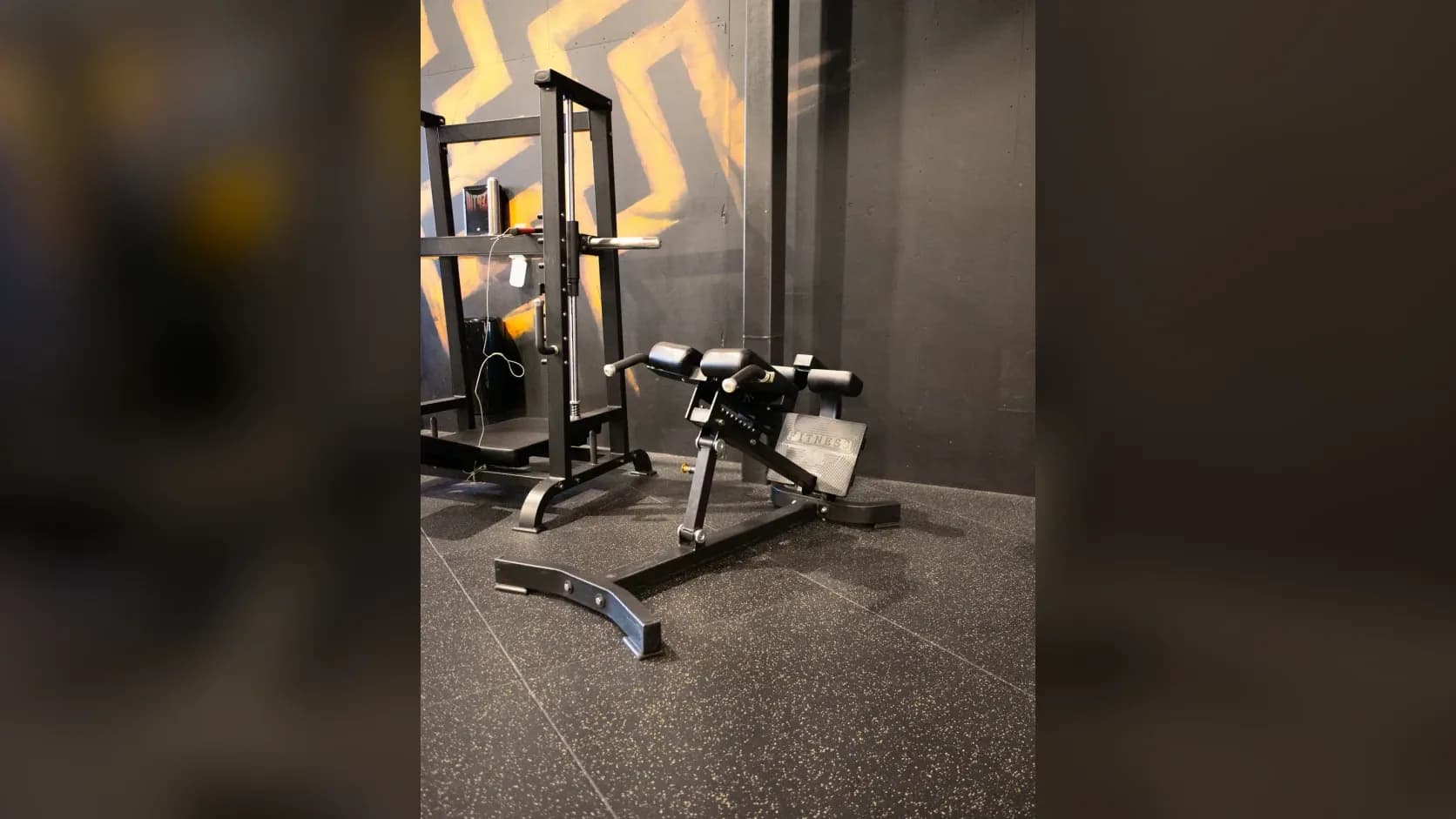
The hyperextension, also called the back extension, is one of the simplest and most undervalued exercises in the gym. Performed on a hyperextension bench or Roman chair, it trains the entire posterior chain: the erector spinae running along your spine, the glutes and the hamstrings. Done with control and sensible loading, it builds the lower-back endurance and hip-extension strength that protect you in every heavy lift and most of daily life.
The short answer to the most common question: no, the hyperextension is not dangerous for a healthy back. The name is misleading. Performed properly, the movement takes the spine and hips through a controlled range and finishes at neutral, not in an exaggerated arch. The risk comes from doing the exercise badly, usually by whipping into an aggressive arch at the top, not from the exercise itself.
This guide covers what the movement actually trains, how to bias it towards the lower back or the glutes and hamstrings, technique on the bench and the Roman chair, and how to programme it as accessory work.
What the hyperextension trains
Lie face down on a 45-degree hyperextension bench with your hips supported on the pad and your feet anchored, and three muscle groups share the work.
The erector spinae are the long muscles either side of your spine. Their job is twofold: extending the trunk, and holding the spine rigid while the hips move under load. Both roles matter, and the hyperextension can train either depending on how you perform it.
The gluteus maximus is the primary hip extensor. When you hinge over the pad and drive back up with a neutral spine, the glutes are doing most of the lifting.
The hamstrings cross the hip as well as the knee, so they assist hip extension throughout the movement, particularly in the stretched position at the bottom.
Which of these dominates is not fixed. It depends on a technique choice most lifters have never been shown.
Lower back versus glutes and hamstrings: two versions of one exercise
The hyperextension has two legitimate variations, and confusing them is the main reason people argue about whether the exercise "works".
The back-biased version: flex and extend the spine
To emphasise the erector spinae directly, allow your spine to round gently as you lower, one segment at a time, then extend it back to neutral as you rise. The spinal muscles move through their full function: lengthening under control, then shortening to straighten the trunk. Keep the load light for this version, bodyweight or a small plate held to the chest, and the tempo slow. Dynamic spinal flexion and extension under heavy load is a poor trade; under light load with control, it is simply the erectors doing their job through a full range.
The hip-biased version: neutral spine, hinge at the hip
To emphasise the glutes and hamstrings, lock your spine in a neutral position, brace, and hinge purely at the hip. Your torso lowers and rises as one rigid unit while the hips do all the moving. In this version the erectors still work hard, but isometrically: they hold the spine stiff while the glutes and hamstrings produce the movement. This is the version that tolerates heavier loading, because the spine never changes shape under load. It is essentially a supported Romanian deadlift, which is why it transfers so directly to the hinge patterns covered in our deadlift variations guide.
Most lifters are best served by making the hip-biased version their default and using the light, back-biased version as occasional mobility and endurance work.
Why this matters for lower-back health
The research on back pain and training keeps arriving at the same place: backs get more robust through graded, progressive exposure to load, not through avoidance. Muscular endurance in the trunk extensors is one of the qualities most consistently associated with resilient lower backs, and the hyperextension trains exactly that quality with minimal spinal compression compared to standing barbell work.
There is a second benefit that shows up under the bar. In a squat or deadlift, the erectors work isometrically to hold your position. When they fatigue before your legs and hips do, your form degrades: the chest drops, the lower back rounds, the lift gets ugly. Building erector endurance with hyperextensions raises that fatigue ceiling, so your positions hold deeper into hard sets. That is why the movement earns its place as accessory work for anyone chasing bigger squats and deadlifts, not just people managing a cranky back.
For members returning from a lower-back episode, the hyperextension is often one of the first loaded movements reintroduced, precisely because the range, load and tempo are all easy to control. Our guides on injury prevention and recovery and training around injuries cover the wider principles; the short version is that a movement you can dose precisely is a movement you can rebuild on.
Technique on the hyperextension bench
At Inception Gym the hyperextension bench sits alongside the Roman chair on a floor of 92 machines, 43 of them plate-loaded, so posterior-chain accessory work never queues behind the racks. Setup takes seconds.
Pad height. Set the pad so its top edge sits at the crease of your hips, roughly at the front of the pelvis. Too high and the pad blocks your hip hinge, turning everything into spinal movement. Too low and you lose support.
Feet. Anchor your heels under the rollers. Pointing the toes slightly outward tends to bias the glutes; a neutral foot position shares the work with the hamstrings.
The movement. Brace, then hinge forward at the hips under control until you feel a firm stretch through the hamstrings, usually with the torso somewhere near vertical on a 45-degree bench. Drive back up by squeezing the glutes, finishing with your body in one straight line from ankles to shoulders.
Stop at neutral. This is the cue that fixes the exercise's bad reputation. The top position is a straight line, not an arch. Rising past neutral into an exaggerated extension pinches the facet joints of the lumbar spine and adds nothing to the training effect. If you want more stimulus, add load or slow the tempo; never add range at the top.
Loading. Start with bodyweight. Progress by hugging a plate to your chest, holding a dumbbell, or holding the plate behind the head for a longer lever. Progress slowly; the erectors respond well to endurance work and do not need heavy loading to adapt.
The Roman chair
The Roman chair holds your body more upright than the 45-degree bench, with the pads at the hips and the ankles braced. The more vertical torso changes the resistance curve: the hardest point of the movement shifts, and the trunk muscles work harder to control the descent. It also suits shorter ranges and isometric holds, where you hold the top position for time to build pure trunk endurance.
Treat the Roman chair as the strict, endurance-focused sibling of the bench. Timed holds of 20 to 45 seconds, or slow sets of 10 to 15 controlled reps, are where it shines. You can browse both pieces, along with the rest of the floor, on our equipment page.
Programming: higher reps, full control
The posterior chain responds well to volume here, and the exercise is low in systemic fatigue, so it slots in at the end of lower-body or pull sessions without eating into recovery.
A sensible structure:
- General lower-back health: 2 to 3 sets of 12 to 20 controlled reps, two sessions per week, bodyweight or light load.
- Accessory work for deadlifts and squats: 3 sets of 10 to 15 reps with a plate held to the chest, after your main hinge or squat work.
- Endurance blocks: Roman chair isometric holds, 3 sets of 20 to 45 seconds, once or twice a week.
Leave a rep or two in reserve on every set. Grinding hyperextensions to failure invites form breakdown at exactly the joint you are trying to protect. Controlled reps, a two to three second lowering phase, and a deliberate glute squeeze at the top deliver the stimulus without the risk.
A small investment, a durable return
The hyperextension asks for very little: no complicated setup, no heavy loading, five minutes at the end of a session. In exchange it builds the trunk endurance that keeps your squat and deadlift positions honest, strengthens the glutes and hamstrings through a supported hinge, and gives you a precise tool for rebuilding after lower-back setbacks. Equipment depth is a large part of why Inception Gym holds a 5.0 rating across 1,078+ Google reviews, and this quiet corner of the floor is a good example of it.
---
The hyperextension bench and Roman chair are two of the 92 pieces of equipment on the floor at Inception Gym in Addington. [View all equipment](/facilities/equipment) or [start with a free trial](/memberships/free-trial) to try them yourself.