Training · Recovery
Training Around Injuries: How to Keep Progressing When Something Hurts
Practical strategies for training around common gym injuries without losing progress. Discover machine alternatives, modification principles, and when to modify versus rest.
By Inception Gym · 24 May 2025
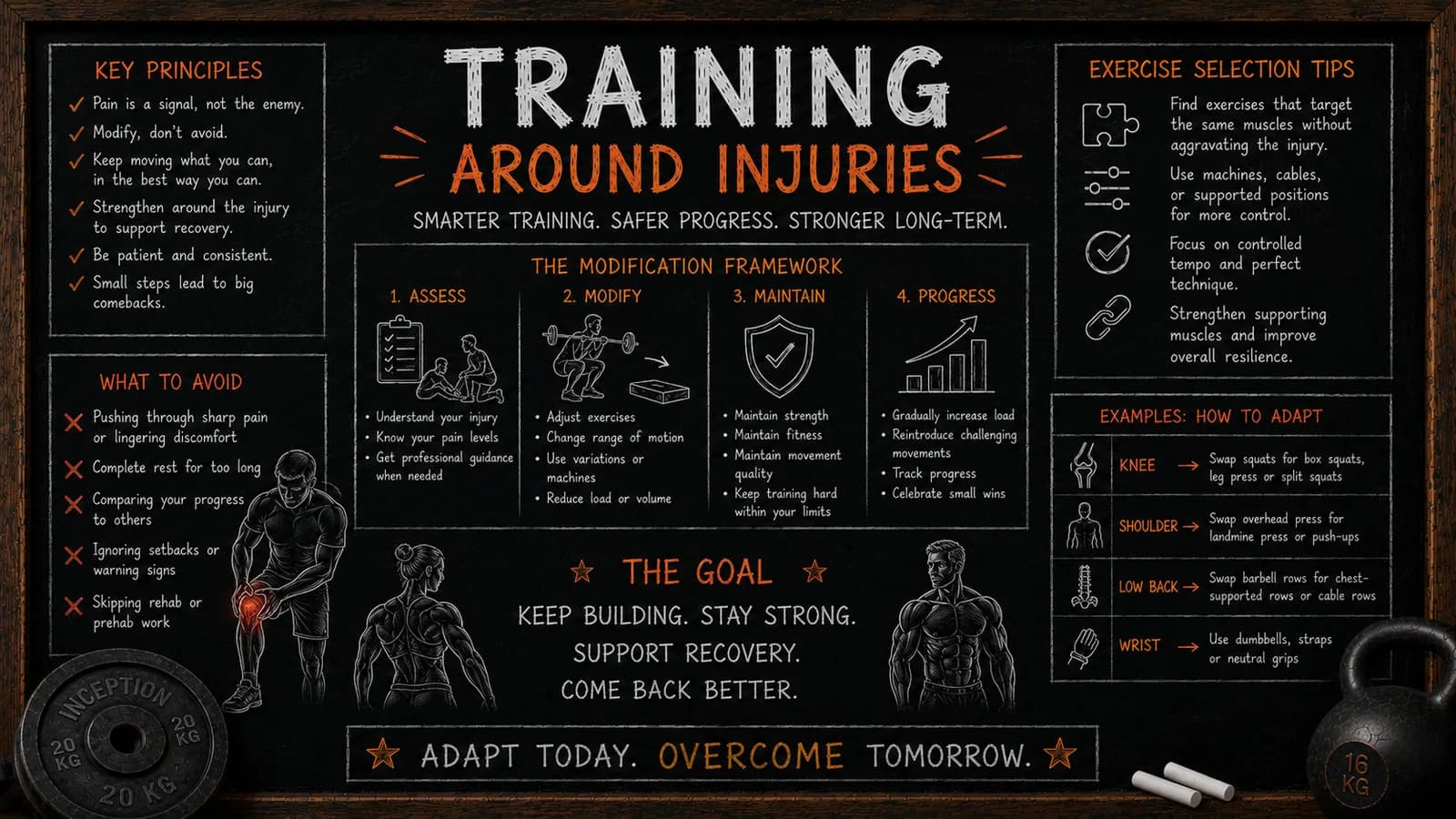
Almost every person who trains consistently will hit a period where something hurts. A shoulder that objects to pressing. A knee that aches during squatting. A lower back that tightens under load. The question is how you respond when you do.
The binary thinking that surrounds injury is unhelpful: either push through the pain or stop training entirely. The reality is more nuanced. Most training-related discomfort falls between "this is normal training sensation" and "this needs medical attention." For the middle ground, the smart response is to modify rather than stop.
This guide covers common gym injuries, the principles of training around them, machine alternatives that reduce joint stress, and when to modify versus when to rest.
Discomfort vs injury
Before getting into specific approaches, it is important to distinguish between types of pain and discomfort:
Muscle soreness (DOMS): Delayed onset muscle soreness is the ache that develops 24-48 hours after an unfamiliar or intense training stimulus. It is a normal adaptation response and is not a reason to avoid training the muscle. Light to moderate training of a sore muscle actually accelerates recovery. This is not injury; it is adaptation.
Training sensation during effort: The burning sensation in a muscle as it approaches fatigue, the cardiovascular discomfort of intense conditioning work, the muscular effort of a heavy set. These are the sensations training is supposed to produce. They are not causes for concern.
Sharp, acute pain: Pain that is sudden, sharp, and localised, particularly if it is associated with a specific movement or load, warrants attention. This is the signal to stop the movement immediately and assess. It does not necessarily mean the training session is over, but it does mean the exercise that produced it stops now.
Joint pain: Pain located in a joint itself (rather than the surrounding muscle) should be taken seriously. Some joint discomfort is position-dependent and resolves with movement modification. Joint pain that is consistent regardless of position, accompanied by swelling, or associated with instability warrants medical assessment.
Nerve pain: Tingling, numbness, or radiating pain that travels down a limb is nerve-related and requires proper assessment. Training through nerve symptoms can worsen the underlying condition.
Common training injuries and how to work around them
Shoulder impingement
Shoulder impingement, where the rotator cuff tendons are compressed during arm elevation, is one of the most common training-related shoulder complaints. It typically produces pain during pressing movements, particularly overhead, and during pulling exercises that take the arm above the shoulder.
What aggravates it: Standard barbell overhead press, upright rows, lateral raises taken behind the plane of the body, any pressing movement that compresses the shoulder in internal rotation.
How to train around it:
- Replace overhead press with a landmine press (the angled bar path is much kinder to the shoulder)
- Use neutral grip (palms facing each other) for all pressing via the multi-grip bar or Kabuki Kadillac
- For chest work, dumbbell presses with a neutral to slightly angled grip are significantly more shoulder-friendly than barbell pressing
- Continue pulling movements (rows, lat pulldowns) but avoid wide-grip pull-ups that require extreme shoulder external rotation at the bottom
- Use cable face pulls, external rotation exercises, and band work to address the rotator cuff weakness that commonly underlies impingement
The key principle: maintain pressing and pulling volume through positions that do not provoke the impingement, while addressing the underlying rotator cuff strength deficit.
Lower back pain
Lower back pain is extremely common among gym-goers, particularly those who deadlift and squat heavily. The causes are varied: disc irritation, facet joint compression, muscular strain, or SI joint dysfunction. The training response depends on the mechanism.
What commonly aggravates lower back pain: Heavy conventional deadlifts, barbell back squats (particularly with anterior pelvic tilt), good mornings, and any loading that increases lumbar compression or requires the spine to work at end range under load.
How to train around it:
- Replace conventional deadlifts with trap bar deadlifts or the plate-loaded deadlift machine, both of which reduce lumbar moment arm significantly
- Switch from barbell back squat to leg press, hack squat machine, or the Transformer Bar squat, all of which reduce spinal loading while maintaining leg training stimulus
- Continue upper body work that does not load the spine: pressing, pulling (seated or supported), and arm work are generally unaffected by lower back issues
- Romanian deadlifts with lighter loads can often be continued when floor-based pulling is problematic
- Prioritise core stability work: dead bugs, bird dogs, and pallof presses build the spinal stability that protects the lower back during training
The principle: substitute the loading position rather than abandoning the movement pattern. Leg training can continue during a period of lower back sensitivity when the loading position is modified.
Knee pain
Knee pain in a training context most commonly involves the patellofemoral joint (kneecap tracking), patellar or quadriceps tendon irritation, or soft tissue issues from overuse. The training response depends on whether the pain is load-dependent, position-dependent, or both.
What commonly aggravates knee pain: Heavy barbell squats with poor tracking, leg extension machine if patellar tendon is involved, running and jumping if patellofemoral.
How to train around it:
- Reduce range of motion on squatting movements: box squats that stop above the painful range allow continued loading with reduced knee stress
- Shift emphasis to hip-dominant movements: Romanian deadlifts, hip thrusts, glute bridges, and cable pull-throughs maintain posterior chain work with reduced knee demand
- Leg press often tolerable when barbell squatting is not: the load position and ability to control foot placement allows adjustment
- Leg extension machine is sometimes appropriate, sometimes contraindicated: if patellar tendon is the issue, avoid; if quadriceps weakness is contributing to patellofemoral pain, limited range leg extension may be therapeutic
- Monitor swelling: if the knee swells during or after training, reduce load and range of motion immediately
Elbow and wrist issues
Tennis elbow (lateral epicondylitis), golfer's elbow (medial epicondylitis), and wrist impingement are common among those doing high volumes of pressing and pulling.
How to train around them:
- Reverse the grip ratio: supinated pulling (underhand rows, reverse curls) is often better tolerated for lateral epicondylitis; pronated pulling for medial
- Use straps to reduce grip demand during pulling if grip is limiting training due to elbow pain
- Neutral wrist position via neutral grip pressing tools (multi-grip bar, Kabuki Kadillac) reduces wrist stress compared to fixed pronation
- Reduce overall volume of direct arm work temporarily while maintaining compound movements that do not provoke pain
- Elbow sleeves for warmth and proprioceptive support during training sessions
The machine advantage for training around injuries
A significant part of what makes Inception Gym suited to training around injuries is the depth of the machine selection. 92 pieces of equipment, 43 of them plate-loaded machines, provide options to maintain training stimulus for almost any muscle group regardless of which movement pattern is currently compromised.
Muscles do not care how they are loaded. The stimulus for adaptation is tension over a range of motion. Whether that tension comes from a barbell, a machine, a cable or a dumbbell is irrelevant to the muscle. When a specific free weight movement is contraindicated, a machine alternative that loads the same muscle group maintains the training effect while removing the mechanical demands causing the problem.
Practical substitutions using Inception's machine range:
| Free Weight Movement | Machine Alternative | |---------------------|---------------------| | Barbell back squat | Hack squat machine, leg press, Smith machine squat | | Conventional deadlift | Plate-loaded deadlift machine, trap bar deadlift | | Barbell bench press | Chest press machine, Smith machine bench | | Overhead press | Machine shoulder press, cable overhead press | | Barbell row | Cable row, machine row | | Pull-up | Lat pulldown machine (adjustable load) |
The full equipment inventory details every machine category.
When to modify versus when to rest
Can you find a movement pattern that loads the target muscles without provoking pain? If yes, modify and continue. If no, rest that area.
Is the pain worsening despite modification? If modifications are not reducing the pain, the area needs rest and assessment.
Is there swelling, significant instability or neurological symptoms? These are medical assessment signals. Pause training for the affected area pending a proper diagnosis.
Is this a first-time acute injury or a chronic recurrence? A new acute injury warrants more caution than a familiar chronic issue.
Informal guidance
One of the genuinely valuable aspects of training at an owner-operated gym is access to expertise for these situations. Inception Gym has been owner-operated since 2022, and during staffed hours the team can talk through injury management, movement patterns and training modifications with you.
For "my shoulder is complaining during pressing, what should I do?" the answer is accessible without booking an appointment.
For more structured support, Inception Nutrition provides coaching that integrates recovery-focused nutrition with training planning. Recovery from injury is faster when the nutritional environment supports tissue repair.
Inception Labs Collagen Whey Protein, available on-site at the Supplement Solutions store at member pricing, provides whey isolate for muscle recovery and bovine collagen peptides for connective tissue repair.
The long-term perspective
The goal of training around injuries is not just to keep the session count up while something heals. It is to use the period of injury as an opportunity to address the underlying weaknesses that contributed to the injury.
Most training injuries have identifiable contributing factors: muscular imbalances, mobility limitations, technique errors, or load management mistakes. A period of modified training that addresses these factors can leave you in a better position post-recovery than you were pre-injury.
Use shoulder impingement as the chance to develop the rotator cuff strength that was insufficient. Use lower back pain as the catalyst for the core stability your programme was missing. Use knee pain as the signal to address hip and ankle mobility.
Injuries are not necessarily setbacks. Managed well, they are often the correction that redirects training in a more sustainable direction.
Explore membership options at Inception Gym or claim a free trial.