Training · Recovery
Injury Prevention and Recovery: Training Smart at Any Age
Injury prevention and recovery strategies for gym training. How to train smart around limitations and build lasting strength at any age.
By Inception Gym · 12 April 2025
Training is a long game
If you have been training for more than a few years, or starting in your thirties, forties or beyond, you already know that injuries come with the territory. A shoulder that clicks, a knee that protests on certain movements, a lower back that reminds you of the time you lifted with poor form ten years ago.
The question is not whether you will hit physical limitations. The question is how you respond to them. People who train successfully for decades are not the ones who never get hurt. They are the ones who learn to train around their limitations while addressing the root causes.
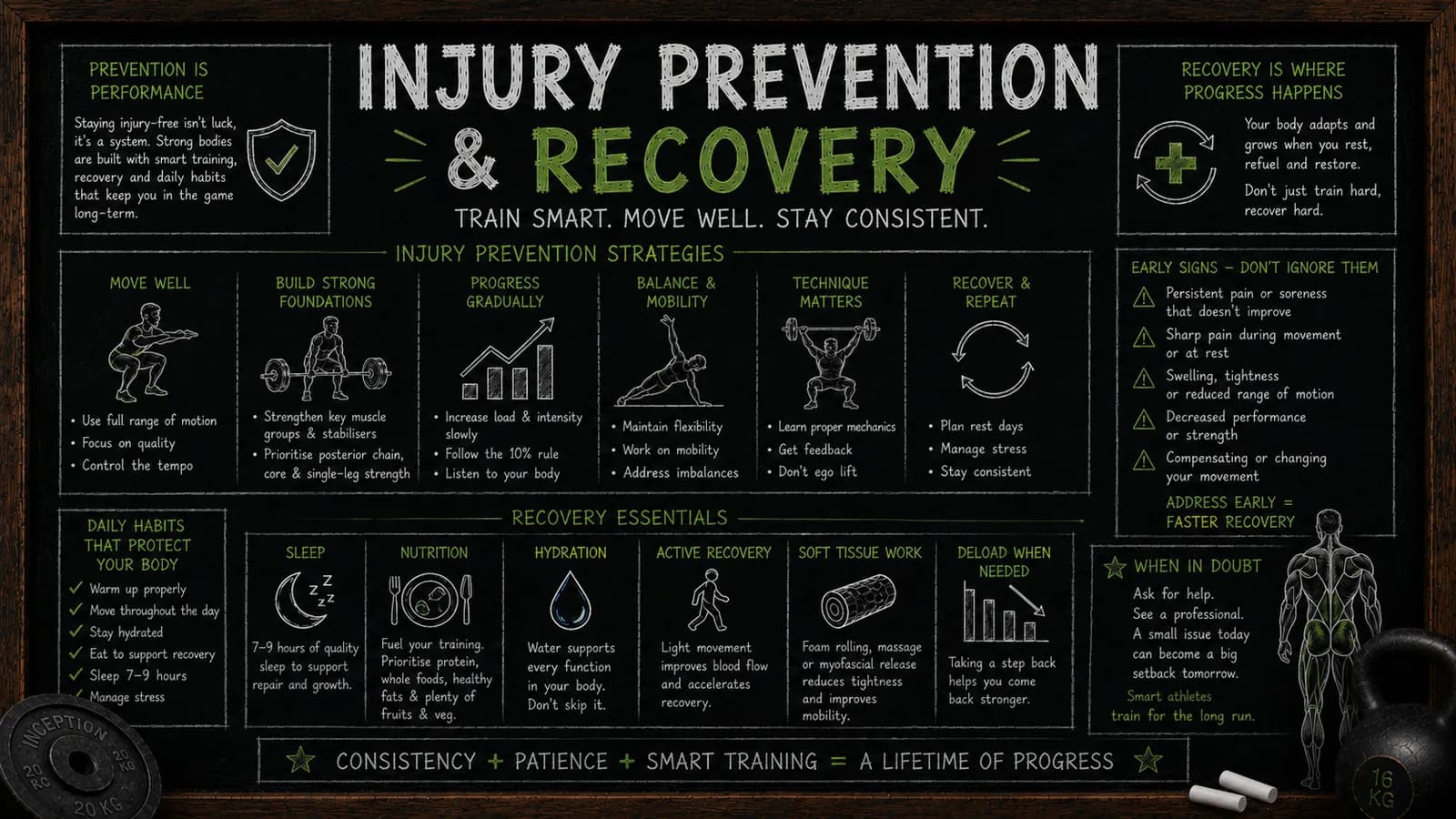
The short version: warm up for the specific movements you are about to do, add load gradually rather than by ego, train full ranges of motion, substitute rather than push through painful movements, and treat sleep and protein as part of the programme. The rest of this guide covers each in detail.
Prevention beats treatment
Most gym injuries are not sudden events. They are the slow accumulation of poor movement patterns, inadequate warm-ups, excessive loading without proper progression, and ignored warning signs. By the time something "goes," the damage has been building for weeks or months.
Prevention is not glamorous, but it is the single most effective strategy for long-term training success.
Warm up properly (not just cardio)
A five-minute walk on the treadmill raises your heart rate, but it does not prepare your joints and muscles for the specific movements you are about to perform. An effective warm-up:
- General cardiovascular activity (3 to 5 minutes): rower, cross-trainer or light cycling to raise blood flow and core temperature.
- Dynamic stretching (3 to 5 minutes): leg swings, arm circles, hip circles, torso rotations. Move through progressively larger ranges.
- Movement-specific preparation (2 to 3 minutes): light sets of the exercises you are about to perform. Squatting? Two sets with the bar. Pressing? Start with the lightest dumbbells and work up.
That ten-minute investment prevents most training injuries.
Progressive overload, not ego loading
The most common cause of gym injuries is loading too much weight too quickly. Progressive overload means gradually increasing demand over time. The key word is "gradually."
Guideline: increase weight by no more than 5 to 10 percent when you can comfortably complete all prescribed reps with good form. If you are doing three sets of ten and only manage seven on the last set, the weight is too heavy. Reduce it, master the movement, and progress when ready.
This matters more for lifters over 35. Tendons and ligaments adapt more slowly than muscles. Your muscles might feel ready for a heavier load weeks before your connective tissue is. Patience is not weakness; it is strategy.
Train through full ranges of motion
Partial reps through limited ranges of motion might let you use heavier weights, but they create imbalances and leave your joints vulnerable in positions they rarely train in. Full range of motion builds strength, maintains flexibility and protects joints against the unexpected.
If a specific range of motion causes pain, that is diagnostic information. Do not push through it. Reduce the load, modify the movement, and if the pain persists, get professional assessment.
Training around existing injuries
Having an injury does not mean you stop training. It means you train differently. The body is adaptable, and almost every injury still allows productive training.
The substitution principle
If a movement hurts, find a variation that works the same muscles without triggering pain. At a gym with limited equipment that is difficult. At a facility with 92 pieces of equipment, you have options.
Common substitutions:
- Shoulder pain on barbell bench press: switch to a chest press machine with a neutral grip, or use dumbbells with a reduced range of motion.
- Knee pain on squats: try a leg press with a higher foot position, or use the hack squat with controlled depth.
- Lower back discomfort on deadlifts: use a seated row or chest-supported row to train the posterior chain without spinal loading. Leg curls target the hamstrings without lower back involvement.
- Elbow pain on barbell curls: switch to a cable curl or a machine curl with a natural wrist position.
The goal is to keep training the target muscle through a pain-free path. 92 pieces of equipment across 800sqm means you will almost always find one that works.
When to train and when to rest
There is a difference between training through discomfort and training through pain. Mild muscular discomfort, delayed onset soreness from a previous session, and the general aches of an active life are normal and safe to train through.
Sharp pain, sudden onset pain, pain that worsens during an exercise, or pain that changes your movement pattern is your body telling you to stop. Listen. Reducing the load or switching exercises is not failure. Ignoring a clear warning signal and making it worse is.
The role of deload weeks
A deload week reduces your training volume and intensity by 40 to 50 percent for one week. That lets accumulated fatigue dissipate and gives your joints and connective tissues time to recover and adapt.
For lifters over 35, a deload every four to six weeks is smart. For those managing chronic injuries, more frequent deloads may be warranted. This is not lost time; it is the investment that lets your next training block run rather than getting cut short.
Recovery: the other half of training
What you do outside the gym determines how effectively you recover and adapt. Recovery is not passive.
Sleep
Sleep is when your body repairs muscle tissue, consolidates motor patterns and regulates hormones that drive recovery. Seven to nine hours a night is the evidence-based recommendation for adults who train regularly. Chronic sleep deprivation impairs recovery, increases injury risk and reduces strength output.
Prioritise sleep as seriously as you prioritise training. They are equally important.
Nutrition
Your body cannot repair what it does not have materials for. Recovery needs protein (1.6 to 2.2 grams per kilogram of body weight daily), sufficient calories to support activity levels, and micronutrients from a varied diet.
Some supplements can make a real difference:
- Creatine monohydrate supports cellular energy. Inception Labs Creatine uses Creapure, the gold standard for purity.
- Collagen protein supports tendon and ligament repair. Inception Labs Collagen Whey Protein combines whey isolate with bovine collagen for muscle and connective tissue support.
- Omega-3 fatty acids reduce systemic inflammation and support joint health.
Members get reduced pricing on Inception Labs products at the on-site Supplement Solutions store.
For a structured approach, <a href="https://www.inceptionnutrition.co.nz" target="_blank" rel="noopener noreferrer">Inception Nutrition</a> provides PhD-led coaching that builds personalised nutrition around your training demands, injury history and recovery needs. Body composition scans at Inception Gym provide the data; Inception Nutrition provides the plan.
Active recovery
Rest days do not mean zero movement. Light walking, gentle stretching, foam rolling and mobility work improve blood flow, reduce stiffness and speed recovery. The goal is movement without load, enough to support recovery without adding training stress.
Talk to someone who knows
One of the most useful resources at Inception Gym is access to knowledgeable people. Matt, one of the founders, holds a PhD and has spent years working through injury management, movement patterns and evidence-based recovery strategies. Ask for him during staffed hours (Mon-Thu 9am to 7pm, Fri-Sat 10am to 2pm, closed Sunday and public holidays).
A five-minute chat about a shoulder issue, a quick discussion about modifying your programme around a knee problem, a recommendation for a different exercise variation: this is the kind of support an owner-operated gym provides. You will not get it from a franchise with minimal staffing.
Our personal trainers also work with members managing injuries and age-related limitations.
Training smart at every stage
In your 30s
Recovery takes a bit longer than it did at 25. Warm-ups become non-negotiable. The movements you could get away with sloppy form on now ask for more attention. This is the decade to build habits that will serve you for the next 40 years.
In your 40s
Joint health becomes a primary consideration. You may need to swap certain barbell movements for machine or cable alternatives. Deload weeks become essential. You can still build significant strength and muscle in your 40s; it just needs smarter programming.
In your 50s and beyond
Strength training becomes more important for bone density, metabolic health and functional independence. The focus shifts toward quality of movement, joint-friendly loading and consistency over intensity. A well-equipped gym with a wide machine range is particularly valuable at this stage, since it provides options for every movement pattern regardless of physical limitations.
The long view
The members still training productively at 60, 70 and beyond did not get there by training through pain in their 30s. They got there by listening to their bodies, modifying when needed, prioritising recovery and surrounding themselves with people who understand the long game.
At Inception Gym we treat training as a lifelong practice. Our facility is built to support that.
Start training smarter
Whether you are managing an existing injury or want to prevent future ones, the right environment matters. Start a free 24-hour trial at Inception Gym.
Explore our membership options from $18.90 per week on a 24-month plan, with an open-term option at $33.90 per week you can cancel with 28 days' notice, or get in touch to discuss your situation.