Training · Strength
Deadlift variations: from conventional to machine
A guide to deadlift variations: conventional, sumo, Romanian, trap bar, and plate-loaded machines. The right deadlift for your goals and body.
By Inception Gym · 13 December 2025
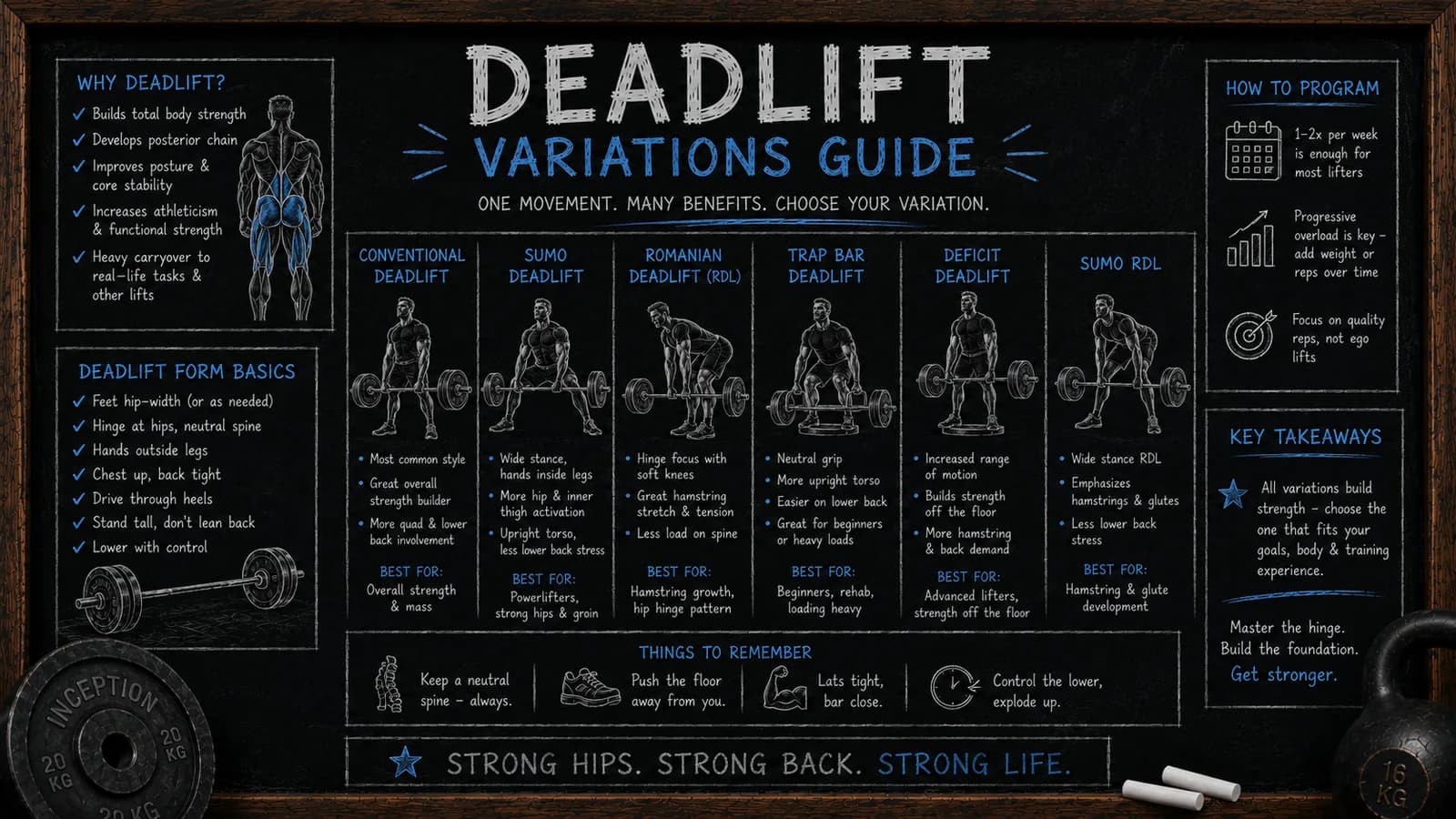
The deadlift is the most basic expression of picking something heavy off the floor. It's also one of the most misunderstood movements in terms of how many ways it can be performed and which variation suits which person and goal.
The conventional barbell deadlift is what most people picture. That's one tool in a varied arsenal. Sumo, Romanian, stiff-leg, trap bar, rack pull, and plate-loaded machine deadlifts each have distinct mechanics, muscle emphasis, and use cases. Knowing the differences lets you programme the right variation for your body, goals, and current limitations.
This guide covers the primary deadlift variations available at Inception Gym, the mechanics of each, and a practical framework for choosing between them.
Why deadlift variation matters
No two people have the same anthropometry. Femur length, torso length, hip width, arm length, and ankle mobility all influence how a given deadlift variation feels and how effectively it loads the intended muscles. A conventional deadlift that feels powerful and natural for one person can be mechanically awkward and injury-prone for someone built differently.
Beyond anatomy, different deadlift variations target the posterior chain differently. Conventional and sumo deadlifts are floor-to-lockout movements that tax the full posterior chain. Romanian deadlifts isolate the hamstrings. Trap bar deadlifts introduce quad contribution. Machine variations provide loaded hip extension with reduced spinal loading.
A good training programme usually includes 2 to 3 deadlift variations to develop the posterior chain completely and manage fatigue across the lower back.
Conventional deadlift
The conventional deadlift is the baseline from which all other variations are measured. The bar is gripped just outside the legs, feet are roughly hip-width apart, and the lifter drives the floor away while keeping a neutral spine.
Muscle emphasis
- Primary: Erector spinae, glutes, hamstrings
- Secondary: Quads, lats (for stability), traps, forearm flexors
Mechanics
The conventional deadlift requires the bar to travel in a vertical path from the floor to lockout. To achieve this, the hips must start in a position that allows the shoulders to remain over or slightly in front of the bar. For lifters with long femurs and short arms, this often means a more horizontal torso angle, which increases lower back loading.
The key technical point is keeping a neutral spine throughout the lift, particularly as fatigue accumulates in later reps. Rounding at the lower back under load is the primary injury mechanism.
Who it suits
The conventional deadlift suits lifters with shorter femurs and longer arms (allows a more upright torso angle) and those training specifically for powerlifting competition or general posterior chain strength.
Form cues
- Set the bar over mid-foot, grip just outside the legs
- Pull the slack out of the bar before driving
- Drive feet into the floor, don't think of pulling with the back
- Keep the bar in contact with the legs throughout the lift
- Lock out by driving hips forward, not by hyperextending the lower back
Sumo deadlift
The sumo deadlift uses a wide stance with the feet turned out significantly, allowing the lifter to grip the bar inside the legs. This stance change produces a substantially different movement pattern.
Muscle emphasis
- Primary: Glutes, hip adductors, quads
- Reduced relative to conventional: Lower back, hamstrings (slightly)
Mechanics
The wide stance shortens the distance between the bar and the hips, allowing a more upright torso. That reduces the moment arm at the lower back compared to conventional. For lifters with wide hips or specific hip anatomy, sumo mechanics can feel meaningfully more natural and allow higher loads with less lower back stress.
The sumo is legal in powerlifting competition and some lifters hit their best deadlift performance using this stance. It isn't a shortcut or a lesser variation. It's a mechanically distinct lift with different demands.
Who it suits
Lifters with wider hips, those who experience lower back discomfort in conventional pulling, and anyone whose anatomy makes the upright sumo torso position feel mechanically superior.
Form cues
- Set up with a very wide stance, toes turned out significantly
- Push the knees out over the toes throughout the movement
- Grip the bar with a narrow overhand or mixed grip
- Drive the floor away while pushing hips through at lockout
- The hip adductors do significant work here; weakness in this area limits sumo performance
Romanian deadlift
The Romanian deadlift (RDL) begins from standing rather than from the floor, and focuses on the eccentric (lowering) phase of the hip hinge to maximise hamstring loading. Arguably the single best exercise for developing the hamstrings through a full range of motion.
Muscle emphasis
- Primary: Hamstrings, glutes
- Secondary: Erector spinae, upper back for stability
Mechanics
Starting with the bar at hip height (from a rack or the top of a conventional deadlift), the lifter pushes the hips back while keeping a neutral spine, lowering the bar along the legs until a strong hamstring stretch is felt. The range of motion is limited by hamstring flexibility, not by the bar reaching the floor.
The slow, controlled eccentric phase is where the training value comes from. Rushing the descent kills the primary stimulus.
Who it suits
Almost everyone. The RDL is one of the safest and most accessible deadlift variations. Excellent for hypertrophy-focused training, injury prevention, and as a primary posterior chain movement for lifters who find floor-based pulling problematic.
Form cues
- Keep a soft bend in the knees throughout
- Push the hips back, don't just bend forward
- Maintain the bar close to the legs at all times
- Lower until a strong hamstring stretch is felt, not until the back rounds
- Drive hips forward to return to standing, squeezing glutes at the top
Trap bar deadlift
The trap bar, also called a hex bar, places the lifter inside the frame rather than behind it. The load is centred on the body, which changes the mechanics significantly versus a conventional deadlift.
Muscle emphasis
- Primary: Quads, glutes, hamstrings (more even distribution than conventional)
- Reduced relative to conventional: Lower back (notably)
Mechanics
The centred load position allows a more upright torso, which increases quad contribution and reduces the moment arm at the lumbar spine. Research comparing trap bar and conventional deadlifts consistently shows lower peak forces at the lower back with the trap bar, while producing similar or higher peak power outputs.
That makes the trap bar an excellent choice for athletic performance training (widely used in sport-specific strength and conditioning), for lifters managing lower back sensitivity, and for beginners learning the hip hinge pattern where the forgiving mechanics help technique.
Who it suits
Athletes needing combined lower body development, lifters managing lower back issues, and beginners. The trap bar is also an excellent primary deadlift for lifters whose individual anthropometry makes conventional mechanics difficult.
Form cues
- Step inside the frame, feet hip-width apart
- Hinge at the hips to grip the handles
- Drive the floor away, keeping the torso relatively upright
- Lock out fully at the top, then lower under control
- The movement pattern sits between a squat and a deadlift
Stiff-leg deadlift
The stiff-leg deadlift keeps straighter legs throughout the movement compared to the conventional deadlift, increasing the hip hinge range of motion and maximising hamstring and lower back loading. Higher-risk for the lower back than the RDL and better suited to intermediate and advanced lifters.
Muscle emphasis
- Primary: Hamstrings, lower back
- Secondary: Glutes
Key difference from RDL
Where the RDL limits range of motion to protect the hamstrings, the stiff-leg deadlift allows the bar to reach the floor, increasing the range of motion and loading potential. Comes with more lower back involvement.
Best used as. An accessory for advanced lifters focused on hamstring development, not as a primary deadlift for most people.
Plate-loaded deadlift machine
Inception Gym's plate-loaded deadlift machine provides a mechanically guided version of the hip extension pattern that underlies deadlifting. This is where machine-based pulling has a real advantage over floor-based variations for specific applications.
What it offers
- Controlled path with variable resistance. The machine guides the movement through a consistent pattern, reducing the skill demand and letting you focus on muscular contraction.
- Reduced spinal compression. The plate-loaded design places the loading in a position that reduces direct compressive loading on the lumbar spine.
- Safe training to failure. Unlike a barbell deadlift where a failed rep can be dangerous, the machine lets you train to absolute muscular failure with negligible injury risk.
- Posterior chain overload. Advanced lifters can use the machine for higher-rep, hypertrophy-focused sets that would be impractical with a barbell due to fatigue and technical breakdown.
Who it suits
The plate-loaded deadlift machine is particularly useful for:
- Anyone managing lower back sensitivity who wants to maintain posterior chain training volume
- Hypertrophy-focused training where high reps and training to failure are the goal
- Supplementary posterior chain work alongside conventional or trap bar deadlifts
It is one of 43 plate-loaded machines on the floor at Inception Gym; see the full equipment inventory for the complete range.
Choosing your deadlift variation: a framework
| Goal | Recommended primary | Supplementary | |------|---------------------|---------------| | General strength and power | Conventional or trap bar | Romanian for hamstring development | | Powerlifting | Conventional or sumo (legal in competition) | Romanian, rack pulls | | Athletic performance | Trap bar | Conventional, Romanian | | Hypertrophy (posterior chain) | Romanian | Machine deadlift for volume | | Lower back sensitivity | Trap bar or machine | Romanian | | Beginner | Trap bar or Romanian | Conventional once form is established |
Programming deadlift variations
A typical week might look like:
Day 1 (primary pull day). Conventional or trap bar deadlift, heavy loading, 3 to 5 sets of 3 to 6 reps.
Day 2 (accessory work). Romanian deadlift, moderate loading, 3 to 4 sets of 8 to 12 reps for hamstring development.
Day 3 (if applicable, higher frequency training). Machine deadlift for volume work, 3 to 4 sets of 12 to 15 reps.
Total weekly posterior chain volume matters more than any single session. Spreading volume across variations and rep ranges develops the posterior chain more completely than heavy conventional deadlifts every session.
Supporting deadlift training
Heavy hip hinge training places significant demands on recovery. Adequate protein intake (supporting muscle repair), sleep (hormonal recovery), and where appropriate, supplements that support connective tissue health are all relevant for lifters pulling heavy regularly.
Inception Labs Collagen Whey Protein combines whey isolate with bovine collagen peptides, which support connective tissue repair alongside muscle recovery. Available on-site at the Supplement Solutions store with member pricing up to 40% off retail.
For lifters managing injury or looking to optimise around individual limitations, Inception Nutrition runs PhD-led coaching that integrates training planning with evidence-based nutrition support.
If you're new to serious deadlift training or looking to refine your technique, the free initial PT and nutrition consultation included with contract memberships is the right starting point. Explore membership options or book a free trial to experience the facility and its posterior chain equipment.