Training · Programming
Rep Ranges Explained: How Many Reps to Do for Your Goal
Strength, size, or endurance? Learn how rep ranges change what your training builds, how to match reps to your goal, and why 6 to 12 is the muscle-growth sweet spot.
By Inception Gym · 20 June 2026
How many reps should you do? It is one of the first questions a new lifter asks, and one of the most common places good effort gets wasted. Train in the wrong range for your goal and you can work hard for months while the result you actually want stays out of reach.
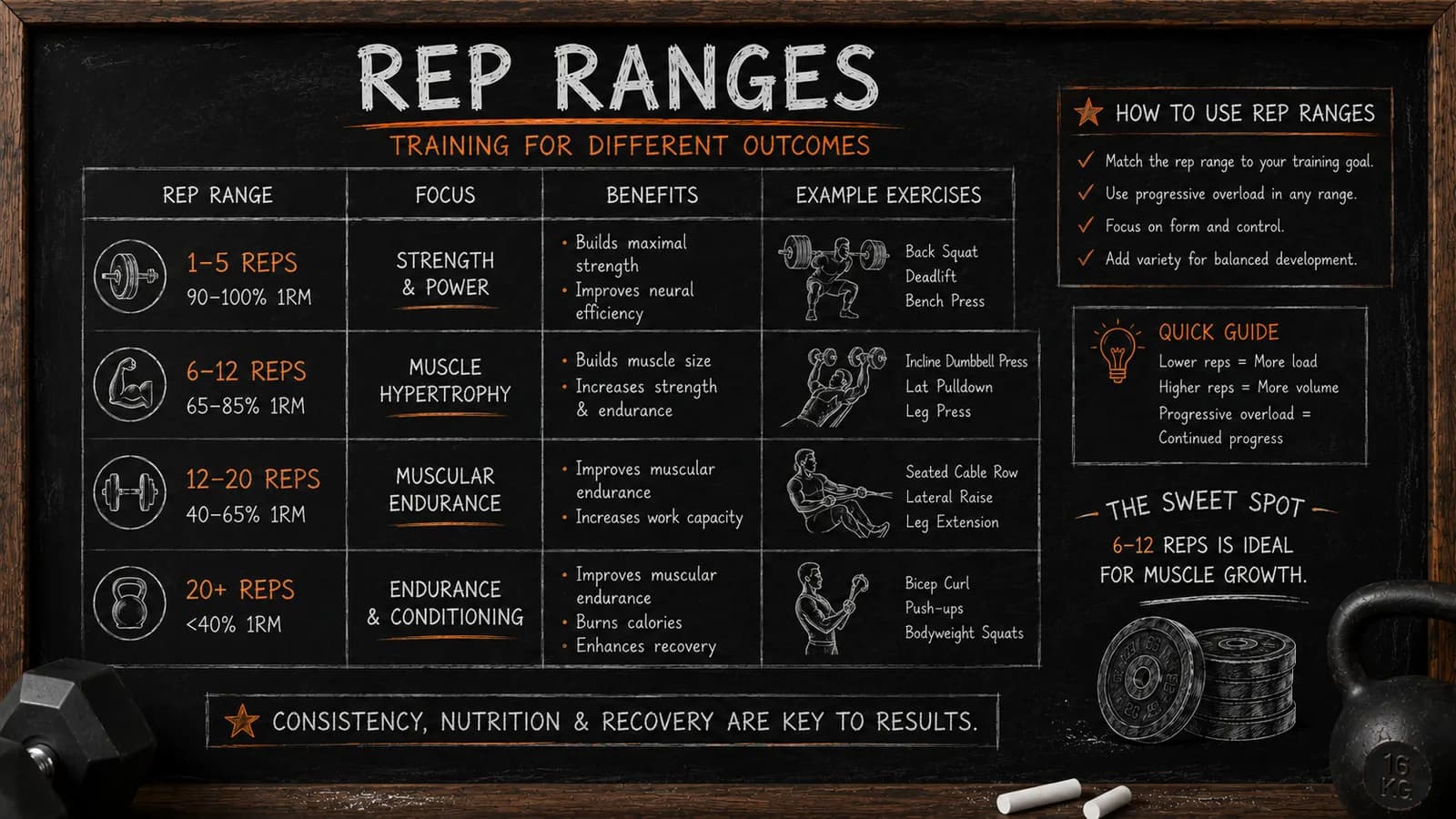
The short answer: 1 to 5 reps builds maximal strength, 6 to 12 builds muscle, 12 to 20 builds muscular endurance, and 20 plus builds conditioning. If your goal is size, anchor most of your training at 6 to 12 reps per set.
The number of reps you perform in a set changes what that set builds. Load, effort and rest all shift with it. This guide breaks down the four working ranges, what each one develops, and how to match your reps to the outcome you are chasing.
Why rep ranges matter
A repetition range is a proxy for load. The fewer reps you can do with a given weight, the heavier that weight is relative to your maximum. Lifting a weight you can only move five times demands near-maximal force. A weight you can move twenty-five times is light enough that endurance, not raw strength, becomes the limiting factor.
That single relationship is why rep ranges organise training. Heavier loads and lower reps bias the body toward strength and neural efficiency. Lighter loads and higher reps bias it toward endurance and work capacity. The middle ground, moderate load and moderate reps, is where most muscle is built.
One number sits behind all of this: your one-rep max, the most weight you can lift once with good form. Every rep range below is expressed as a percentage of that maximum, so the same range scales to any lifter regardless of how strong they are.
The four rep ranges
1 to 5 reps: strength and power
At 90 to 100 percent of your one-rep max, you are training the nervous system as much as the muscle. Low-rep work builds maximal strength and improves neural efficiency: your body gets better at recruiting high-threshold motor units and firing them in sync.
This range builds the raw force behind every other kind of training. It also demands the most from you. Technique has to be sound, warm-ups have to be thorough, and rest between sets runs long, usually two to three minutes, so force output holds from set to set.
Typical exercises: back squat, deadlift, bench press. Compound barbell lifts where you can load heavy and stay safe.
6 to 12 reps: muscle hypertrophy
At 65 to 85 percent of your one-rep max, you are in the classic muscle-building range. There is enough load to create meaningful mechanical tension, and enough reps to accumulate the metabolic stress and time under tension that drive growth. This range also builds a useful blend of strength and endurance along the way.
For most people chasing size and better body composition, this is where the bulk of training should live. It balances stimulus against fatigue better than either extreme.
Typical exercises: incline dumbbell press, lat pulldown, leg press. Movements where you can push close to failure with control.
12 to 20 reps: muscular endurance
At 40 to 65 percent of your one-rep max, the emphasis shifts toward muscular endurance and work capacity: your muscles' ability to sustain effort and resist fatigue. This range still builds muscle when sets are taken close to failure, but its calling card is conditioning the muscle to keep working.
It is well suited to isolation exercises and to movements where heavy loading would compromise technique or stress a joint you are managing.
Typical exercises: seated cable row, lateral raise, leg extension.
20 plus reps: endurance and conditioning
Below 40 percent of your one-rep max, high-rep sets improve muscular endurance, burn calories and support recovery through increased blood flow. This range is less about size and more about capacity, resilience and metabolic conditioning.
It works well for bodyweight movements, finishers, and joint-friendly training for older lifters or anyone rebuilding after a layoff.
Typical exercises: bicep curl, push-ups, bodyweight squats.
The sweet spot: 6 to 12 reps
If your goal is to build visible muscle, 6 to 12 reps is the range to anchor your programme around. It sits at the intersection of enough load to matter and enough volume to grow, without the long rests and technical demand of maximal-strength work or the diminishing size returns of very high reps.
That does not mean you should only ever train in this band. The best programmes borrow from all four ranges: some low-rep work to build the strength that lets you handle heavier weights for your hypertrophy sets, a core of moderate-rep work for size, and higher-rep sets on isolation movements to accumulate volume without grinding your joints. The range is a default, not a cage.
How to use rep ranges
The infographic above distils it to four rules, and they hold up:
- Match the rep range to your training goal. Strength, size and endurance each have a home range. Decide what you are training for before you decide how many reps to do.
- Use progressive overload in any range. Reps organise the stimulus, but they do not replace the need to make training harder over time. Whatever range you pick, add weight, reps or sets as you adapt. Our progressive overload guide covers the methods in full.
- Focus on form and control. A clean rep in the target range beats a sloppy one every time. Load only counts when the muscle you are training is the one doing the work.
- Add variety for balanced development. Different ranges and different exercises load a muscle from different angles. Rotating them produces more complete development than running the same three sets forever.
Remember the quick rule: lower reps mean more load, higher reps mean more volume, and progressive overload in either direction is what turns effort into continued progress.
Rep ranges are only part of the picture
Reps decide the character of a set, but they do not work in isolation. Total weekly volume, how many sets you do per muscle group, matters as much as the range you do them in. So does effort: a set of any length only counts toward growth when it is taken close enough to failure to recruit your largest fibres. Our hypertrophy training guide goes deeper on volume, frequency and effort.
Equipment variety is what makes training across ranges practical. Heavy low-rep work needs stable, loadable movements. High-rep isolation work needs machines and cables that let you push a muscle to fatigue safely. At Inception Gym the 92-piece inventory, with 43 plate-loaded machines and 71 machine variants, covers every muscle group with multiple loading options, so you are never forced into the wrong range because the right tool is taken.
Tracking whether it is working
Choosing the right rep range is a starting point, not proof of progress. To know whether your training is building muscle, you need objective measurement. The scale alone will mislead you: you can add muscle while it holds steady, or while it climbs as fat comes off at the same time.
As an Inception member you get complimentary body composition scans that separate lean mass from fat mass. Run one every six to eight weeks and you will see whether your programme is actually adding muscle, whatever the rep range on paper. If lean mass is flat despite consistent, well-structured training, the answer is almost always nutrition, and Inception Nutrition can build a plan around your scan data.
The bottom line
Rep ranges are a tool for aiming your effort. One to five reps builds strength and power, six to twelve builds muscle, twelve to twenty builds muscular endurance, and twenty plus builds conditioning. Pick the range that matches your goal, apply progressive overload within it, hold your form, and rotate enough variety to develop the whole muscle.
Consistency, nutrition and recovery are what turn the right numbers into results.
---
Ready to put it into practice? [View our membership options](/memberships/options) or [book a free trial](/memberships/free-trial) and train across the full equipment range at Inception Gym Christchurch.