Training · Strength
Progressive Overload: The Only Rule You Need for Muscle Growth
Progressive overload is the single most important principle for building muscle and strength. Learn methods, tracking strategies, and how to apply it at any level.
By Inception Gym · 28 February 2026
People spend enormous time and energy searching for the optimal training programme, the perfect split, the ideal rep range, the magic supplement stack. Most would benefit far more from understanding one principle: progressive overload.
Progressive overload is not complicated. Over time, you subject your muscles to greater stress than they have previously handled. Without that, your body has no reason to adapt. With it, muscle and strength gains are largely guaranteed, assuming the other fundamentals (nutrition, sleep, consistency) are in place.
This guide covers what progressive overload is, the methods for applying it, how to track it, and why ignoring it is the main reason most gym-goers plateau.
What is progressive overload?
The principle was formalised by Thomas DeLorme in the 1940s during work rehabilitating injured soldiers. DeLorme found that systematically increasing the load on muscles was the key variable driving strength and size improvements. The application has become more sophisticated since then. The core principle has not changed.
Your body is an adaptive organism. When subjected to a stress it cannot fully manage with current capacity, it adapts to handle that stress more effectively in the future. In resistance training that means building more muscle tissue and becoming neurologically more efficient at recruiting it.
The catch is that once your body has adapted, the same stimulus no longer drives further adaptation. You have to increase the stimulus. That is progressive overload.
Why most gym-goers plateau
The plateau is not a mystery. It is the predictable outcome of doing the same thing indefinitely.
If you have been doing four sets of ten bench press at 60kg for six months, your body is fully adapted to that demand. It does not need to grow more muscle to handle it. Repeating the same programme with the same weights maintains your current capacity but does not build on it.
This is the invisible ceiling that frustrates so many gym members. They are training consistently, putting in the time, eating reasonably well, and not seeing results. The issue is not commitment. Commitment without progression is just maintenance.
The five methods of progressive overload
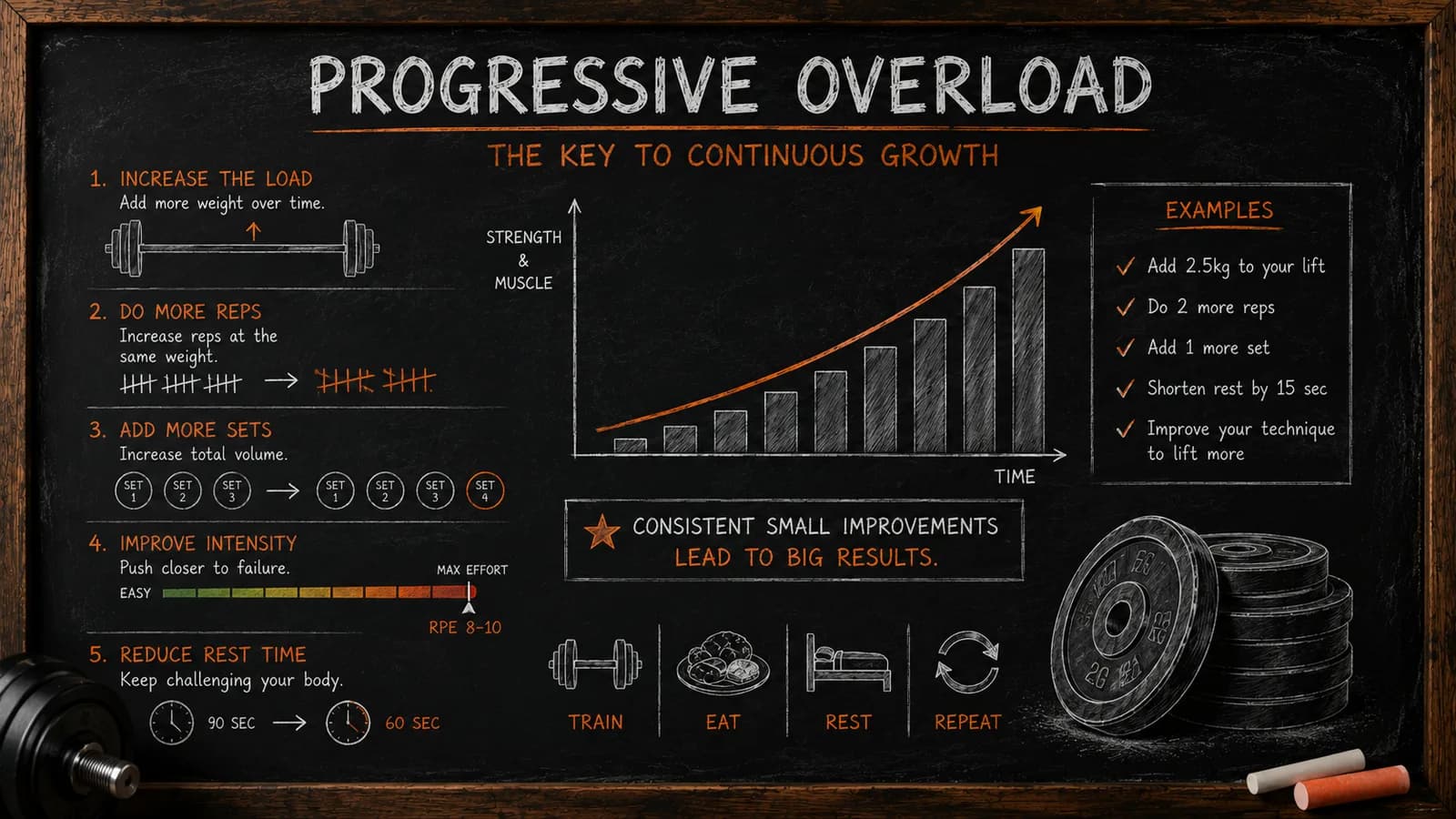
Progressive overload is most commonly associated with adding weight to the bar, but increasing load is only one of five methods.
Method 1: increasing load
The most obvious method. If you did four sets of eight bench press at 80kg last week, doing those same sets at 82.5kg this week is progressive overload.
This is the most reliable method for compound lifts, particularly in the early to intermediate stages when strength gains are rapid. Small regular increments (2.5kg per session for upper body, 5kg for lower body) produce dramatic progress over months if applied consistently.
You cannot add weight on a linear basis forever. Strength gains slow as you become more advanced, and form breakdown under excessive load undermines the muscle-building stimulus.
Method 2: increasing reps
If you did four sets of eight at 80kg, then next session four sets of ten at 80kg, that is progressive overload. More total work, same load.
This is useful when you have hit a temporary ceiling on load. It builds work capacity at a given weight before you eventually add load and start the rep progression again. The basis of the classic "double progression" model: build reps within a target range, then increase load when you hit the top of that range.
Method 3: increasing sets (volume)
Adding a set to an exercise increases total volume, one of the primary drivers of hypertrophy. Three sets of ten last week to four sets of ten this week is more volume for that muscle group.
This is powerful but has practical limits. You can only add so many sets before recovery becomes the bottleneck. Increase volume gradually.
Method 4: reducing rest periods
Performing the same work in less time increases training density, which is a form of progressive overload. If you rested three minutes between sets last month and now rest ninety seconds at the same weight, your body is handling a higher relative demand.
Less commonly tracked but useful for conditioning, body composition and work capacity. Be careful not to reduce rest so much that performance on subsequent sets collapses. Progressive overload requires performance to stay the priority.
Method 5: improving technique and range of motion
A technically better rep is a different stimulus than a sloppy one. Squatting to parallel is a greater range of motion than a quarter squat. A bench press that touches the chest produces more pec stretch than one that stops six centimetres short.
Often undervalued but arguably the most important form of progression early on. Achieving a genuine full range of motion and consistent technique at a given load is progressive overload in a meaningful sense, and sets the foundation for safe load increases later.
How to track progress
Progressive overload requires tracking. Without records you are relying on memory, which is unreliable and optimistic.
At minimum, record:
- Exercise name
- Weight used
- Sets and reps achieved
- Date
Over time you build a clear picture of your trajectory. If your bench press has gone from 60kg for three sets of eight to 90kg for four sets of ten over twelve months, you have objectively got stronger. If those numbers have not moved in three months, you have a clear signal that programming or recovery needs to change.
Many lifters use a notebook. Others use an app. The format does not matter. The habit does.
Measuring outcomes: body composition data
Weight on the bar is the input. Body composition is the output. Tracking one without the other gives you an incomplete picture.
Scale weight is unreliable as a measure of training progress. A person who gains 2kg of muscle and loses 2kg of fat shows no change on the scale while making real progress. Without a body composition scan that progress is invisible.
All Inception Gym members get complimentary body composition scans that show lean muscle mass, body fat percentage and distribution. Scan data alongside your training log gives you the full picture: are you applying progressive overload correctly, and is your body responding the way you want?
If you have been consistently overloading but your muscle mass is not moving, that points to a nutrition issue. If training records show stagnation, you have a programming issue. The data tells you where to focus. See our membership page for details.
Periodisation
Progressive overload cannot run in a straight line indefinitely. The body does not respond linearly and accumulated fatigue eventually needs management.
Periodisation is the planned variation of training stimulus over time. At its simplest:
- Accumulation phases: higher volume, moderate intensity, building work capacity
- Intensification phases: lower volume, higher intensity, peaking strength
- Deload phases: reduced volume and intensity to allow recovery
Novice lifters can often progress on a simple linear progression (adding weight every session) for months before periodisation becomes necessary. Intermediates and advanced lifters need more sophisticated planning.
For most gym members who are not competitive powerlifters or bodybuilders, a simple approach works well: train with progressive intent for six to eight weeks, then take a lighter deload week, then return to progressive training with slightly adjusted targets.
Progressive overload and different goals
For muscle growth (hypertrophy)
Research on hypertrophy identifies volume (total sets x reps x load) as the primary driver. Progressive overload in a hypertrophy context means consistently increasing total volume over time, through combinations of more weight, more reps and more sets.
Rep ranges of six to twenty per set all contribute to hypertrophy when effort is high. The emphasis should be on progressive load within a moderate rep range (8 to 15 reps) for most exercises.
For strength
Strength is primarily a neurological adaptation. It requires heavier loads and lower rep ranges (1 to 6 reps) with high specificity to the target lifts. Progressive overload here is predominantly load-based.
For general fitness
If your goal is general fitness rather than specific muscle growth or strength, progressive overload still applies. Gradually increasing the challenge of your sessions, whether through more weight, more reps, shorter rest or more complex movements, drives adaptation and prevents the plateau.
Practical application
If you are not currently tracking your sessions and applying deliberate progressive overload, start here:
- Record current working weights and rep schemes for your main exercises.
- For each exercise, pick the simplest form of progression available. Usually that is: complete all target reps in all sets before adding weight.
- Aim to apply at least one form of progressive overload to each major exercise every one to two weeks.
- Review your log monthly. Are the numbers moving?
For nutrition support that underpins your ability to recover and adapt, Inception Nutrition provides evidence-based coaching from practitioners who understand how nutrition and training interact.
The bottom line
Progressive overload is not optional if you want to build muscle and strength. It is the mechanism. Everything else, the split, the exercises, the supplements, the timing, is secondary to the requirement that your training must become progressively more demanding over time.
Apply it deliberately, track it consistently, and back it with appropriate nutrition and recovery.
For further reading on how to get started at the gym, see our beginner's guide to training. For the equipment that supports your programme, 92 machines with 43 plate-loaded and dumbbells to 70kg, visit our equipment page.