Training · Programming
Training Splits Explained: How to Structure Your Gym Week
Push pull legs, upper lower, full body, or bro split? Learn which training split suits your schedule and goals, and how to make any approach work effectively.
By Inception Gym · 5 July 2025
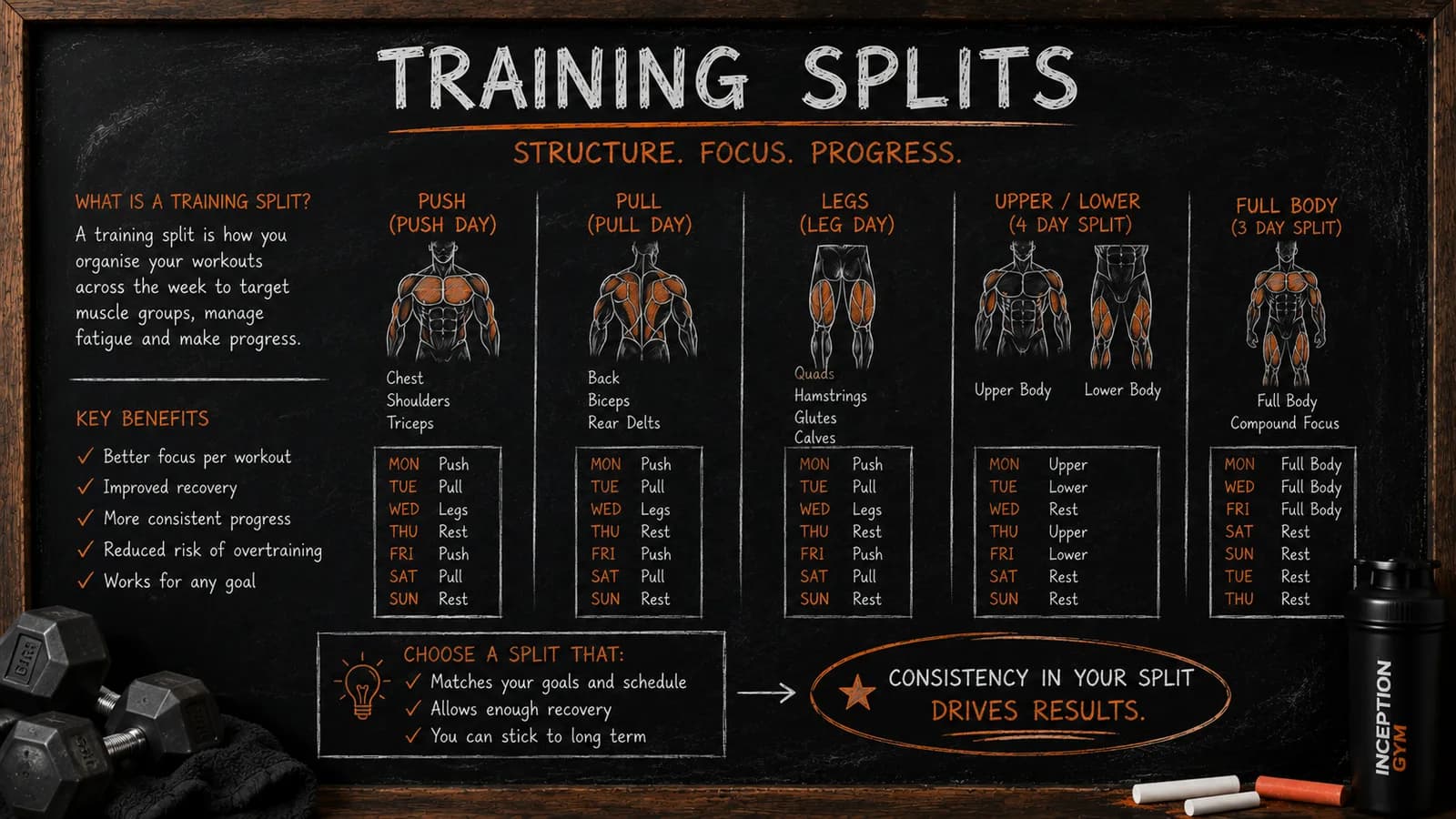
One of the most common questions from people starting or reorganising their training is how to structure the week. Train your whole body each session? Focus one day on chest and back? Follow a push/pull/legs rotation? The number of options can make the decision feel harder than it needs to be.
No single split is universally superior. The short answer: if you can train two or three days per week, train full body; four days, run an upper/lower split; five or six days, push/pull/legs. Different structures suit different schedules, recovery capacities, experience levels and goals. Understanding what each split means, and what drives results inside any split, will help you choose one and commit rather than constantly second-guessing.
What is a training split?
A training split is simply the way you organise which muscles you train on which days. The split determines:
- How frequently each muscle group is trained per week
- How much recovery time each muscle group gets between sessions
- How much volume can be applied per session to specific muscle groups
- How the training week flows logistically
The split is not the programme. It is the organisational framework that a programme sits within. Two people following the same split can get dramatically different results depending on the quality of their exercise selection, the effort they apply, their nutrition, and their recovery habits.
With that context in place, here are the main splits, their strengths, and who they suit.
Full body training
What it is
Each training session targets the whole body: lower body compound movements, upper body push and pull movements, and accessory work, all in the same session.
A full body session might include: barbell squat, bench press, barbell row, overhead press, and two to three accessory exercises, trained three times per week.
Strengths
High training frequency: Each muscle group is stimulated three times per week. Research on training frequency consistently shows that two to three sessions per week per muscle group produces superior hypertrophy outcomes compared to once per week, assuming volume is matched.
Efficiency for limited training days: If you can only get to the gym two or three times per week, full body training ensures no muscle group is severely under-trained.
More practice on the big lifts: Squatting, pressing and pulling three times per week means three chances to rehearse technique. For beginners, that skill practice drives strength progress faster than any volume manipulation.
Limitations
Lower per-session volume per muscle: Because you are training everything in one session, you cannot do as many sets per muscle group as you would in a more specialised split without the session becoming impractically long.
Fatigue management: Training everything three times per week generates significant accumulated fatigue, particularly on the central nervous system. Recovery demands are higher.
Session length: A properly structured full body session takes sixty to ninety minutes. If your available training time is limited, fitting everything in becomes difficult.
Best for
Beginners, people with three or fewer available training days, and those returning from a long break.
Upper/lower split
What it is
The training week is divided between upper body sessions and lower body sessions. A typical structure is four days per week: upper, lower, rest, upper, lower, rest or rest.
Strengths
Excellent frequency-to-volume balance: Each major muscle group is trained twice per week, which hits the sweet spot identified in hypertrophy research. Upper body sessions allow more volume for pushing and pulling muscles than a full body session would permit.
Manageable session length: Sessions are typically sixty to seventy-five minutes.
Structural clarity: The upper/lower division is intuitive. You always know what you are training.
Good recovery structure: Training the same muscle group again after two to three days is consistent with current understanding of the muscle protein synthesis timeline.
Limitations
Requires four training days: Less flexible for people with unpredictable schedules.
Lower body sessions are demanding: Squats and deadlifts both sitting in the same session creates significant recovery demand, particularly for the lower back. Programming requires some care to avoid overlap.
Best for
Intermediate lifters with four consistent training days per week. One of the most recommended splits for general muscle building and strength development.
Push/pull/legs (PPL)
What it is
Sessions are organised into three types:
- Push: Chest, shoulders, and triceps (all pushing muscles)
- Pull: Back and biceps (all pulling muscles)
- Legs: Quadriceps, hamstrings, glutes, and calves
Typically run over six days (push, pull, legs, push, pull, legs, rest), but can be run over three or four days at the cost of muscle group frequency.
Strengths
High specificity and volume per session: A push session allows significant chest, shoulder, and tricep volume that would be impossible in a full body context.
Logical muscular grouping: Pushing exercises naturally use the chest, shoulders, and triceps together. Grouping them in the same session leverages this overlap and avoids fatigue spillover between sessions.
Six-day structure hits excellent frequency: Running PPL twice per week means every muscle group is trained twice, with volume distributed over two sessions rather than one.
Popular for a reason: PPL is used by experienced bodybuilders and strength athletes because it works. It is a mature, well-tested approach.
Limitations
Requires five to six training days for full benefit: Running PPL on three days only means each muscle group is trained once per week, losing the frequency advantage.
Shoulder overlap on push days: Heavy pressing loads the anterior deltoids significantly. If push day includes both heavy bench and heavy overhead press, the shoulder recovery demand is high.
Best for
Intermediate to advanced lifters with five to six available training days and a specific goal of muscle growth (hypertrophy).
The "bro split" (body part split)
What it is
Each session targets a single muscle group or closely related pair: chest day, back day, shoulders day, arms day, legs day. Classic bodybuilding structure, five or six days per week.
Strengths
Maximum per-session volume for each muscle group: A dedicated chest day allows fifteen to twenty-plus sets of chest work without any competing fatigue from other muscle groups.
Recovery advantage (in theory): Each muscle group gets five to six days of recovery before being trained again.
Limitations
Low training frequency: Most current hypertrophy research suggests training each muscle group twice per week is superior to once per week when total volume is matched. A bro split typically provides once-per-week frequency, which leaves gains on the table for most natural lifters.
Requires consistent five to six day training weeks: If you miss a day, your whole week's split is disrupted in a way that a more flexible structure would not be.
Often used by advanced (sometimes pharmaceutical) athletes: The volume a well-developed competitive bodybuilder can apply in a single chest session, combined with the extended recovery they sometimes need, is different from the context of a natural intermediate lifter.
Best for
Advanced lifters with five to six consistent training days who have already built a solid foundation and specifically want to bring up individual body parts. Not typically recommended as a starting point for most natural lifters.
Choosing your split
The right split is the one you will actually follow consistently. Beyond that:
How many days per week can you train consistently?
- 2 to 3 days: full body
- 4 days: upper/lower
- 5 to 6 days: PPL or upper/lower with added day
What is your experience level?
- Beginner (under 12 months): full body or upper/lower
- Intermediate (1 to 3 years): upper/lower or PPL
- Advanced (3+ years): any, with conscious periodisation
What is your primary goal?
- General fitness and health: full body or upper/lower
- Muscle growth: upper/lower or PPL
- Strength: upper/lower, or a strength-specific programme within full body
- Body composition: any split with adequate volume and nutrition
Frequency matters more than the split name
Research on training frequency generally concludes that training each muscle group twice per week is meaningfully better than once per week for hypertrophy, assuming volume is equated.
That does not make PPL inferior to full body. It means a six-day PPL (each muscle twice per week) outperforms a three-day PPL (each muscle once). The split name matters less than the frequency it produces.
Equipment that supports any split
At Inception Gym, with 92 pieces of equipment across 71 machine variants, 43 of them plate-loaded, plus a full free weight area with dumbbells to 70kg, equipment availability does not constrain your split.
A dedicated push day can run through flat machine press, incline dumbbell press, cable crossovers, machine lateral raises and tricep pushdowns without equipment conflict. A pull day uses the plate-loaded row, cable rows, lat pulldown, face pulls and barbell curls. Legs has leg press, hack squat, Romanian deadlift, leg extension, leg curl and standing calf raise available at the same time.
View the full equipment inventory.
Integrating nutrition
Your split determines your recovery demands, which determine your nutritional needs. A six-day PPL has different protein timing and caloric requirements than a three-day full body programme.
For most people the principles apply regardless of split: adequate daily protein (1.6 to 2.2 grams per kilogram of bodyweight), calories matched to goal, and timing that ensures you arrive at training sessions fuelled.
For structured nutrition planning aligned with your specific programme, Inception Nutrition provides PhD-led coaching that integrates your split, volume, goals and body composition data.
The most important variable
Whatever split you choose, apply progressive overload within it consistently. A poorly designed split with progressive overload will outperform the optimal split with stagnant programming.
Choose a structure that fits your schedule. Commit to it for at least twelve weeks before assessing or adjusting. Track your sessions.
Start your free trial and work out what suits you in practice.