Training · Recovery
The gym warm-up routine: prepare your body for better performance
A gym warm-up routine that prevents injury and improves performance. Dynamic protocols, muscle activation drills, and how to use cardio equipment effectively.
By Inception Gym · 8 November 2025
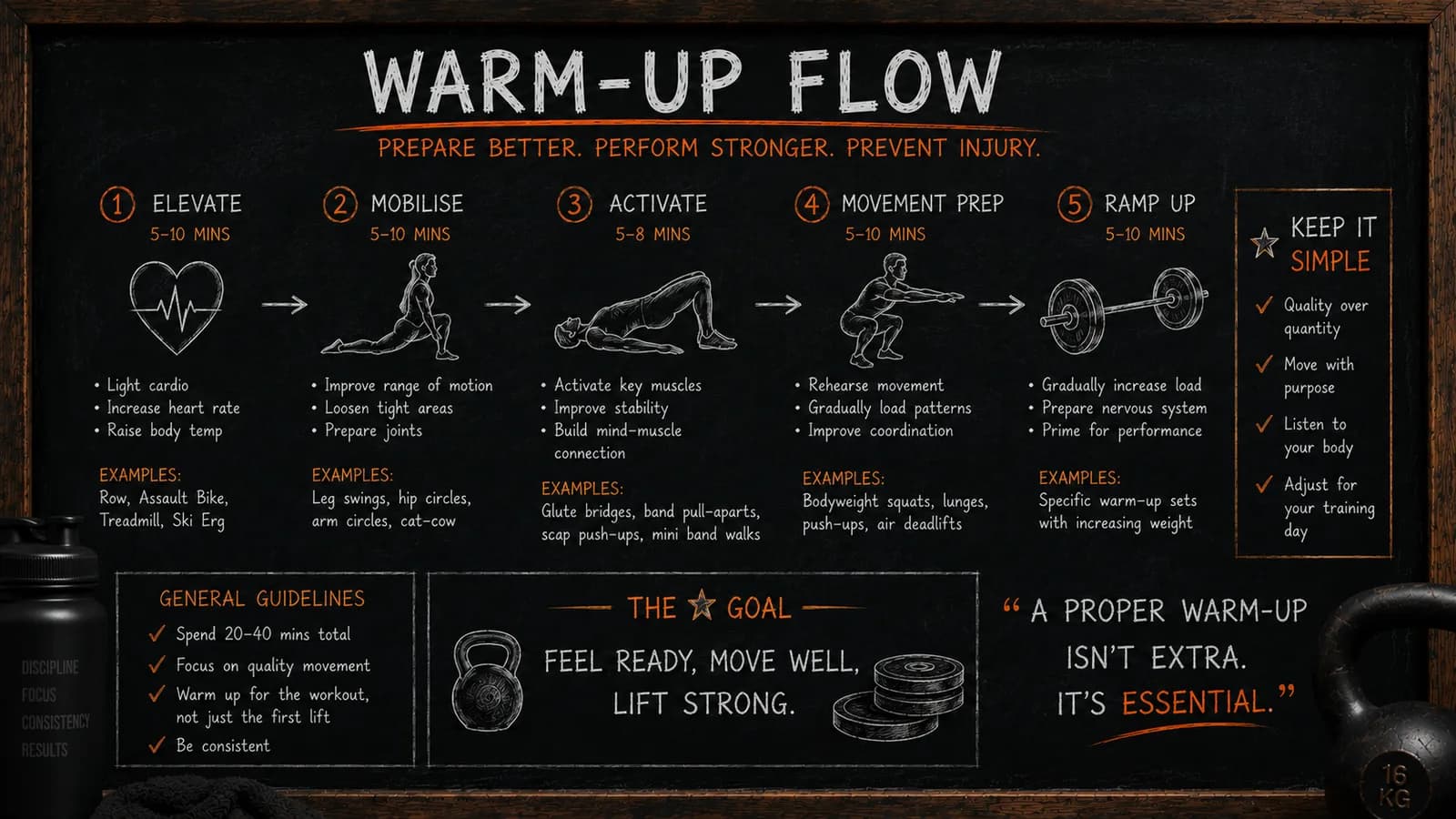
Most people skip their warm-up, or do a token version: a couple of arm circles, maybe thirty seconds on the bike, and straight into the working sets. One of the most common mistakes in the gym, and over time it costs people either performance or injury or both.
A proper warm-up isn't about killing time before the real work starts. It's an investment in the quality of every rep you perform that session. Done correctly, it lifts your output, reduces injury risk, and prepares your nervous system for what you're about to do.
Here's the short answer: an effective gym warm-up has three parts. Five to eight minutes of easy cardio to raise body temperature, a set of dynamic mobility and activation drills matched to the session you're about to do, and progressive warm-up sets on your first compound lift. Ten to twenty minutes total. The rest of this guide covers exactly what to do in each part and why.
Why warming up matters
The term "warm-up" is literal. Raising your core body temperature and the temperature of working muscles has direct performance benefits. Warmer muscle tissue is more pliable, contracts more forcefully, and recovers more quickly between efforts than cold muscle.
Beyond temperature, a thorough warm-up:
- Increases synovial fluid production in joints, reducing friction and wear
- Elevates heart rate gradually, priming the cardiovascular system
- Activates the specific motor patterns you're about to perform
- Mentally shifts your focus from whatever preceded the session to the training itself
- Identifies any tightness or restriction before it becomes an injury under load
Research consistently shows athletes who warm up properly perform better and have fewer soft tissue injuries. The five to fifteen minutes you invest before your first working set pays dividends across the session and your long-term training longevity.
The two phases of an effective warm-up
A well-structured warm-up has two phases: the general warm-up and the specific warm-up. Most people do neither properly. Understanding both will change how you approach the start of every session.
Phase one: general warm-up
The general warm-up raises your overall body temperature and heart rate. Five to eight minutes, comfortably aerobic, not exhausting. You want to arrive at your first exercise with a light sweat and an elevated heart rate, not fatigued.
Options at Inception Gym:
Rowing machine. The rower is particularly effective for a general warm-up because it involves the whole body. A moderate five-minute row at a comfortable pace raises your heart rate, engages your posterior chain, and works your shoulders and arms through a loaded range of motion. Keep the intensity conversational.
Stationary bike. For lower body-dominant sessions (squat day, leg day), the bike is an excellent choice. It warms the hips, knees, and ankles specifically without loading the spine before you're ready.
Treadmill incline walk. Walking at a moderate incline for five minutes is simple and effective. The incline recruits the glutes and hamstrings more than flat walking, useful before any lower body session.
Light skipping. If you enjoy it and it's available, three to five minutes of light skipping is one of the best full-body warm-up options. Raises temperature quickly, challenges coordination, and warms the calves and ankles, often neglected areas.
The goal in this phase isn't intensity. If you're working hard enough to be breathless, you're working too hard. You haven't started your session yet.
Phase two: dynamic warm-up
This is where most gym-goers fall short. The dynamic warm-up replaces static stretching (which research now shows is counterproductive before resistance training) with active movement that prepares the specific muscles and joints for the session.
Dynamic warm-up exercises move your joints through their full range of motion under controlled conditions, activating the muscles you're about to load and priming the nervous system for the patterns you'll use.
Key word is dynamic: you're moving, not holding.
Dynamic warm-up exercises by session type
For a lower body session (squat, deadlift, leg press)
Leg swings (front to back). Stand facing a wall with one hand for support. Swing one leg forward and back in a controlled arc, gradually increasing range. Ten to twelve reps per leg. Opens the hip flexors and activates the glutes through a range the squat will demand.
Lateral leg swings. Same position, now swing the leg side to side across the body. Ten reps per leg. Targets the hip abductors and adductors, preparing the hip for multi-directional stability under load.
Hip circles. Stand with feet hip-width apart, hands on hips. Rotate the pelvis in large circles, clockwise and anticlockwise. Eight rotations each direction. Simple and effective for hip joint prep.
Bodyweight squat with pause at bottom. Ten to fifteen bodyweight squats, pausing for two seconds at the bottom of each rep. Keep your chest up and knees tracking over your toes. Mobility drill and activation exercise for the glutes and quads.
Glute bridge. Lie on your back with feet flat and knees bent. Drive your hips to the ceiling, hold two seconds at the top, lower with control. Twelve to fifteen reps. Essential glute activation before any lower body session. Many people squat and deadlift without their glutes firing properly, which shifts load to the lower back.
World's greatest stretch. Step into a long lunge. Place the same-side hand on the ground inside your front foot. Open your chest and rotate your arm toward the ceiling. Pause, lower, repeat on the other side. This single exercise opens the hip flexors, thoracic spine, and shoulders at once. Four reps per side before any compound session.
For an upper body session (bench, row, overhead press)
Arm circles. Start small and increase the range progressively. Ten rotations forward, ten backward. Then switch direction. Simple, but it genuinely warms the shoulder capsule.
Band pull-aparts. Using a light resistance band or a cable at chest height, hold the band in front of you with arms extended and pull it apart to a T position. Fifteen to twenty reps. Activates the rear deltoids and rotator cuff, critical for shoulder health before pressing.
Shoulder dislocations (with a dowel or resistance band). Hold a band or lightweight stick with a wide grip in front of you. Slowly arc it overhead and behind you without bending your elbows. If you can't complete the range without pain or bending your arms, widen your grip. Ten controlled reps. One of the single best shoulder preparation exercises available.
Cat-cow for thoracic spine. On all fours, move through a slow cat-cow sequence, creating movement specifically in the thoracic (mid-back) region rather than just the lumbar. The thoracic spine's mobility is critical for overhead pressing and rowing. Eight to ten slow reps.
Face pulls with light cable. Set a cable at face height with a rope attachment. Pull toward your face, separating your hands at the end of the movement and rotating your elbows upward. Fifteen reps with a light weight. Activates the rear delts, rotator cuff, and mid-traps before any pressing session.
Scapular push-ups. In a push-up position, keep your arms straight and let your chest drop between your shoulder blades, then push the floor away and protract the scapulae as far as possible. Activates the serratus anterior, an often-neglected stabiliser essential for shoulder health.
For a pull session (deadlift, rows, lat pulldown)
The world's greatest stretch, hip hinges, and cat-cow are all essential before a heavy pulling session. In addition:
Bodyweight hip hinge. Stand with feet hip-width apart. Push your hips back as if reaching behind you for a wall, keeping a slight bend in the knees and your back in a neutral position. Feel the hamstring stretch and the posterior chain loading. Ten slow, controlled reps. Activates the exact pattern of the deadlift without load.
Dead bug. Lie on your back with arms pointing to the ceiling and knees bent at ninety degrees. Lower opposite arm and leg toward the floor while keeping your lower back pressed to the ground. Activates the deep core stabilisers that protect the spine under heavy pulling loads.
The specific warm-up: working up to your working weight
Once your general and dynamic warm-up are complete, don't jump straight to your first working set. Do warm-up sets.
A simple warm-up set protocol for compound lifts:
- One set at 50% of your working weight for ten reps
- One set at 70% for five reps
- One set at 85 to 90% for two to three reps
- First working set
The specific warm-up grooves the exact movement pattern you're about to perform under load, identifies any technique issues at sub-maximal intensity before they become problems under maximum load, and prepares the tendons and connective tissue for peak force.
Never skip warm-up sets on heavy compound movements. It isn't saving time; it's removing the insurance policy.
How long should your warm-up take
A realistic total warm-up, including both phases and specific warm-up sets, takes ten to twenty minutes depending on the session type and intensity.
Heavier sessions and complex movement patterns (deadlifts, heavy squats, overhead pressing) warrant longer warm-ups. Light accessory or machine-only sessions need less preparation. Adjust accordingly rather than following a rigid time target.
Nutrition and warm-up
A warm-up is a physical protocol, but your pre-workout nutrition also plays a role in how effectively your body responds to it. Arriving at the gym in a depleted state (no food for hours, low hydration) makes even a thorough warm-up less effective. Your body doesn't have the fuel to respond optimally.
If you're looking to optimise your pre-session fuel and performance supplement stack, Inception Nutrition provides PhD-led guidance that integrates nutrition timing with your training schedule. The on-site Supplement Solutions store at Inception Gym also stocks a full range of performance supplements, including the Inception Labs Valor pre-workout with 350mg of caffeine and Alpha GPC for focus.
Common warm-up mistakes
Static stretching before lifting. Holding a hamstring stretch for thirty seconds before your deadlift reduces force production temporarily. Save static stretching for after your session, not before.
Skipping the general warm-up. Going straight to dynamic exercises before raising your heart rate and core temperature means you're performing activation work on cold tissue. Do the general warm-up first.
Warming up one body part when training another. If you're squatting, warming up your shoulders and nothing else doesn't make sense. Match your warm-up to your session.
Using the warm-up as a conditioning session. Your general warm-up should be moderate intensity. If you arrive panting, you've either worked too hard in the warm-up or you arrived too close to your session start time.
No warm-up sets on heavy lifts. The dynamic warm-up prepares you for training. Warm-up sets prepare you for the specific demands of your heaviest working sets. Both are necessary.
Making it a habit
The best warm-up is the one you actually do consistently. If a full protocol feels overwhelming when you're starting out, begin with the minimum: five minutes of general cardiovascular warm-up and three to four targeted dynamic exercises matching your session type.
As the habit forms, add complexity. The warm-up protocols above are not the ceiling; they're a solid starting point that works for most people in most sessions.
For a structured approach to building better training habits from day one, see what to expect on your first day at Inception Gym. If you want warm-up protocols built into a full programme, contract memberships include a free initial PT consultation; start with a free trial to see the floor first.
Your session doesn't start when you load the bar. It starts when you walk through the door. Use that time well.