Nutrition · Supplements
Creatine monohydrate: benefits, dosing, and why Creapure matters
Creatine monohydrate is the most researched supplement in sport science. The benefits, correct dosing, and why Creapure-sourced creatine is the reference standard.
By Inception Gym · 31 May 2025
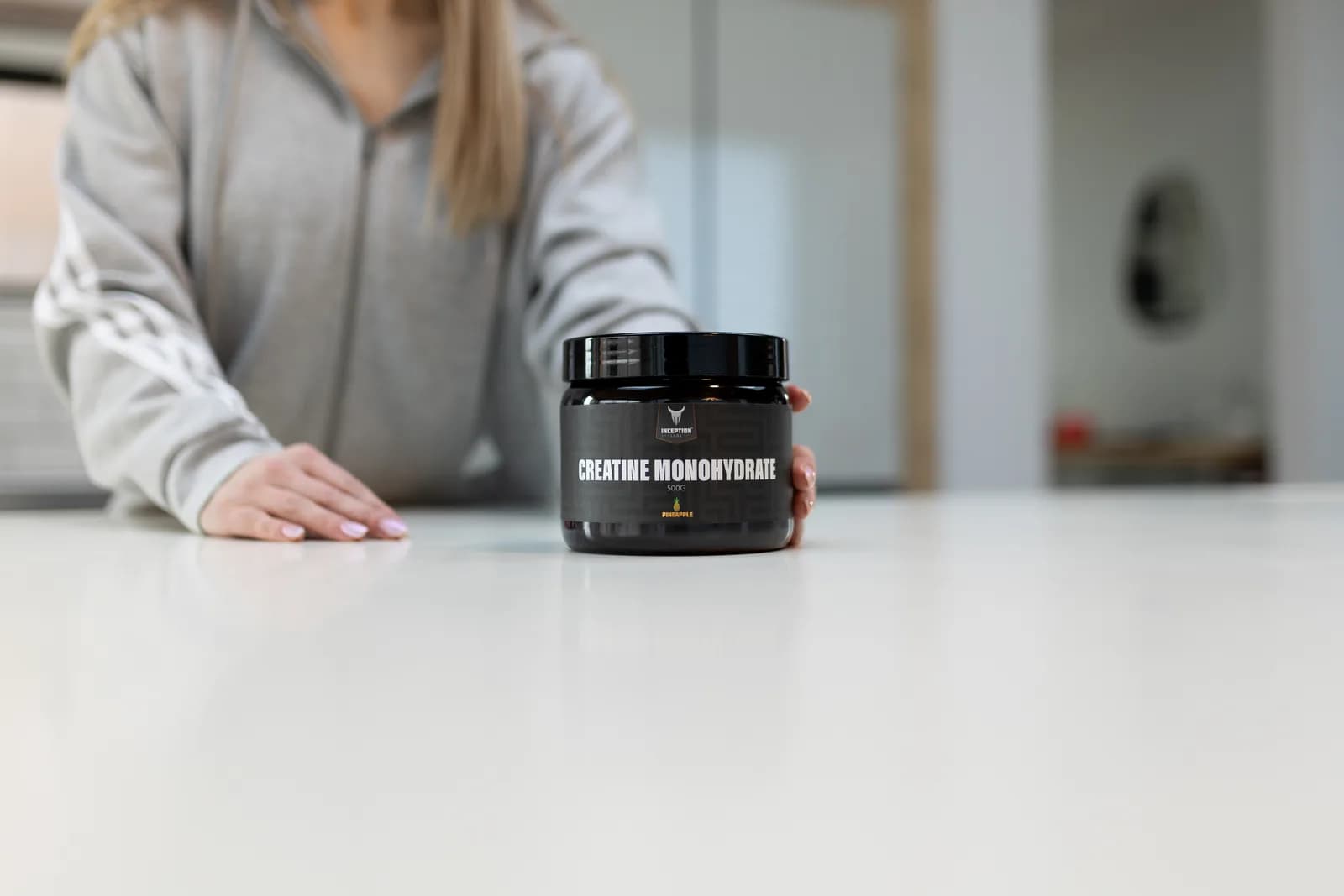
If you could only take one supplement, the evidence would point to creatine monohydrate every time. More research has been conducted on creatine than on any other sports supplement in history. The findings are consistent: creatine works, it's safe, and the benefits extend well beyond the gym floor.
Yet there's still a lot of confusion about creatine: what it does, how to use it, whether loading is necessary, and whether the source matters. This guide covers all of it, based on the current research.
What is creatine
Creatine is a naturally occurring compound produced in the body from three amino acids: glycine, arginine, and methionine. It is also found in small amounts in meat and fish. The body stores creatine primarily in skeletal muscle as phosphocreatine, where it plays a central role in energy production.
Specifically, phosphocreatine is used to regenerate ATP (adenosine triphosphate) rapidly during short, high-intensity efforts. ATP is the currency of cellular energy. During explosive exercise (a heavy squat, a sprint, a maximum-effort pull), your body burns through available ATP in seconds. Phosphocreatine is the fastest available mechanism for replenishing that ATP supply.
When you supplement with creatine, you increase the phosphocreatine stored in your muscles beyond what diet alone can provide. This gives you more fuel for high-intensity efforts.
The core benefits
Increased strength and power output
This is the most extensively documented benefit. Meta-analyses of dozens of studies consistently show that creatine supplementation increases maximal strength (one-rep max) and power output across a range of exercise modalities.
The mechanism is straightforward: more phosphocreatine means faster ATP regeneration, which means your muscles can sustain high-intensity effort slightly longer before fatigue sets in. Over a session, that translates to more reps at a given weight, which over time translates to more progressive overload and more muscle growth.
Strength increases from creatine supplementation in the research typically range from eight to fourteen percent over equivalent training periods compared to placebo groups. For a lifter squatting 100kg, that's an eight to fourteen kilogram advantage on the same programme.
Improved high-intensity repeat capacity
Creatine's benefit is most pronounced in activities that involve repeated short bursts of high-intensity effort with brief recovery. That matches the structure of most resistance training sessions. Each working set is a short, high-intensity effort followed by a rest period.
Studies on repeat sprint ability, repeated jump performance, and multiple-set resistance training all show performance advantages with creatine versus placebo.
Muscle hypertrophy
Creatine promotes muscle growth through several mechanisms:
Direct effect. Greater training volume per session (more reps, heavier loads) creates a stronger progressive overload stimulus.
Cell volumisation. Creatine draws water into muscle cells, increasing cell volume and creating an anabolic signalling environment.
Myogenic satellite cell activity. Some research suggests creatine may directly influence the activity of satellite cells, which are involved in muscle repair and growth.
IGF-1 signalling. Creatine has been shown to increase IGF-1 (insulin-like growth factor 1) expression in muscle tissue, a key anabolic signal.
Cognitive benefits
A less-discussed but well-established area of creatine research. The brain, like muscle, uses phosphocreatine as a rapid energy buffer. Supplementing with creatine has been shown to:
- Improve cognitive performance under sleep deprivation
- Enhance memory and reasoning tasks, particularly in vegetarians and vegans who have lower baseline creatine stores from diet
- Show protective effects against neurological stress in multiple studies
Research into creatine as a neuroprotective agent is ongoing, and the findings are compelling. For older adults in particular, cognitive preservation is an increasingly discussed application.
Recovery
Creatine reduces markers of muscle damage and inflammation following intense training. Studies show lower creatine kinase levels (a marker of muscle damage) and reduced perceived muscle soreness in creatine users following high-intensity sessions. Better recovery supports higher training frequency, which compounds the training volume advantage over time.
Bone and connective tissue
Emerging research suggests creatine may have benefits beyond muscle and brain. Some studies indicate positive effects on bone density, particularly when combined with resistance training in older populations. An active area of research rather than an established finding, but it adds to the case for creatine across the lifespan.
Does creatine work for everyone
Creatine doesn't produce identical responses in all users. Non-responders exist: people whose muscles are already saturated with creatine from diet, whose muscles have fewer fast-twitch fibres (which rely more on phosphocreatine), or who metabolise supplemental creatine differently.
Estimated non-response rates vary in the literature, but most analyses suggest ten to thirty percent of supplementers see minimal performance enhancement. There's no reliable pre-test to identify non-responders, so the pragmatic approach is to supplement for six to eight weeks and assess response through training performance and body composition data.
Notably, creatine's cognitive and recovery benefits may still be present in partial muscular non-responders, which makes it a reasonable supplement for virtually all active adults.
Dosing
Loading phase (optional)
The historical loading protocol: twenty grams per day (four five-gram doses) for five to seven days, followed by a maintenance dose.
Loading saturates muscle stores rapidly, so you get full benefits within a week. Downside: some people get gastrointestinal discomfort at higher doses, and the evidence that loading provides a meaningful long-term advantage over gradual supplementation is weak.
Standard daily protocol (recommended)
Three to five grams per day, every day, no loading phase. Reaches muscle saturation within three to four weeks and is as effective as loading over any meaningful training timeframe, with far lower risk of digestive discomfort.
No evidence that the timing of creatine consumption (pre- or post-workout, with or without food) makes a clinically meaningful difference for most people. Consistency matters more than timing. Take it at the same time each day, whatever fits your routine.
Cycling
Many older protocols recommended cycling creatine on and off. Current evidence doesn't support this. No benefit to cycling, and stopping supplementation simply allows muscle stores to return to baseline over four to six weeks. If creatine is working for you, keep taking it.
Why monohydrate vs other forms
Supplement marketing has produced a long list of creatine variants: creatine HCl, creatine ethyl ester, buffered creatine, creatine nitrate, liquid creatine, and others. Each has been marketed as superior to plain creatine monohydrate.
The evidence doesn't support those claims. Head-to-head comparison studies consistently show creatine monohydrate performing equivalently or better than alternative forms, at a fraction of the cost. The few instances where alternative forms showed marginal advantages were often industry-funded studies with methodological issues.
Creatine monohydrate is the form used in the overwhelming majority of research. It's the reference standard. Unless there's a specific reason to avoid it (rare), monohydrate is the right choice.
Why Creapure matters
Not all creatine monohydrate is equal. Creatine is produced through a chemical synthesis process, and the quality of that process varies between manufacturers.
Creapure is a brand of creatine monohydrate produced by AlzChem in Germany. It's become the reference quality standard in the industry for several reasons:
Purity. Creapure goes through rigorous production and testing to ensure minimal contaminants. Some cheaper creatine products have tested positive for dihydrotriazine (a creatine production byproduct), dicyandiamide, and other impurities. Creapure's manufacturing process is designed to eliminate these.
HPLC verification. High-performance liquid chromatography testing confirms the purity and identity of the creatine. An analytical standard, not a marketing claim.
Banned substance testing. Creapure is tested for substances banned by WADA, making it a credible choice for competitive athletes. Many other creatine products are not independently tested.
Vegan. Creapure is produced synthetically and contains no animal-derived ingredients.
The price premium for Creapure-sourced creatine is modest. The confidence in what you're consuming is not.
Inception Labs Creatine Monohydrate
Inception Labs creatine uses Creapure-sourced creatine monohydrate. HPLC verified, vegan, and banned substance tested.
RRP is $70. Member price at the Supplement Solutions store is $50, a saving of $20 per tub. At a daily dose of five grams, a standard container lasts two months. Member pricing brings your cost to $25 per month for a supplement with the deepest evidence base in sport science.
For context, $50 for two months of Creapure creatine is below the price many people pay at general supplement retailers for lower-grade creatine monohydrate products. The member pricing advantage isn't trivial.
View the full Inception Labs creatine product at inception-labs.com.
Stacking creatine with other supplements
Creatine's effects are independent of most other supplements, so it can be combined freely without interaction concerns. Common and effective stacks:
Creatine and protein. The two primary inputs for muscle growth. One handles the training performance input, the other handles the building block supply.
Creatine and pre-workout. If your pre-workout doesn't include creatine (and many now do, sometimes at sub-effective doses), adding creatine separately ensures you get a full evidence-backed daily dose.
For a personalised view of which supplements are appropriate for your goals, the team at Inception Nutrition runs PhD-led coaching that considers your training, body composition data, and goals together.
Who should take creatine
Most people who train with any regularity.
The evidence covers strength athletes, endurance athletes, team sport athletes, older adults, and general fitness enthusiasts. The safety profile over decades of research is excellent. No evidence of harm to kidney or liver function in healthy individuals at standard doses.
Groups with potential particular benefit:
- Vegetarians and vegans, who have lower dietary creatine intake and typically start with lower muscle creatine stores, often showing the most pronounced response to supplementation
- Older adults, for whom muscle preservation and cognitive benefits are relevant
- Anyone pursuing progressive overload in their training, which should be everyone
Common myths
"Creatine causes water retention and makes you look puffy." Creatine draws water into muscle cells, not under the skin. The intracellular water retention is a feature (it contributes to cell volume and anabolic signalling) and isn't visible as subcutaneous bloating in the way some claim.
"Creatine is a steroid." Creatine is an amino acid derivative produced naturally by the body and found in food. It has no hormonal activity and is not classified as a controlled substance anywhere. Comparing creatine to anabolic steroids reflects a misunderstanding of both.
"You need to cycle creatine." No credible evidence supports this. Creatine doesn't cause your body to downregulate its own production in a way that warrants cycling.
"Creatine is bad for your kidneys." Multiple studies have examined kidney function in creatine users, including long-term supplementation, and found no adverse effects in healthy individuals. People with pre-existing kidney conditions should consult a medical professional before supplementing, as with any supplement.
Getting started
If you're an Inception Gym member and want to add creatine, Inception Labs creatine is available in-store at the Supplement Solutions counter. At $50 for a member-priced tub (compared to $70 RRP), it's the most accessible high-quality creatine in Christchurch.
For a fuller supplement review as part of a broader nutrition strategy, book a session or explore the guidance available through Inception Nutrition.
For more on the evidence behind supplement choices, see our related post on supplements that actually work. To understand how your training and supplementation results are tracked, see body composition scans included with your membership.