Training · Strength
Strength Training for Women: Why Lifting Heavy Changes Everything
Discover why lifting heavy is one of the best things women can do for their health, body composition, and longevity. No, you will not get bulky.
By Inception Gym · 28 March 2026
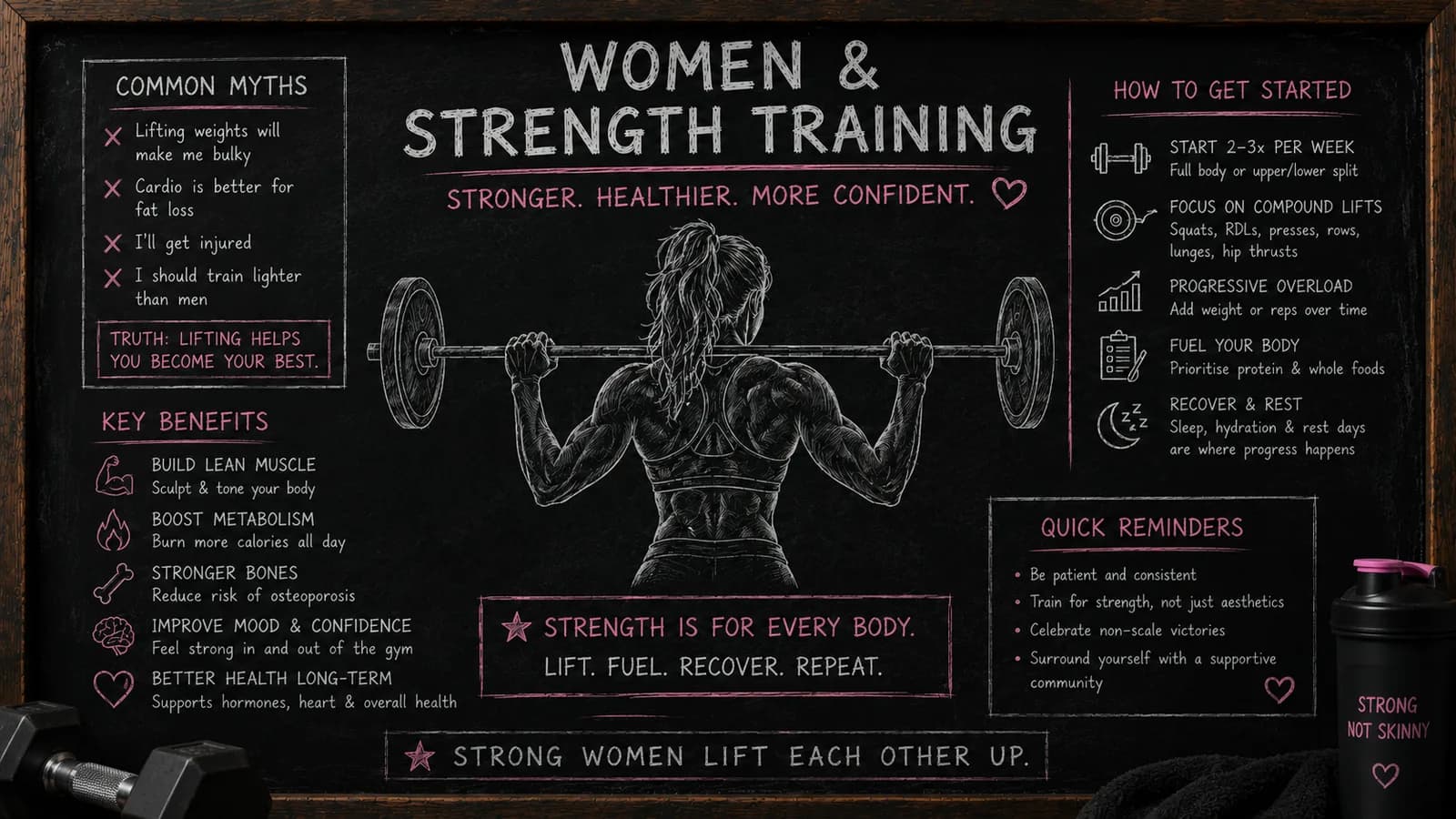
There is a persistent myth in gyms that lifting heavy is something women should approach cautiously. That heavy barbells lead to unwanted bulk. That women should stick to light weights and high reps for a "toned" look. That the squat rack is not really for them.
That is wrong. The research supporting resistance training for women is among the most compelling in sports science. Lifting heavy changes body composition, improves bone density, raises metabolism and produces health outcomes that cardio alone cannot deliver.
This guide covers what the evidence says, what to expect when you start training seriously, and why Inception Gym is built for women who want to train at a level that matches their goals.
The "bulky" myth
The number one reason women cite for avoiding heavy weights is fear of becoming bulky. That fear is based on a misunderstanding of how muscle physiology works in women.
Building significant muscle mass requires high levels of testosterone. Men produce 10 to 20 times more testosterone than women do naturally. That hormonal reality means even if a woman trains with maximum intensity and optimal nutrition, the rate of muscle accumulation is different from a male physique.
What happens when women lift heavy consistently:
- Muscle fibres increase in density and efficiency
- Body fat percentage decreases as metabolic rate rises
- The body takes on a leaner, more defined appearance
- Strength increases substantially without equivalent increases in muscle size
The physique changes most women describe as their goal (athletic, lean, defined) are almost exclusively the result of strength training. Cardio-only training burns calories but does not produce those body composition shifts.
Fitness competitors who develop a more muscular appearance work under very specific conditions: years of training history, targeted nutrition, and in some cases pharmaceutical assistance. That is not the outcome of a woman starting a barbell programme at her local gym.
What strength training does for women
Bone density
This is the most underappreciated benefit and arguably the most important for long-term health. Osteoporosis affects women at significantly higher rates than men, particularly post-menopause. The primary driver of bone density is mechanical loading, which is exactly what resistance training provides.
Research consistently shows that women who engage in regular strength training maintain higher bone density across their lifespan compared to those who do not. Every heavy squat, every loaded deadlift, every pressing movement creates mechanical stress on bones that signals the body to lay down more bone tissue.
This is not a marginal effect. For women in their 30s and 40s especially, the window for building and preserving bone density is meaningful. Starting now has compounding returns across decades.
Metabolic rate
Muscle tissue is metabolically active. It burns calories at rest in a way that fat tissue does not. When you add lean muscle through resistance training, your resting metabolic rate increases.
This has practical implications for body composition management over time. Women who rely solely on cardio for weight management often find that their bodies adapt by becoming more efficient, requiring progressively more exercise to maintain the same caloric deficit. Strength training sidesteps this adaptation by increasing the amount of energy the body burns at baseline.
The combination of resistance training and appropriate nutrition produces body composition results that are more sustainable and more pronounced than cardio-focused approaches.
Hormonal health
Resistance training has documented positive effects on insulin sensitivity, cortisol regulation, and hormonal balance. Women dealing with conditions like PCOS (polycystic ovary syndrome), which affects insulin sensitivity and hormonal regulation, consistently show improvement in markers with regular strength training.
The effect on mood and cognitive function is also significant. Exercise-induced release of endorphins, BDNF (brain-derived neurotrophic factor), and other neurochemicals produces measurable improvements in anxiety, depression, and cognitive performance.
Functional strength and injury resilience
The ability to carry groceries, lift children, move furniture, manage your own household without physical limitation is directly tied to functional strength. Women who train with weights maintain independence and physical capability across decades in a way that sedentary individuals do not.
Strength training also significantly reduces injury risk by building the muscle and connective tissue that support joints. Knee injuries, lower back pain, and shoulder problems are all mitigated by appropriate strength training that addresses the muscular imbalances that cause them.
Where to start
Learn the foundational movements
Heavy compound movements are the core of any effective strength programme. These are:
- Squat variations: Back squat, front squat, goblet squat
- Hip hinge variations: Deadlift, Romanian deadlift, hip thrust
- Horizontal push: Barbell bench press, dumbbell press
- Horizontal pull: Barbell or cable rows
- Vertical push and pull: Overhead press, lat pulldown, pull-up progressions
These movements recruit the largest muscle groups across the body, produce the most significant strength adaptations, and provide the best training return for time invested.
Progressive overload is the mechanism
The principle that drives results in strength training is progressive overload: consistently increasing the demands placed on the body over time. This does not mean going heavier every single session. It means tracking your training and ensuring that over weeks and months, you are lifting more weight, doing more reps, or performing the same work with better technique.
A common mistake for new lifters is repeating the same weights indefinitely. The body adapts quickly. Once an adaptation has occurred, maintaining that stimulus produces maintenance, not improvement. Incrementally increasing load is what drives ongoing progress.
Nutrition
Training stimulus without adequate nutrition produces limited results. For women specifically:
- Protein: 1.6 to 2.2g per kilogram of bodyweight daily to support muscle protein synthesis
- Calories: under-eating relative to training demand is one of the most common reasons women do not see results from strength programmes
- Consistency: broadly consistent 80-90% of the time produces better outcomes than perfect adherence followed by extended periods of poor eating
For personalised nutrition guidance, Inception Nutrition provides PhD-led coaching built around your body composition data and training demands.
Inception Gym
Inception Gym's 800sqm facility at Tower Junction has 92 pieces of equipment (43 plate-loaded), dumbbells to 70kg, two squat racks and a layout that supports the full range of training.
The equipment selection addresses one of the most common limitations in women's strength training: access to quality machines for hip and glute development:
- Dedicated glute equipment including hip thrust stations and cable systems
- Full cable tower setup for pull-through variations and unilateral work
- Specialty bars including trap bars and multi-grip options
- Leg press, hack squat and leg extension/curl stations
The equipment page has the full inventory.
A culture that welcomes serious training
Inception Gym's 5.0 Google rating across 1,078+ reviews reflects the culture inside the gym. Members consistently describe it as professional, welcoming and free from the judgement many women experience in gyms where serious lifting is implicitly coded as something only men do.
The gym is owner-operated and staffed Mon-Thu 9am to 7pm, Fri-Sat 10am to 2pm (closed Sunday and public holidays), with staff available for conversations about programming and technique.
Free body composition scans
All members get complimentary body composition scans, which give you lean mass, fat mass and how these change over time.
Body weight alone is an unreliable proxy for progress. It is common for women to see body weight stay stable or even increase slightly in the early stages of a strength programme while body fat decreases and lean mass increases. Without a body scan, that positive shift can be misread as lack of progress.
Getting started
The most common barrier for women entering a serious strength programme is uncertainty: whether the programme is right, whether technique is correct, whether the environment will be welcoming.
If you want to use the gym before committing to a membership, claim a free 24-hour trial.
Strength training is not an optional extra. The equipment, the culture and the support to do it properly are all at Tower Junction.