Equipment · Free Weights
Specialty Bars Explained: Kabuki, Trap Bar, and Multi-Grip Options
Understand what specialty bars do and how to use them. Kabuki, trap bar, multi-grip and more at Inception Gym Christchurch. Reduce joint stress, improve movement quality.
By Inception Gym · 18 April 2026
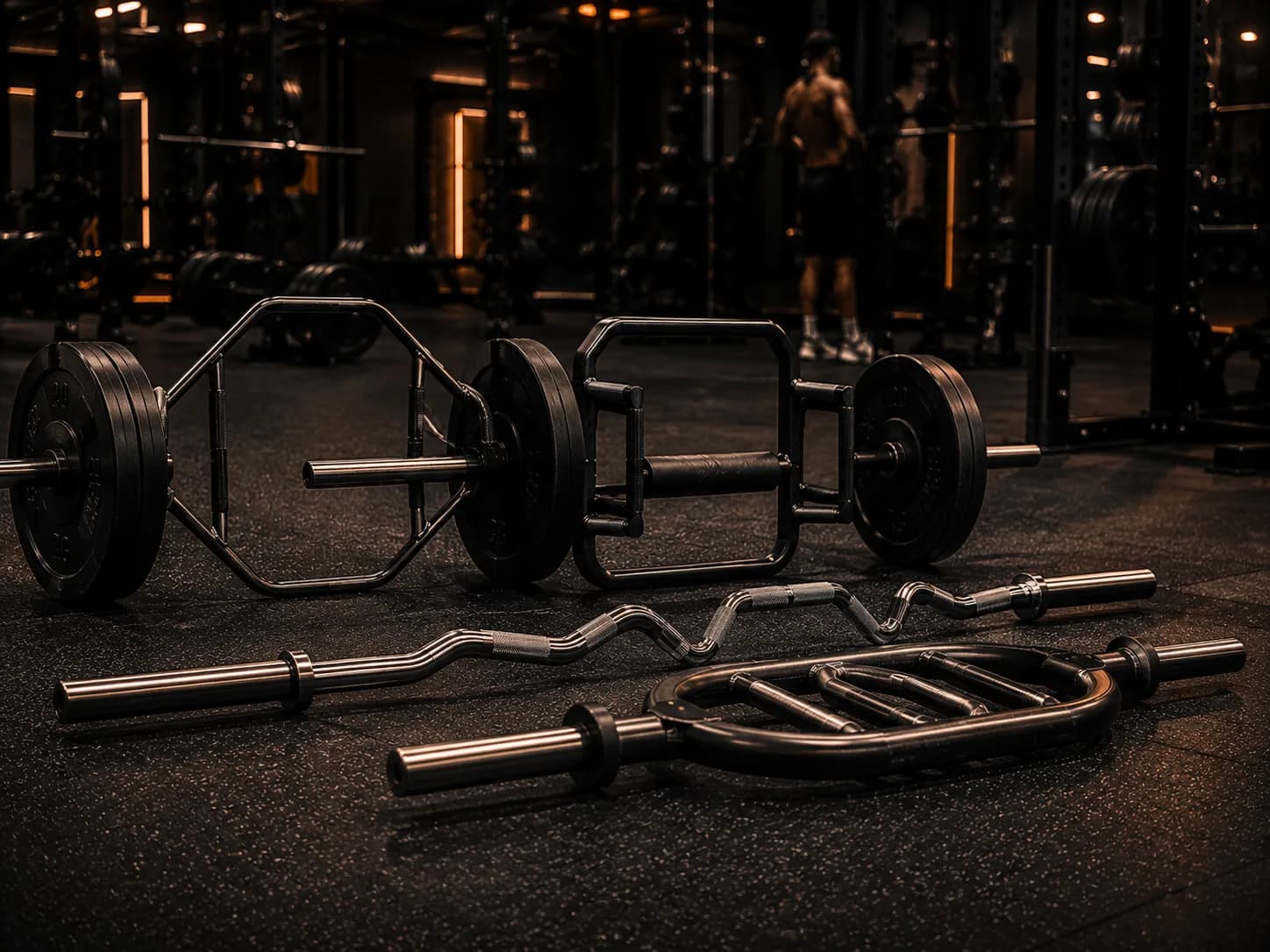
Most gyms have a standard straight barbell. Some gyms have an EZ curl bar and a hex bar. Fewer gyms invest seriously in specialty bars, and almost none in Christchurch have the depth of barbell options available at Inception Gym.
Specialty bars are not gimmicks or novelties. They are engineering solutions to real training problems: how to load movements effectively when shoulder mobility is limited, how to reduce spinal compression during squatting, how to find a pressing angle that does not aggravate an impingement, how to deadlift productively when conventional mechanics cause lower back issues.
This guide covers the specialty bars at Inception Gym, what they do, who benefits from each, and how to incorporate them into a training programme.
Why specialty bars exist
The standard straight Olympic barbell is a general-purpose tool. It works for a wide range of movements and has been the foundation of strength sports for over a century. But general-purpose tools have specific constraints, and for many people those constraints create real problems.
The most common issues with standard bars:
- Wrist and shoulder position during pressing: A fixed-width grip on a straight bar requires a specific degree of shoulder external rotation and wrist extension. For lifters with shoulder impingement, prior injuries, or limited external rotation, this position can be painful or outright unsustainable.
- Bar path constraints during squatting: A straight bar on the back creates a fixed load vector relative to the lifter's centre of mass. Variations in torso length, femur length, and hip anatomy mean that optimal bar path differs significantly between individuals.
- Spinal loading in deadlifting and carries: Conventional bar positioning places the load in front of the body, creating a moment arm that increases spinal loading. Changing the load position relative to the body can dramatically alter the mechanical demands of the movement.
Specialty bars address these constraints by changing grip width, grip orientation, load distribution, or bar path. The result is often a movement that is biomechanically more appropriate for a specific individual or training goal.
The Kabuki Kadillac bar
The Kabuki Kadillac is a multi-purpose bar engineered by the Kabuki Strength team. It is one of the most versatile specialty bars available and one of the more serious investments a gym can make in equipment quality.
What it does
The Kadillac features multiple grip positions: neutral handles, angled handles at different positions, and traditional pronated grip options. This grip versatility allows it to be used effectively for:
- Pressing movements with shoulder-friendly mechanics: The neutral or angled handle positions allow the wrists and forearms to be in a natural rotation rather than the fixed pronated position of a standard bar. For lifters with shoulder impingement or rotator cuff issues, pressing with neutral handles dramatically reduces the compressive and shear forces at the shoulder joint.
- Rows and pulling patterns: The same grip options that make it shoulder-friendly for pressing apply to rows, allowing the elbows to track in a path that suits individual mechanics rather than forcing a fixed position.
- Loaded carries and general loading: The multiple handle configurations make the Kadillac useful for farmers carry variations, overhead work, and unconventional loading patterns.
Who benefits most
- Lifters with shoulder impingement, bicep tendon issues or AC joint irritation who need to maintain pressing volume without aggravating injury
- Anyone with limited shoulder external rotation who finds the standard bar pressing position uncomfortable
- Intermediate and advanced lifters looking to address weak points in pressing patterns through angle variation
The Kabuki Transformer bar
The Transformer Bar addresses squatting mechanics. It is a cambered squat bar with a safety-squat-style harness design, and it changes the mechanical demands of the squat.
What it does
The Transformer Bar sits across the upper back via shoulder pads and allows the hands to hold handles in front of the body. This design produces several distinct mechanical changes compared to a standard back squat:
- Reduced spinal compression: The cambered design shifts the centre of mass of the bar relative to the lifter's spine, reducing the compressive loading that can be problematic for lifters with disc issues or upper back limitations.
- Reduced upper body positioning demands: Because the bar is self-stabilising through the harness, it does not require the same degree of upper back tightness and shoulder mobility that a standard back squat demands. Lifters who struggle to maintain a secure bar position due to limited shoulder mobility can squat productively with the Transformer Bar.
- Variable angle and squat mechanics: The bar allows different torso positions to suit the lifter's anatomy, making it easier to find a squat variation that is mechanically appropriate without forcing a fixed pattern.
Who benefits most
- Lifters with lower back or disc issues where high-compression squatting is contraindicated
- Anyone with shoulder or upper back limitations that make holding a standard back squat position difficult or painful
- Powerlifters and strength athletes using it as an accessory tool to develop quad strength and squat mechanics from different angles
The trap bar (hex bar)
The trap bar, also called a hex bar, places the lifter inside the frame of the bar rather than behind it. That single change in load position has significant mechanical implications.
What it does
When you deadlift with a trap bar, your hands are at your sides and the load is centred on your body rather than in front of it. This changes several important variables:
- Reduced moment arm on the lower back: With a conventional deadlift, the bar must travel in a path that creates a significant moment arm at the lumbar spine. The trap bar's centred load dramatically reduces this. Biomechanics research comparing the two lifts consistently measures lower peak lumbar forces in the trap bar deadlift at the same load.
- More quad involvement: The centred load position allows the lifter to maintain a more upright torso, which increases the contribution of the quadriceps. This makes the trap bar deadlift a useful exercise for athletes who need both quad and posterior chain development.
- Higher handles reduce range of motion demands: Most trap bars have raised handles as an option, which reduces the range of motion required to break the weight from the floor. This makes it accessible for beginners and useful for lifters with hip mobility limitations.
Trap bar exercises beyond deadlifting
The trap bar is more versatile than many lifters realise:
- Loaded carries: holding the bar at your sides for a farmer's walk creates a joint-friendly loading position
- Jump training: the centred load makes the trap bar effective for loaded jump squats, used widely in athletic performance training
- Romanian deadlift variation: the hip hinge pattern translates cleanly to a trap bar RDL
Who benefits most
- Lifters managing lower back sensitivity who want to keep heavy hip hinge training
- Athletes who need quad and posterior chain development at the same time
- Beginners learning the hip hinge pattern, where the trap bar's forgiving mechanics make technique acquisition easier
The multi-grip Olympic bar
A multi-grip bar, sometimes called a Swiss bar or football bar, has a set of parallel handles at various widths along a horizontal frame. Like the Kadillac, it addresses the wrist and shoulder position problem in pressing, via a different design.
What it does
The parallel handles allow pressing with a neutral grip (palms facing each other), which places the shoulder in a significantly more anatomically comfortable position than the pronated grip of a standard bar. This matters for:
- Bench press variations: Neutral grip pressing reduces the degree of shoulder external rotation required and often resolves impingement-related pain in pressing movements
- Overhead pressing: The neutral grip option for overhead work is kinder to the shoulder joint than the standard pronated overhead press position
- Close-grip pressing for tricep development: The narrower handles allow close-grip bench press work with reduced wrist strain
Who benefits most
- Any lifter with shoulder discomfort during standard barbell pressing
- Lifters who want to add pressing variation without aggravating injury
- Anyone with wrist issues where the fixed pronation of a standard bar causes problems
Integrating specialty bars into your training
The most effective approach is not to replace all standard barbell work, but to use specialty bars strategically.
For injury management: if a shoulder issue makes standard bar pressing painful, replace your primary press with a neutral-grip option on the Kadillac or multi-grip bar while maintaining volume. Continue standard bar work where you are pain-free.
For movement quality: if your squat mechanics are limited by mobility or body proportions, use the Transformer Bar as a primary squat movement while working on the mobility required for a standard back squat.
For posterior chain loading with lower back sensitivity: use the trap bar as your primary deadlift variation when managing a lower back issue.
For advanced variation: even without injury, intermediate and advanced lifters benefit from specialty bars as supplementary movements. Different bar angles and load positions develop strength across a broader range of mechanics.
Where to learn more
If you are unsure how to use any of these bars, the team at Inception Gym can walk you through setup and technique during staffed hours at Tower Junction, Addington.
The full range of equipment including specialty bars is on the equipment page. Inception Nutrition works with members on integrated training and nutrition planning.
A free 24-hour trial gives you hands-on access to the full equipment range.