Equipment · Machines
Smith Machine Exercises: 12 Effective Movements for Strength and Stability
Discover 12 effective Smith machine exercises for strength, stability, and muscle growth. Plus when to use the Smith machine versus free weights at Inception Gym.
By Inception Gym · 6 December 2025
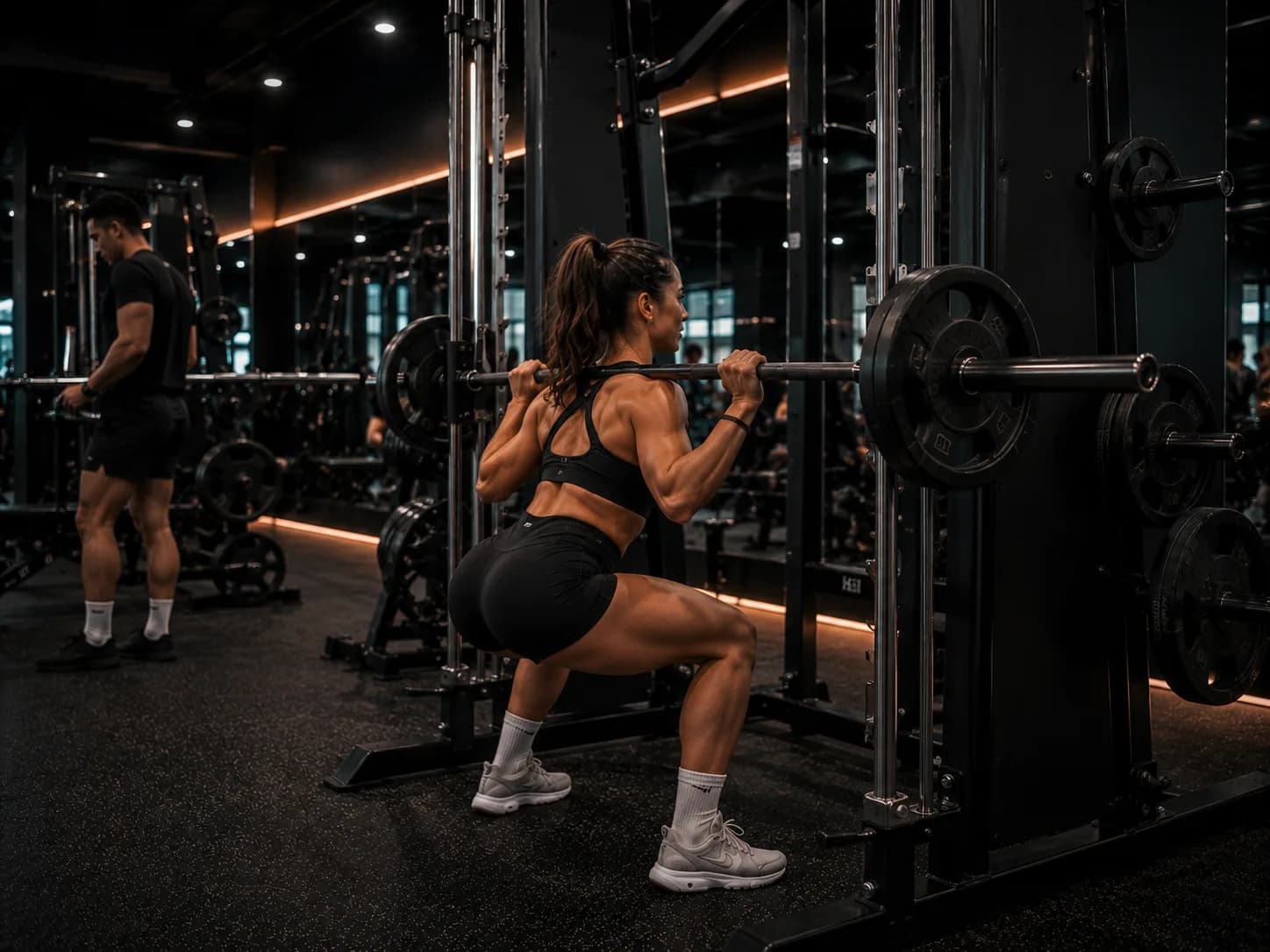
The Smith machine is one of the most consistently misunderstood pieces of equipment in a gym. Purists dismiss it as a crutch for people who cannot lift free weights, and treat it as inferior to the barbell across the board. Neither characterisation is accurate.
The Smith machine is a specialised tool with specific applications where it outperforms free weight alternatives: controlled isolation work, training without a spotter, certain pressing variations for shoulder health, and exercises where a fixed bar path is an advantage rather than a limitation.
This guide covers 12 effective Smith machine exercises, technique cues for each, and when to choose the Smith machine over free weights.
How the Smith machine works
The Smith machine is a barbell fixed to vertical rails that guide the bar through a linear (sometimes slightly angled) path. Safety hooks let you rack the bar at any point in the range of motion. The counterbalanced bar typically weighs 6 to 15kg depending on the machine, less than a standard 20kg Olympic barbell.
The fixed path removes the stabilisation demand of a free weight movement, but it also means the bar cannot deviate to follow natural joint mechanics. That is the trade-off: reduced stabiliser demand in exchange for a controllable, predictable movement path.
12 effective Smith machine exercises
1. Smith machine squat
The Smith machine squat allows you to position your feet slightly in front of your body rather than directly below the bar, which changes the mechanics relative to a free weight squat. This forward foot placement increases the contribution of the quadriceps and reduces lower back involvement.
Technique: Place your feet 15-30cm in front of the bar, about shoulder-width apart. Keep your chest up, descend to at least parallel (thighs parallel to the floor), and drive through your heels to stand. The fixed bar path means you can focus entirely on leg drive rather than bar balance.
Best for: Quad-focused training, lifters managing lower back sensitivity, early learning of squat mechanics.
2. Smith machine Romanian deadlift
The Romanian deadlift on the Smith machine targets the hamstrings and glutes through a hip hinge pattern. The fixed bar path keeps the movement simple and allows significant loading without the free weight coordination demands.
Technique: Stand with feet hip-width apart, bar against your thighs. Hinge at the hips, pushing them back and lowering the bar along your legs. Keep your back flat and feel the stretch through the hamstrings. Drive hips forward to return to standing.
Best for: Hamstring and glute development, lifters new to the Romanian deadlift pattern, training to fatigue safely without a spotter.
3. Smith machine bench press
The Smith machine bench press is one of the most practical applications of the equipment. Training to failure on a barbell bench press without a spotter is a risk most lifters accept reluctantly. The Smith machine allows you to rack the bar safely at any point, making it genuinely safe to push to failure without assistance.
Technique: Position the bench so the bar path aligns with your mid-chest. Use a grip slightly wider than shoulder-width, lower the bar under control to your chest, and press. The fixed path means you need to ensure the natural arc of your press aligns with the bar's linear path.
Best for: Solo training to failure, building pressing volume safely, beginners learning pressing mechanics.
4. Smith machine incline press
Incline pressing targets the upper chest and anterior deltoid. The Smith machine allows the angle to be dialled in precisely and the load pushed hard without a spotter.
Technique: Set the bench to 30-45 degrees. Position so the bar aligns with your upper chest. The same principles as flat bench apply: controlled descent, full range of motion, drive at the top.
Best for: Upper chest development as part of a complete chest programme, solo training.
5. Smith machine shoulder press
The overhead press is a movement where the Smith machine's fixed path becomes more relevant as a consideration. A strictly vertical bar path is not perfectly aligned with the natural arc of an overhead press, so some lifters find the fixed path uncomfortable. Using a bar that has a slight backward angle (as some Smith machines do) or positioning carefully can address this.
Technique: Set up with a shoulder-width grip, bar at the top of your chest. Press to full lockout overhead and lower under control. If wrist or shoulder discomfort occurs, adjust foot and hip position relative to the bar to find a more natural alignment.
Best for: Shoulder development when a heavy dumbbell overhead press is impractical, training to failure without a spotter.
6. Smith machine bent-over row
The Smith machine row allows you to lock into a bent-over position and focus entirely on the pull, without the balance challenge of a barbell row where the floor-based stability is your own.
Technique: Stand with feet hip-width apart, hinge forward to a roughly 45-degree torso angle, grip the bar at shoulder width, and pull to the lower chest, driving elbows back and squeezing the shoulder blades together at the top.
Best for: Back development, high-rep rowing work where fatigue makes free weight balance challenging.
7. Smith machine reverse grip row
By supinating the grip (palms facing up) on a Smith machine row, you shift emphasis from the upper back and rear delts toward the lower lats and biceps. This variation is difficult to load effectively with a standard barbell due to grip and wrist demands.
Technique: Set up as per the bent-over row, but rotate your grip to a reverse (underhand) position. Pull to the upper abdomen rather than the lower chest.
Best for: Lower lat development, grip variety, elbow health (supinated grip reduces elbow stress for some lifters).
8. Smith machine hip thrust
The hip thrust is a primary movement for glute development. The Smith machine provides a stable bar that does not require the coordination of a free barbell, allowing you to focus entirely on glute activation and drive.
Technique: Set up with your upper back against a bench, feet flat on the floor, bar across the hip crease (use a pad for comfort). Drive hips to full extension, squeezing the glutes hard at the top. Lower under control.
Best for: Glute development, anyone who has struggled to stabilise a standard barbell hip thrust.
9. Smith machine split squat (Bulgarian split squat)
The Bulgarian split squat is one of the most effective single-leg strength exercises. The Smith machine version allows you to focus entirely on lower body drive without the additional challenge of balancing a free barbell.
Technique: Place your rear foot on a bench, Smith machine bar across your upper back. Lower into a single-leg squat until your rear knee nearly touches the floor, then drive through your front heel to stand.
Best for: Single-leg strength development, addressing left-right imbalances, when high barbell loads make free weight split squats impractical.
10. Smith machine calf raise
The standing calf raise is one of the most natural Smith machine movements. The fixed bar path is completely aligned with the vertical calf raise pattern.
Technique: Stand with the balls of your feet on a raised surface (a weight plate works well), bar across the upper back. Lower your heels as far as possible, then rise to full plantar flexion, holding the contraction at the top.
Best for: Calf development. The calf raise is one of the movements where the Smith machine is unambiguously the right tool.
11. Smith machine good morning
The good morning is a hip hinge movement that targets the hamstrings, glutes, and lower back through a demanding range of motion. The Smith machine version allows this challenging movement to be performed with controlled loading and the safety of being able to rack at any point.
Technique: Stand with feet hip-width, bar across the upper back. Hinge forward, keeping your back flat, until your torso is roughly parallel to the floor. Drive hips forward to return to standing.
Best for: Posterior chain development, building hip hinge strength, as a supplement to deadlift and squat work.
12. Smith machine shrug
Trap development through the shrug pattern is well served by the Smith machine, which allows you to focus entirely on the vertical shrugging movement without any balance or positioning distraction.
Technique: Stand inside the machine, bar at hip height. Grip the bar, stand upright, and shrug your shoulders directly upward toward your ears. Avoid rolling the shoulders. Lower under control.
Best for: Upper trap development as part of a complete back and neck programme.
When the Smith machine is the right choice
Training without a spotter. Any pressing movement taken to near-failure is safer on the Smith machine than with a free barbell. Being able to rack the bar at any point removes the risk of a failed rep with no way out.
Isolation work where stabilisation is not the goal. If the objective is overloading a specific muscle group, removing the stabilisation demand of the fixed path lets you load the primary mover more aggressively.
Injury or mobility limitations. The Smith machine allows modified movement patterns that maintain training volume around limitations. Adjusting foot position for squatting, or finding a press angle that avoids shoulder impingement, makes it a practical tool for injury management.
Beginners learning movement patterns. The fixed path reduces the complexity of learning a new movement. Squatting or pressing without the simultaneous challenge of balancing a free barbell lets a beginner focus on the primary mechanics first.
When free weights are the better choice
The Smith machine is not the answer for everything. Movements that depend on natural bar path variation (the conventional deadlift, overhead squat), exercises where full-body coordination is the training goal, and movements where the fixed path is biomechanically misaligned with your individual mechanics are all better served by free weights.
A good programme uses both: the Smith machine for volume and isolation work, free weights for compound strength work where stabilisation and natural mechanics matter.
The equipment at Inception Gym
Inception Gym at Tower Junction, Addington runs 92 machines across 71 variants, 43 of them plate-loaded, alongside dumbbells to 70kg and two squat racks, so the Smith machine sits within a full free weight and machine floor. The equipment page details the full inventory.
For programming guidance, the team is available during staffed hours for informal conversations about technique and programming.
For training planning paired with nutrition, Inception Nutrition provides PhD-led coaching.
Explore membership options at Inception Gym or claim a free trial.