Training · Recovery
Rest Days and Recovery: Why What You Do Outside the Gym Matters More
Rest days are where gains are made. Learn the science of recovery, how to spot overtraining, and why your sleep and nutrition matter more than any supplement.
By Inception Gym · 31 January 2026
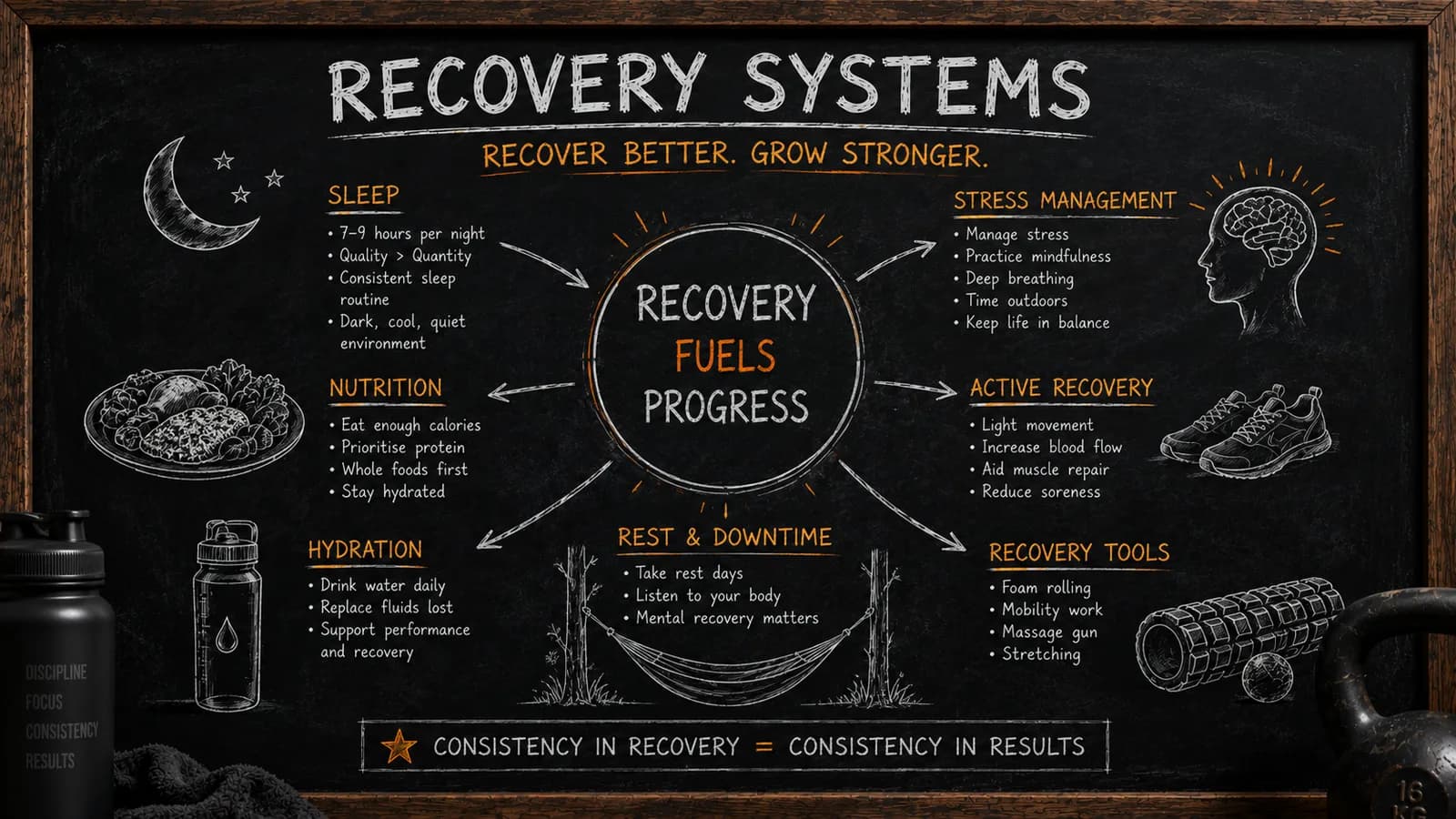
One counterintuitive thing about training is that the gym session itself does not make you stronger or more muscular. The session creates the stimulus. The growth, repair and strengthening happen in the time between sessions. Rest and recovery are not interruptions to your progress. They are where the progress occurs.
The short answer on rest days: most intermediate and advanced trainees need at least 1 to 2 full rest days per week from high-intensity training, and some do better with 3. The longer answer depends on your training volume, sleep, nutrition and life stress, which is what this guide unpacks.
Yet rest and recovery remain among the most underinvested areas of most people's training. Many gym-goers carefully track workouts, optimise exercise selection and research programming while ignoring the variables that determine whether any of that effort translates into results.
This guide covers the physiology of recovery, how much rest you need, the markers of overtraining to recognise early, active recovery strategies, how to use deload weeks, and how body composition tracking gives you objective data on whether your recovery is working.
The physiology of recovery
During a training session, muscle fibres sustain mechanical disruption at the microscopic level. Connections between the actin and myosin filaments that produce contraction are stressed and some are damaged. The metabolic environment within muscle cells shifts toward acidity as exercise continues. Glycogen stores deplete, and the nervous system accumulates fatigue at both peripheral (muscle) and central (brain and spinal cord) levels.
After the session ends, a cascade of repair processes begins. Inflammation activates, not as a problem to suppress, but as a signal that directs repair resources to damaged tissue. Satellite cells (muscle stem cells) get recruited for fibre repair. Protein synthesis rates elevate, drawing on circulating amino acids to rebuild damaged contractile proteins. Glycogen stores get replenished from dietary carbohydrates.
If the repair process is given adequate resources and time, the result is tissue slightly more capable than before the session. That is the adaptation. Repeat this cycle consistently over months and years and the cumulative result is meaningful change in strength, muscle mass and performance capacity.
This process requires:
- Sufficient time between sessions for the repair cycle to complete
- Adequate protein and total calories to support the synthesis processes
- Quality sleep, during which most repair hormones (growth hormone in particular) are secreted
- A nervous system not in chronic stress
When any of these is absent, the adaptation cycle is incomplete. Training hard without adequate recovery does not produce more adaptation. It produces less, and eventually regression.
How many rest days do you need?
No single correct answer. It depends on training volume, intensity, exercise selection, age, nutritional status, sleep quality and life stress outside the gym.
What the evidence supports is the 1 to 2 full rest days per week noted above, with some trainees doing better on 3. Training 7 days per week without any low-intensity or rest periods is manageable for a short period (a training camp or a push phase) but is not sustainable for most people.
A more useful framework than counting rest days is training stress distribution. The question is not "how many days off" but "how much systemic fatigue are you accumulating and are you recovering from it between sessions?"
Light activity on rest days is generally compatible with recovery and often better than complete inactivity.
Muscle group recovery vs systemic recovery
Different muscle groups have different recovery timelines. A bicep curl session produces relatively low systemic fatigue and the biceps typically recover within 48 hours. A heavy squat and deadlift session produces significant systemic fatigue (nervous system, hormonal, cardiovascular) that may take 72 hours or more to recover from.
Training frequency at the muscle group level and at the systemic level are separate variables. You can train biceps every other day without systemic overreaching. You cannot deadlift maximally every other day without consequences.
Upper/lower splits and push/pull/legs splits manage this by ensuring the same muscle groups do not face maximal loading on consecutive days while still allowing meaningful training frequency for hypertrophy.
Signs of overtraining
Overtraining (more accurately overreaching, the early and reversible stage) is more common than many gym-goers recognise. Symptoms are often misinterpreted as lack of motivation, bad days or seasonal illness.
Performance decline
The clearest sign is a sustained decline in performance. If your lifts are not progressing despite consistent training, or if weights that previously felt manageable now feel heavy, accumulated fatigue is likely the cause. Look for decline across multiple sessions, not one bad day.
Sleep disruption
Overtraining is associated with disrupted sleep, particularly difficulty falling asleep or maintaining sleep. The paradox: the person who needs rest most is also experiencing the hormonal environment (elevated cortisol, suppressed testosterone) that makes restful sleep harder to achieve.
Mood changes and irritability
Chronically elevated cortisol has direct effects on mood: irritability, reduced positive affect, and in severe cases symptoms resembling mild depression. If training has been going well by feel but your mood is worse and your temper shorter, overreaching is worth considering.
Persistent soreness and fatigue
Normal DOMS from a hard session resolves within 48 to 72 hours. Soreness that persists beyond that, or is present before a session, suggests incomplete tissue recovery.
Systemic fatigue that does not resolve with a rest day, feeling tired and heavy despite adequate sleep, is a clear signal that recovery demand is exceeding recovery capacity.
Elevated resting heart rate
For those who track resting heart rate, an elevation of 5 to 7 beats per minute above baseline across several consecutive days is associated with overreaching and acute illness. A measurable marker rather than a subjective feeling.
Sleep: the highest-impact recovery tool
No supplement, active recovery modality or nutritional strategy matches sleep for recovery impact. During deep sleep stages, human growth hormone secretion peaks, protein synthesis rates are elevated, and the nervous system undergoes consolidation and repair processes that no waking activity can replicate.
Sleep deprivation, even partial (6 hours instead of 7 to 8), measurably impairs muscle protein synthesis, increases cortisol, reduces testosterone, and impairs cognitive function including the focus that training quality depends on.
Practical sleep optimisation:
Consistent sleep and wake times. Your circadian rhythm regulates sleep quality. Irregular schedules disrupt that rhythm and reduce both total sleep duration and quality.
Cool, dark sleeping environment. Core body temperature drops during the transition to sleep. A room around 18 degrees Celsius supports that transition. Light exposure suppresses melatonin; a dark room keeps the melatonin signal.
Limit blue light in the 60 to 90 minutes before sleep. Screens emit blue light that delays melatonin secretion. One of the highest-impact simple changes for sleep quality.
Watch training timing. Very intense sessions within 2 to 3 hours of bedtime can delay sleep onset due to elevated core temperature and catecholamine levels. If you train at 9pm and struggle to sleep, that may be a factor.
Nutrition for recovery
The nutritional requirements for recovery are not fundamentally different from the requirements for training. Adequate total calories, sufficient protein, appropriate distribution across the day.
What changes on rest days is the caloric requirement, not the strategy. Training days have higher energy expenditure, so total calorie intake is higher. Rest day calories can be slightly lower, though for most people with ambitious physique or performance goals, keeping calories and protein consistent across all days simplifies adherence.
Protein: 1.6 to 2.2 grams per kilogram of bodyweight daily provides the substrate for muscle protein synthesis. Spread across 3 to 5 meals or shakes for more consistent MPS than one or two large servings.
Carbohydrates: glycogen replenishment after training requires dietary carbs. Post-training meals with meaningful carbohydrate alongside protein restore glycogen faster than protein alone.
Anti-inflammatory nutrition: chronic low-grade inflammation impairs recovery. Diets rich in vegetables, fruit, omega-3 fatty acids (fatty fish, flaxseed, walnuts) and minimally processed whole foods are associated with better recovery markers.
For a nutrition plan built around your training, body composition and recovery demands, Inception Nutrition provides PhD-led coaching built on your scan data and goals.
Active recovery
Complete rest is generally less effective than gentle movement. Light activity on rest days:
- Increases blood flow to muscle tissue, delivering oxygen and nutrients and removing metabolic byproducts
- Maintains joint mobility and reduces stiffness
- Supports the parasympathetic nervous system state
- Helps regulate mood and sleep quality
Light walking is the most accessible active recovery tool. A 20 to 45 minute walk at easy pace produces meaningful circulation benefits.
Swimming and cycling at easy intensity serve similar purposes.
Mobility and flexibility work including static stretching, yoga and foam rolling are appropriate on rest days and contribute to joint health without interfering with recovery.
Lower-intensity technical practice such as a very light session focused on movement patterns rather than loading can serve as active recovery while reinforcing technique.
Deload weeks
A deload is a planned reduction in training volume, intensity or both, typically one week. The purpose is to let accumulated fatigue dissipate while maintaining movement patterns.
Deloads are most useful after 4 to 8 weeks of progressive training. When accumulated fatigue masks fitness improvements, a deload lets the fatigue clear and the underlying adaptations express themselves.
A simple deload reduces training volume by 40 to 50% while keeping the same exercises. If you normally do 4 sets per exercise, deload to 2. Keep intensity (weight relative to your max) moderate rather than very heavy or very light.
After the deload week, return to training with measurably better performance and lower perceived effort at previous weights. That rebound is the clearest signal deloading was the right call.
Tracking recovery with body composition data
Subjective feeling is an unreliable proxy for what is happening in the body. You can feel good while accumulating overtraining. You can feel tired and sore during a period of significant adaptation.
Objective data resolves this. The complimentary body composition scans available to all Inception Gym members track lean mass and fat mass separately, giving you measurable evidence of whether your training and recovery approach is producing the intended outcome.
If lean mass is increasing over 6 to 8 week intervals between scans, your recovery is likely adequate. If lean mass is flat or declining despite consistent training, something in your recovery stack needs adjustment. The data tells you the answer.
Tracking at regular intervals also removes the discouragement of relying on subjective daily variance. A bad training week does not erase months of physiological progress. The scan data shows the trend the mirror and the scale cannot.
Recovery is not passive
Recovery is not something that happens to you. It is something you actively create through the choices you make outside the gym. Sleep, nutrition, stress management, movement quality and structured programming are all levers you control.
The best training programme in the world, executed in the best facility, produces suboptimal results if the recovery environment is not built to support it. Training and recovery are a system. Both need investment.
---
For personalised nutrition support, talk to [Inception Nutrition](https://www.inceptionnutrition.co.nz). To track your body composition with free scans, [explore Inception Gym memberships](/memberships/options).