Equipment · Arms
Preacher Curl Machines: Why They Build Better Biceps Than Free Weights Alone
Why the preacher curl machine isolates the biceps better than standing curls: plate-loaded vs pin-loaded, setup and technique cues, rep ranges, and the options at Inception Gym Christchurch.
By Inception Gym · 2 May 2026
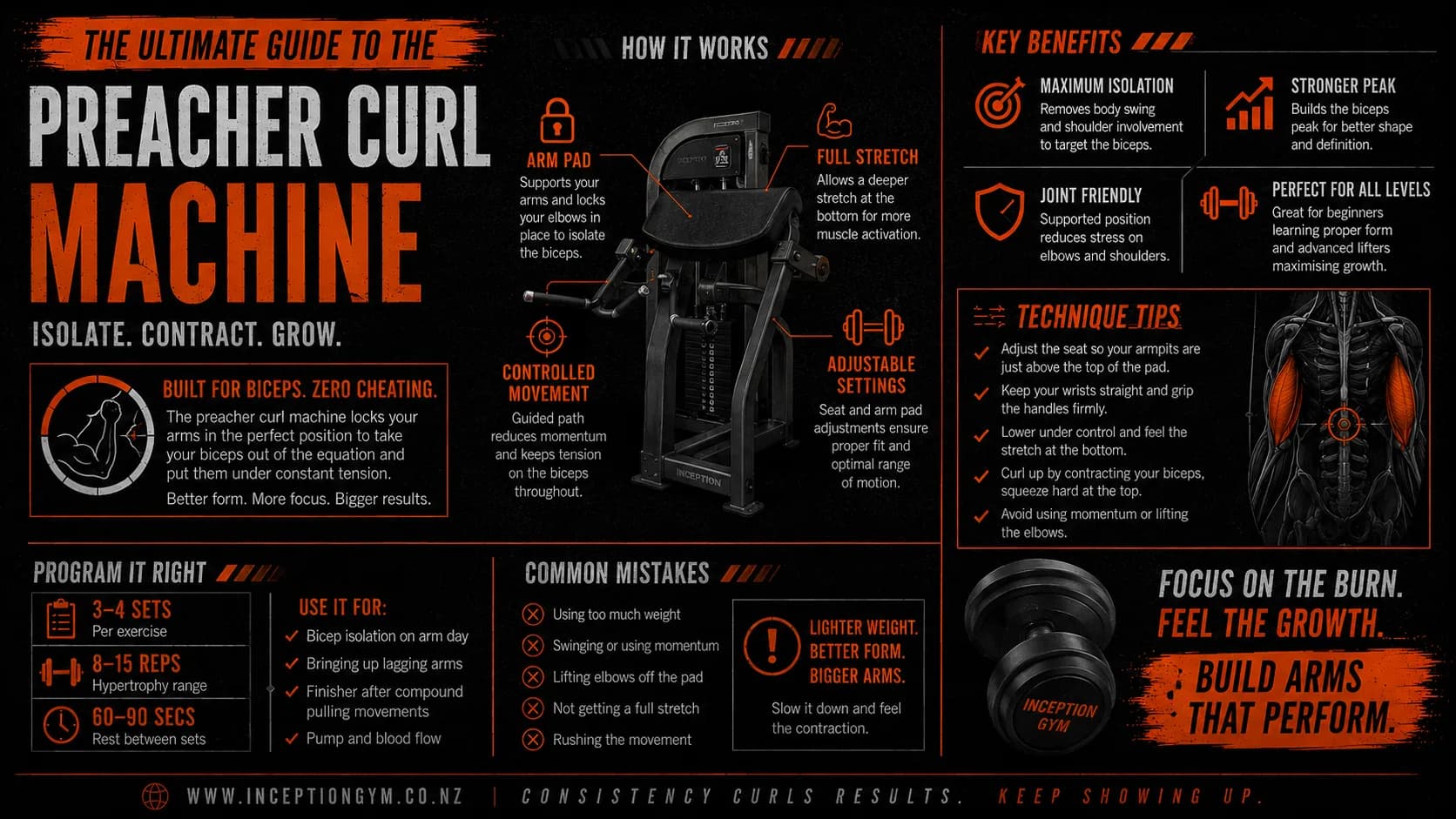
If you have ever finished a set of standing barbell curls and wondered why your biceps do not feel as pumped as they should, you have run into what most lifters eventually discover: momentum and shoulder involvement rob your biceps of the work they deserve. The preacher curl machine solves this problem in a way that willpower alone cannot replicate with free weights.
This guide covers why the preacher position is mechanically superior for bicep isolation, the differences between plate-loaded and pin-loaded preacher curl machines, the technique cues that separate effective reps from wasted ones, and how to programme preacher curls for real arm growth.
Why the preacher position changes things
The problem with standing bicep curls is that the shoulder joint is free to move. As fatigue builds, your elbows drift forward, your shoulders shrug and your back swings. Each compensation shifts load away from the biceps and spreads it across other structures. You finish the set feeling like you worked hard, but the biceps were only under meaningful tension for a fraction of the reps.
The preacher bench fixes the upper arm against an angled pad, typically 45 to 60 degrees. That removes elbow drift and shoulder involvement. The bicep is now the only structure that can move the forearm, so every kilogram on the bar or stack runs through the muscle you are trying to develop.
There is also a mechanical advantage specific to the stretched position. The bicep is a two-joint muscle: it flexes the elbow and assists with shoulder flexion. When the upper arm is braced on a preacher pad angled forward, the bicep starts each rep in a lengthened state. Research on hypertrophy shows training through a full range with emphasis on the stretched position produces better growth than training in a shortened range. The preacher curl delivers that.
Long head vs short head
The biceps brachii has two heads. The long head runs along the outer portion of the upper arm and contributes to the peak. The short head runs along the inner portion and contributes to width and thickness.
Because the preacher position places the arm slightly in front of the body, it preferentially loads the short head. That is a feature, not a limitation. Most people who train arms already do plenty of standing curls, hammer curls and incline curls that bias the long head. The preacher curl rounds out arm development by driving volume into the short head, which is often the lagging factor in overall bicep size.
Plate-loaded vs pin-loaded preacher curl machines
At Inception Gym members have access to both plate-loaded and pin-loaded preacher curl options, part of a floor that runs 92 machines with 43 of them plate-loaded.
Plate-loaded preacher curl machines
Plate-loaded machines use weight plates rather than a fixed stack. The main benefit is loading range: you can go very light for high-rep hypertrophy work or load it heavily for lower-rep strength sets. There is also a subtle difference in the resistance curve. Because plate-loaded machines typically use a direct lever arm, resistance is hardest at the mid-range of the curl, where the forearm is roughly parallel to the floor. That mirrors the sticking point most people experience.
For lifters who want to track progressive overload precisely, plate-loaded machines allow small jumps. Adding a 1.25kg or 2.5kg plate to each side is a much smaller increment than moving to the next pin on a stack.
Pin-loaded preacher curl machines
Pin-loaded machines use a weight stack with a selector pin, which makes adjusting load between sets quick. That is useful in time-limited sessions or for high-volume training with shorter rest.
Many pin-loaded preacher curl machines also use a cam or pulley system that adjusts the resistance curve to better match the strength curve of the bicep. Rather than resistance peaking at mid-range, a well-designed cam keeps tension more consistent through the movement. Some lifters find that produces a better pump.
Technique
The preacher curl is only as effective as the technique you use. Sloppy form still gets partial bicep activation; it just wastes the mechanical advantage the machine provides.
Setup
Adjust the seat height so that when your upper arms rest on the pad, your armpits are close to the top edge of the pad without any gap. Too high and your shoulder will internally rotate and you will feel discomfort rather than a stretch. Too low and your elbow will lose contact at the bottom of the movement.
Grip the handles or bar at about shoulder width with a supinated grip (palms facing up). A neutral or hammer grip shifts emphasis toward the brachialis and brachioradialis rather than the biceps brachii, which is a different exercise.
The rep
Start from the fully extended position. Do not lock out hard at the bottom; allow a controlled stretch without hyperextending the elbow. Drive the forearms upward in a smooth arc, focusing on the biceps doing the pulling rather than your hands pulling the weight. At the top, squeeze briefly and resist the urge to let the weight crash back down.
Lower under control. The eccentric phase is where a significant portion of muscle damage and growth stimulus comes from. 2 to 3 seconds on the way down is a useful target.
Common errors
Cutting the range of motion short. Many lifters stop the descent before full extension because the stretched position feels uncomfortable. That is precisely where the growth stimulus is strongest. Work into the stretch gradually if your bicep tendons are sensitive, but do not permanently avoid the bottom of the movement.
Gripping too hard. Excessive grip tension activates the forearm flexors and can reduce the neural signal reaching the bicep. A firm but not white-knuckle grip keeps the focus on the target muscle.
Using momentum at the top. Some lifters generate a slight shoulder shrug to get a stalled rep moving. That defeats the isolation purpose of the preacher curl. If you cannot complete the rep strictly, the weight is too heavy.
Programming preacher curls
Building bigger biceps takes consistent progressive overload over months, not weeks. The preacher curl is best used as a complement to compound pulling movements and other curl variations, not a replacement.
Volume
For most intermediate lifters, 10 to 16 sets of direct bicep work per week is a productive range. The preacher curl might account for 4 to 8 of those sets, with the rest from standing curls, incline curls, cable curls, and compound rows and pull-ups.
Rep ranges
Biceps respond to a variety of rep ranges. A typical weekly structure:
- Heavy work: 3 sets of 6 to 8 reps with the plate-loaded machine, focusing on full range and a controlled eccentric
- Moderate work: 3 sets of 10 to 12 reps with the pin-loaded machine, slightly shorter rest periods
- High-rep pump work: 2 to 3 sets of 15 to 20 reps, focusing on the stretch and squeeze
Rest periods
Because the preacher curl is an isolation exercise with relatively low systemic fatigue, 60 to 90 seconds of rest is appropriate for most sets. For heavy sets of 6 to 8 reps, extending to 2 minutes allows fuller recovery.
Progressive overload
Track your weights and reps. When you can complete the top end of your target rep range across all sets with good technique, add the smallest available increment. On a plate-loaded machine that might be 2.5kg total (1.25kg per side). On a pin-loaded machine, one step up the stack.
That sounds slow, but a 2.5kg increase every two to three weeks compounds over a training year.
Beyond the machine
The preacher curl is one tool. Arm development is a whole-body project. Compound pulling movements like rows and pull-ups provide significant bicep stimulus and let you move more total weight than any isolation exercise. Make sure your programme includes enough pulling volume alongside direct arm work.
Nutrition matters as much. Muscles grow during recovery, not during the training session. Adequate protein, roughly 1.6 to 2.2 grams per kilogram of bodyweight per day, provides the raw materials for muscle protein synthesis. If hitting your protein targets is hard, a quality protein supplement can bridge the gap. Inception Labs Collagen Whey Protein, available at the on-site Supplement Solutions store with member pricing, provides whey isolate for muscle recovery and bovine collagen for joint health.
For a personalised approach to nutrition, Inception Nutrition provides PhD-led coaching built on your body composition data and goals.
The verdict
The preacher curl machine is not a substitute for compound pulling, but it is the most effective tool available for isolating the biceps brachii, particularly the short head. The fixed upper arm position removes compensatory movement patterns, the stretched starting position maximises the hypertrophic stimulus, and the loading options between plate-loaded and pin-loaded machines let you match the tool to the training goal.
To see where your arms actually are now and track how they respond, the complimentary body composition scans available to all Inception members give you objective data.
---
Ready to get started? [Explore our membership options](/memberships/options) or [try the gym free for 24 hours](/memberships/free-trial).