Equipment · Machines
The Complete Guide to Plate-Loaded Machines: Why They Build Muscle Faster
Plate-loaded machines offer biomechanical advantages that pin-loaded machines can't match. Learn why and how to use them for faster muscle growth.
By Inception Gym · 27 December 2025
What are plate-loaded machines?
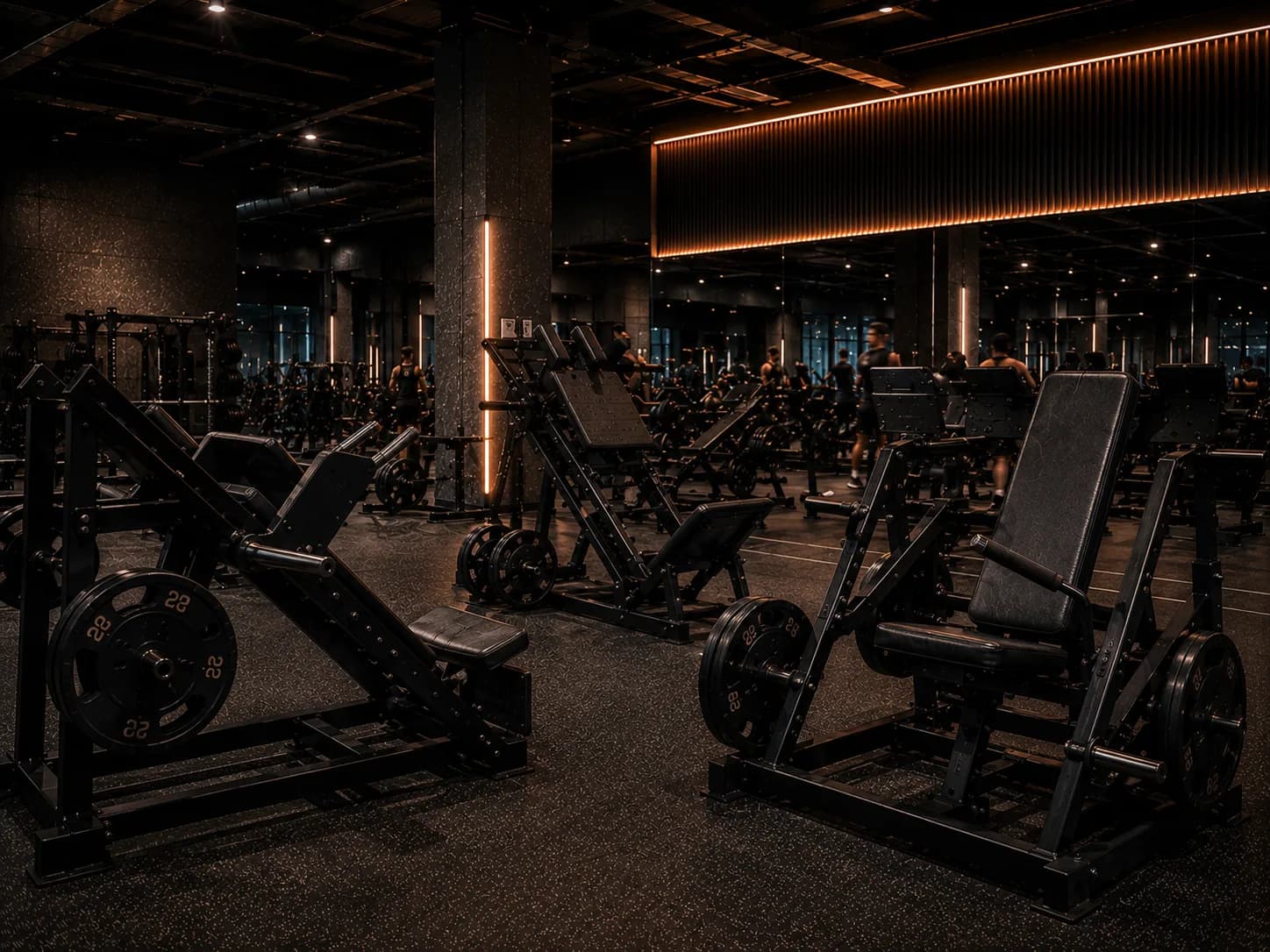
Plate-loaded machines are resistance machines you load yourself with standard Olympic plates, stacked onto a sleeve or horn rather than selected with a pin. The machine provides the biomechanical path; the resistance is entirely variable and loaded by you.
Walk into most commercial gyms and you will find rows of pin-loaded machines instead: the kind where you set your weight by inserting a pin into a numbered stack. They are convenient, fast to adjust and beginner-friendly. But they are only one approach to resistance training, and not the most effective one.
The distinction sounds simple, but the implications for training outcomes are significant.
At Inception Gym Christchurch we invested heavily in plate-loaded equipment because the evidence supports it as a superior tool for building muscle and strength. Our 92-piece equipment selection includes one of the deepest plate-loaded inventories you will find in any gym in Christchurch: 43 plate-loaded machines.
Biomechanical advantages
Higher mechanical tension at the right point
Muscle growth is primarily driven by mechanical tension: the load placed on a muscle, particularly at long muscle lengths. Research over the past decade has increasingly highlighted that exercises which load a muscle when it is stretched, at the bottom of a movement range, produce more hypertrophy than those that only load at shorter lengths.
Plate-loaded machines are typically designed with this in mind. Many use cam systems or lever geometries that increase resistance where the muscle is under the most stretch. Compare that to a basic cable or pin-loaded machine where the resistance curve is often flat or, worse, heaviest at the shortened position.
When you are on a plate-loaded chest press and feel the resistance deepen as you lower the weight, that is not incidental. It is mechanical design working for you.
Greater overload potential
Weight stacks on pin-loaded machines typically top out at 100 to 150kg. For intermediate and advanced members, that ceiling gets reached relatively quickly on exercises like leg press, hack squat or seated rows.
Plate-loaded machines have no practical ceiling. If you want to load 200kg onto a leg press or 180kg onto a chest press, you can. That matters for progressive overload, the principle underneath all long-term strength and muscle development.
Progress requires adding load over time. Machines that cap your maximum load cap your progress.
More natural movement paths
The best plate-loaded machines are engineered to mirror the natural movement patterns of free weight exercises. A plate-loaded incline press, for instance, can offer the pressing mechanics of a barbell movement with the added stability of a guided path.
That means you can train to a higher degree of muscular effort, closer to momentary failure, without the stability demands and injury risk of free weight equivalents. For hypertrophy training, where training close to failure is essential, that is a real advantage.
Plate-loaded vs pin-loaded: when to use each
This is not an argument that plate-loaded machines are universally better. Both have roles in a well-designed programme.
Pin-loaded machines excel when:
- You need rapid weight adjustments between sets or for drop sets
- You are training high volume with short rest and quick transitions
- You are working with beginners who need simple, quick setup
- You are doing isolation exercises where the load range does not approach the stack maximum
Plate-loaded machines excel when:
- You are targeting hypertrophy with heavier loads and progressive overload
- You want control over resistance and loading increments (you can add a 1.25kg micro-plate, impossible on most pin stacks)
- You want exercises that mirror free weight mechanics with guided stability
- You are an intermediate or advanced lifter who hits the ceiling of standard weight stacks
A good programme uses both. The problem most gyms in Christchurch have is plenty of pin-loaded machines and very few plate-loaded options. If your gym does not have a plate-loaded press, a plate-loaded row and dedicated plate-loaded leg machines, you are missing significant training tools.
The Inception Gym plate-loaded selection
Forty-three of the 92 machines on our floor load with plates, spanning every major muscle group. The line is built around Hammer Strength Iso-Lateral machines plus specialist pieces like the pendulum squat:
- Chest and pressing: Iso-Lateral chest press and incline chest press
- Back and pulling: Iso-Lateral lat pulldown and row
- Legs: Iso-Lateral leg press and pendulum squat
- Shoulders: Iso-Lateral shoulder press
That is a sample, not the full list. That depth lets you build a programme around plate-loaded movements if that suits your goals. Or use plate-loaded for your primary compound movements and supplement with pin-loaded and cable stations for isolation work.
Programming plate-loaded machines
Loading increments
One underrated advantage of plate-loaded machines is micro-plates. Standard weight increments on a pin stack might be 5kg per jump. On a plate-loaded machine you can add a 1.25kg plate to each side for a total increment of 2.5kg.
For heavier exercises, smaller increments allow more consistent progressive overload without forcing you to jump to a weight you cannot handle properly.
Working close to failure
Training within approximately three reps of failure is the primary driver of hypertrophy, regardless of rep range. Plate-loaded machines let you safely train close to failure on heavy compound movements because:
- The guided path removes the need to stabilise the weight if form starts to break
- There is no risk of dropping a barbell if you reach failure
- Spotting is easier or unnecessary on most plate-loaded machines
Use it. If you are doing sets of 8 to 12 on a plate-loaded incline press, you should finish those sets with 1 to 3 reps left in the tank, not 5 or 6.
Pairing plate-loaded with free weights
An effective approach for upper body training is to start with a barbell or dumbbell movement, then transition to a plate-loaded machine for your second and third exercises.
Example chest session:
- Flat barbell bench press: 4 sets of 5 to 8 reps (primary strength work)
- Plate-loaded incline press: 3 sets of 8 to 12 reps (hypertrophy focus)
- Plate-loaded flat press: 3 sets of 10 to 15 reps (volume, pump)
That combines the neurological and strength benefits of free weight training with the load and muscle-length advantages of plate-loaded equipment.
The equipment investment question
Why do some gyms lack good plate-loaded equipment? Cost, mostly. Quality plate-loaded machines from manufacturers like Hammer Strength, Life Fitness Signature Series or Atlantis are more expensive than pin-loaded equivalents. A quality plate-loaded hack squat costs considerably more than a standard leg press with a weight stack.
Maintenance is the other factor. Plate-loaded machines need members to load and unload plates correctly, which means gyms need adequate plate inventory and members who re-rack.
At Inception Gym we treat that investment as non-negotiable. Every piece of plate-loaded equipment on our floor was selected because it supports a specific movement pattern that cannot be replicated adequately with pin-loaded alternatives.
Nutrition and recovery
Equipment is only part of the equation. The training stimulus from heavy plate-loaded work needs protein, energy and recovery to translate into actual muscle growth.
Members at Inception Gym get access to the on-site Supplement Solutions store, stocking the full Inception Labs range including Creapure-sourced creatine monohydrate and Collagen Whey Protein at member pricing year-round.
For a structured approach to nutrition alongside training, Inception Nutrition provides PhD-led coaching that integrates your body composition data (from the complimentary scans available to all Inception members) with a personalised nutrition protocol.
Getting started at Inception Gym
If you are new to plate-loaded machines, the variety can look intimidating. In practice the movements are intuitive: you are performing the same patterns (press, pull, squat, hinge) you already know, on equipment with a guided path and plate-loaded resistance.
Our team is on the floor during staffed hours. If you want to use the equipment before committing to a membership, our free trial gives you 24 hours of full gym access.
For those ready to build a programme around our plate-loaded selection, the full inventory is on our equipment page.
The bottom line
Plate-loaded machines are not a niche preference for powerlifters and bodybuilders. They are the most effective category of resistance machines for building strength and muscle over the long term.
The advantages: greater overload potential, better resistance curves, natural movement paths, and micro-loading for consistent progressive overload. Over a year of training those differences compound.
The caveat is that you need access to good plate-loaded equipment. That means a gym that has invested in it, maintains it properly, and carries enough variety to cover all major muscle groups.