Equipment · Legs
The Pendulum Squat: Why This Machine Is a Game Changer for Leg Training
The pendulum squat delivers deep-range quad training with minimal spinal stress. What it is, how it differs from the leg press and hack squat, and how to programme it at Inception Gym Christchurch.
By Inception Gym · 21 March 2026
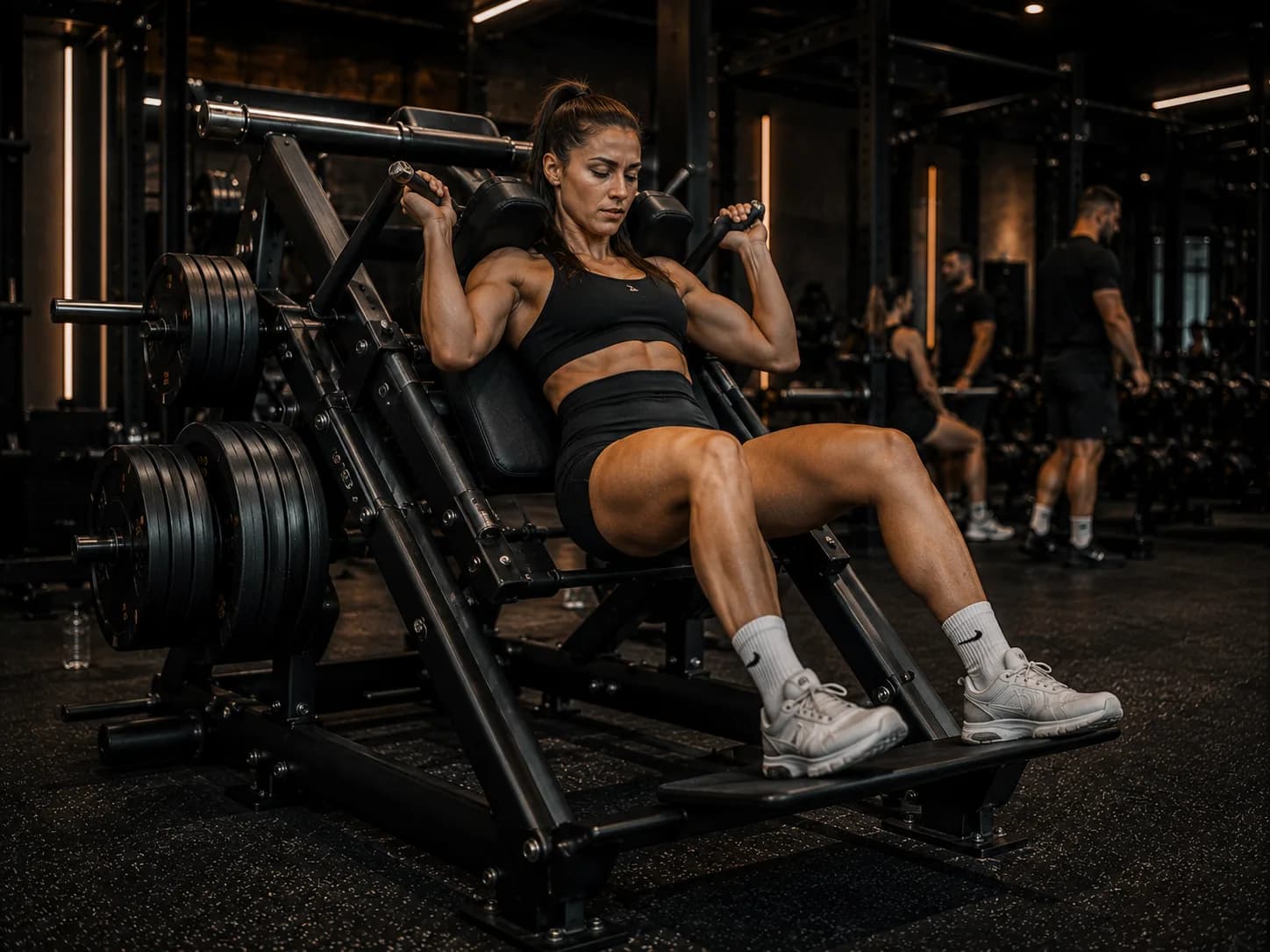
Most commercial gyms have a leg press. A handful have a hack squat. Very few have a pendulum squat, and that absence matters more than people realise when they are trying to build serious quad development.
The pendulum squat is not a variation on the leg press or hack squat. The biomechanics are different and the training effect is difficult to replicate on other equipment. This guide covers what the pendulum squat is, why it works, who benefits most, and how to programme it.
Inception Gym has the pendulum squat, one of the few facilities in Christchurch to stock it.
What is a pendulum squat?
The pendulum squat is a plate-loaded squat machine where the resistance arm moves in a pendulum arc rather than a linear track. The shoulder pads and foot platform are connected to a pivot point, and as you squat, the weight travels in a circular path around that pivot.
The arc creates a loading pattern that more closely resembles a free squat than a leg press or hack squat, while still providing the stability of a machine.
The foot platform is angled, with the heels elevated relative to the toes. The built-in heel elevation promotes a more upright torso position during the squat and allows greater knee travel over the toes, without the ankle mobility limitations that restrict many people's depth in a free squat.
Why the biomechanics differ
A short comparison with the two most similar machines.
Leg press comparison
The leg press has your back supported at an angle and your legs pressing weight away from your body along a fixed track. The range of motion is fixed, and the resistance curve does not match natural squat mechanics. The leg press places almost no demand on trunk stability and loads the quads in a knee-dominant pressing pattern without significant hip movement.
Hack squat comparison
The hack squat puts your back against a pad and has you squat along a fixed linear track. It is more squat-like than the leg press, but the fixed track means your body has to conform to the machine's path rather than moving through a natural arc. That can create awkward joint angles for some users, particularly at the transition between descent and ascent.
What the pendulum does differently
Because the pendulum moves through an arc, the machine accommodates the natural path of your hips and knees rather than constraining them to a fixed line. The shoulder pads provide support without dictating exact joint positions. The movement feels more like a squat and less like a mechanical press.
The pendulum arc also produces a different resistance curve. At the bottom of the movement, as your knees are most bent, the resistance hits a point in the arc that loads the quads intensely. That increased loading at peak knee flexion is one of the reasons lifters find the pendulum squat effective for quad development.
Quad targeting
The quadriceps consist of four muscles: rectus femoris, vastus lateralis, vastus medialis and vastus intermedius. Effective quad training needs knee flexion under load through a significant range of motion.
The pendulum squat provides:
Greater depth: the heel-elevated platform and forgiving arc allow most users to achieve greater squat depth than they can in a barbell squat. Greater depth means greater range of motion through the quad, which research consistently associates with superior hypertrophy.
Reduced posterior chain involvement: in a conventional barbell squat the glutes and hamstrings are heavily recruited, particularly at the bottom. The pendulum's mechanics and the supported position reduce posterior chain involvement, keeping load on the quads.
Consistent tension across the range: the pendulum arc maintains meaningful tension on the quads through the full range, including the top of the movement where many squat variations allow a brief period of reduced tension.
Spinal load
Barbell squatting places the load on the spine, through the barbell resting on the upper back and compressing the vertebral column. With good technique and progressive load management that is manageable for most people, but it places real demands on the lower back and core.
The pendulum squat transfers the load to the shoulders via pads, not the spine. The torso is largely free of axial loading. That makes the pendulum squat far less demanding on the lower back than barbell squatting.
Who benefits most:
- Athletes with previous lower back injuries or disc issues
- Taller lifters who find barbell squat mechanics geometrically challenging
- Older athletes maintaining quad volume without the wear of heavy barbell squatting
- Anyone managing cumulative spinal stress
- Competitive athletes in other sports who cannot afford lower back strain
This does not mean the pendulum squat replaces barbell squatting. For lifters who squat with good mechanics and no back issues, the barbell squat is still a fundamental movement. But the pendulum squat fills a role the barbell cannot: high-quality, high-intensity quad training with dramatically reduced spinal demand.
Technique
Setup
Adjust the shoulder pads to sit on your upper traps, like a high-bar barbell squat position. Feet roughly hip to shoulder width apart on the platform. Experiment with toe angle. Many people find a slight toe-out position (20 to 30 degrees) allows more comfortable depth and better quad engagement.
The descent
Unlock the machine and lower yourself under control. Keep your weight distributed across the whole foot rather than shifting to toes or heels. Maintain an upright torso. The elevated heel helps. Lower to full depth, or the deepest range where you can maintain a neutral spine and comfortable joint positions.
Target depth: the greater the depth, the greater the range of motion through the quad. If your mobility and joint health allow, aim for thighs approaching or reaching parallel with the floor. The machine's arc accommodates this far more comfortably than a barbell squat.
The ascent
Drive through the full foot and push the weight back up through the arc. Keep the knees tracking over the toes, not caving inward. At the top, do not lock out completely between reps if you are aiming for continuous tension.
Breathing and bracing
Inhale and brace your core at the top before descending. Hold the brace through the descent and into the initial phase of the ascent. Exhale as you approach the top of the rep. The bracing pattern is less critical than in a barbell squat but still helps with stability.
Programming
The pendulum squat works as either a primary or secondary quad movement.
As a primary quad movement
Treat it with the same respect you would give a barbell squat for progressive overload. Work in the 6 to 12 rep range with genuinely challenging weight. Progress by adding weight when you can complete the top of your rep range with good form.
Example primary slot:
- Pendulum squat: 4 sets of 8 to 10
Follow with leg curl for hamstring balance and a single-leg or isolation exercise for additional volume.
As a secondary movement
Pair the pendulum squat with a barbell movement in the same session. The barbell squat provides the full-body, neurally demanding stimulus. The pendulum squat provides isolated quad volume without additional spinal stress.
Example pairing:
- Barbell squat: 4 sets of 5 to 6 (strength focus)
- Pendulum squat: 3 sets of 10 to 15 (hypertrophy, higher rep)
Higher rep work on the pendulum squat after heavy barbell work is effective because the mechanical safety of the machine allows sustained effort even when fatigue is affecting stability and focus.
Volume
The quads are a large muscle group with significant capacity for volume. 15 to 20 working sets per week across two leg sessions is a reasonable target. The pendulum squat can account for 6 to 10 of those sets depending on what other quad-focused exercises are in the programme.
Equipment availability
The broader equipment selection at Inception Gym covers multiple units of high-demand equipment, a full range of both pin-loaded and plate-loaded machines, and enough variety to run a sophisticated programme without compromise. 92 pieces of equipment across 800sqm at Tower Junction means the equipment you need is available when you need it.
For a personalised leg training programme that incorporates the pendulum squat alongside the full range, Inception Nutrition provides PhD-led coaching that builds a protocol around your training.
The bottom line
The pendulum squat fills a specific role: high-quality, deep-range quad training with minimal spinal stress. For athletes managing back issues, older lifters prioritising longevity, and anyone adding significant quad volume without the injury risk of heavy barbell squatting, it is one of the most useful machines available.
---
Inception Gym is located at Tower Junction, 65 Blenheim Road, Addington, Christchurch. 24/7 access, 92 pieces of equipment including the pendulum squat. [Join now](/memberships/options) or [try a free 24-hour pass](/memberships/free-trial).