Equipment · Back
Lat Pulldown Variations: How to Target Every Part of Your Back
Master lat pulldown variations to build a wider, thicker back. Technique guide covering grip, angle, and machine options available at Inception Gym Christchurch.
By Inception Gym · 13 June 2026
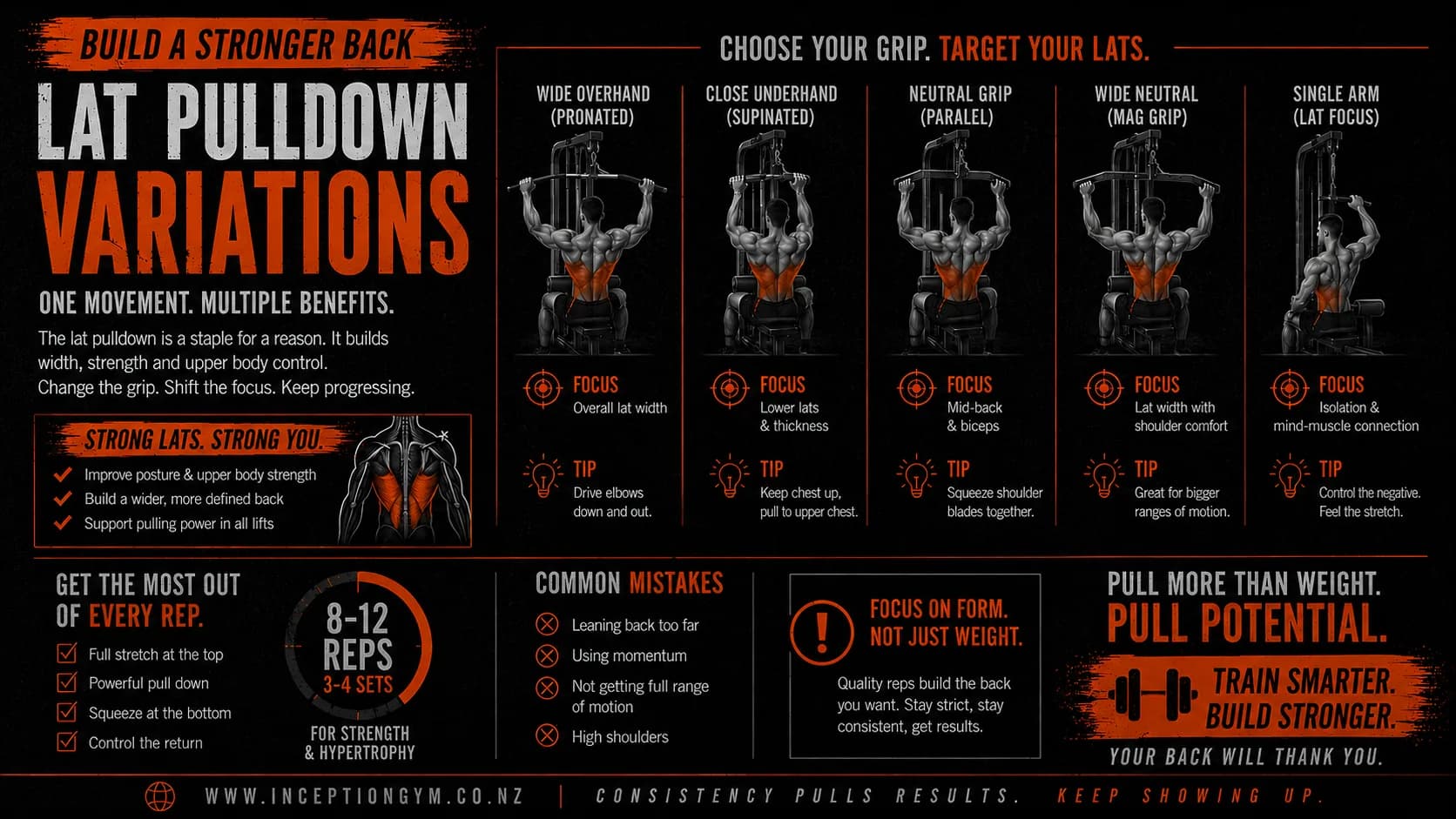
The lat pulldown is one of the most effective exercises for back width and upper body pulling strength. It is also one of the most frequently performed incorrectly, with common errors robbing the movement of its effectiveness and sometimes producing shoulder discomfort along the way.
The primary lat pulldown variations are the pronated (overhand) pulldown, the supinated (underhand) pulldown, wide and close grip pronated pulldowns, the neutral grip pulldown, and independent-arm iso lat pulldown machines in both pronated and supinated formats. Each shifts emphasis across the lats through grip orientation, grip width and movement path. This guide covers the mechanics behind each variation, and the equipment options Inception Gym offers that most commercial gyms do not.
The anatomy
Knowing the target muscles helps you feel whether a variation is working.
Latissimus dorsi (lats): the primary target of all pulldown movements. The lats are the largest muscle in the back, originating along the lower spine and iliac crest and inserting into the humerus. Their primary functions are shoulder adduction (pulling the arm toward the body) and extension (pulling the arm behind the body). The lats produce the wide V silhouette.
Teres major: a smaller muscle that works closely with the lats and assists with similar shoulder movements. The "little lat", sitting at the posterior armpit area.
Biceps brachii and brachialis: the elbow flexors that assist all pulling movements. Bicep recruitment depends heavily on grip orientation.
Lower and middle trapezius, rhomboids: the mid-back muscles involved in scapular retraction and depression, which should occur at the end of every pulldown rep.
Rear deltoid: assists, particularly in wider-grip variations.
The lats are not a single-function muscle. Their fibres run in different directions, and different grip positions and movement angles create different emphasis across the lat.
Pronated (overhand) lat pulldown
The most common lat pulldown variation, with palms facing away.
Technique
Grip the bar just outside shoulder width. Pull your shoulder blades down and slightly back before starting the movement. That scapular depression cue is critical for getting the upper traps out of the way and making the lats the primary driver.
Pull the bar to your upper chest, not your chin. Lean back very slightly (10 to 15 degrees) so the bar can travel in a natural arc. Flare your elbows out and down as the bar descends. At the bottom, your elbows should point toward the floor and slightly behind your torso, with shoulder blades fully depressed and moderately retracted.
Control the return to the start position, resisting the weight as your arms extend. Keep scapular engagement rather than letting the shoulder blades "wing" at the top of each rep.
What it targets
A wider pronated grip places more emphasis on the outer lat fibres for width. It also creates a stretch at the top that many lifters find effective for lat engagement.
Common errors
Pulling with the arms instead of initiating with the back. Focus on driving your elbows down and back, not bending your arms. Imagine putting your elbows in your back pockets.
Leaning back too much. A small lean is fine. A large lean turns the movement into a partial row and reduces lat stretch.
Not depressing the scapulae. Shrugging up as you pull removes the lats from the movement and loads the upper traps.
Supinated (underhand) lat pulldown
The supinated grip places palms facing toward you. Often called "reverse grip" or "underhand" pulldown.
Technique
Use a closer grip than the pronated variation, roughly shoulder width or slightly inside. Same scapular depression cue. The movement path is similar but slightly more vertical because the shoulder is in a different rotational position.
The underhand grip puts the biceps in a stronger mechanical position, so you may handle slightly more weight. That can become a crutch if the movement turns biceps-dominant rather than lat-dominant.
What it targets
The supinated grip places slightly more emphasis on the lower lats and creates a different pull angle that some lifters find easier to feel. It is also easier on the shoulders for many people, particularly with limited shoulder mobility.
Wide grip vs close grip pronated
Within the pronated grip category, width changes the emphasis.
Wide grip (significantly wider than shoulders): greater stretch at the top, more outer lat emphasis, but reduced range of motion. Some research suggests the classic "as wide as possible" grip reduces lat activation compared to a moderate width. Very wide grips also stress the shoulder joint. A grip just outside shoulder width to 1.5x shoulder width is often the right range.
Close grip pronated (hands close together on a narrow bar): allows a greater range of motion and can increase the stretch on the lats at the top. The lats sit in more internal rotation, which changes the emphasis. Many lifters find close grip variations easier to feel in the lats.
Neutral grip pulldown
A neutral grip (palms facing each other) is available with a V-bar or parallel grip attachment. This is often the most shoulder-friendly variation.
Why neutral grip works
The neutral grip is anatomically natural for the shoulder joint. Many lifters with shoulder discomfort on overhand or underhand variations find neutral grip comfortable. It also allows strong biceps contribution alongside lat activation.
The movement can be performed with close or moderate width depending on the attachment. Both versions work, particularly for anyone managing shoulder issues.
Iso lat pulldown machines
Standard cable lat pulldowns pull both arms on the same bar at once. Iso lat pulldown machines run each arm independently, which changes the movement.
Pronated iso lat pulldown
Inception Gym has dedicated pronated iso lat pulldown machines that allow independent arm movement with an overhand grip. Each arm moves through its own arc, so the torso can rotate slightly into each rep, adding range of motion through the lat.
The unilateral movement forces each side to work equally, removing the common compensation pattern where the stronger side dominates a bilateral exercise. It also allows a slight rotation toward the working arm, increasing the lat stretch at the start.
For back width, the pronated iso lat pulldown is one of the most effective machine movements available. The feel is distinctly different from a cable pulldown; many lifters find the lat connection more pronounced.
Supinated iso lat pulldown
The supinated iso lat pulldown machines offer the same independent arm movement with an underhand grip. That combines the lat engagement of independent arms with the lower lat emphasis and shoulder-friendly position of the underhand grip.
Using both the pronated and supinated iso lat pulldown machines within the same training cycle, or within the same session, targets the lats from two distinct angles with the independent-arm advantage of the machine format.
Programming
Volume
Back is a large muscle group that responds well to moderate-to-high volume. A reasonable target for trained lifters is 15 to 20 working sets per week, spread across two sessions.
Within a session, 3 to 4 sets of a primary lat pulldown variation alongside other back movements is a solid base.
Rep ranges
The lats respond across a broad range. Heavy work in the 5 to 8 rep range builds strength. Moderate work in the 8 to 12 rep range is the standard muscle-building range. Higher rep work at 12 to 20 reps has hypertrophy benefit and can be especially useful for the lats because it adds time under tension.
Using different rep ranges across your training week, a heavier set and a higher-rep set, develops both strength and size.
Exercise selection in a session
A back session does not need to use every pulldown variation. Pick one or two as your primary lat-focused exercises and pair them with a rowing variation for mid-back thickness.
Example session pairing:
- Pronated iso lat pulldown: 4 sets of 8 to 10 (primary back width)
- Seated cable row: 4 sets of 10 to 12 (mid-back thickness)
- Supinated cable pulldown: 3 sets of 12 to 15 (secondary lat, higher rep)
- Face pull: 3 sets of 15 to 20 (rear delt and rotator cuff health)
When to progress
Progressive overload is the primary driver of strength and muscle development. For pulldown variations that means:
- Adding weight while keeping the same rep range and technique
- Adding reps at the same weight before increasing load
- Improving the quality of contraction and range of motion before adding load
A training log is essential. Without recording last session you have no reference point for progression.
If you want guidance on structuring your back training within a broader programme, our personal training options include technique assessment in person, which is more useful than written cues alone.
Back training and shoulder health
Strong lats and mid-back muscles are not just aesthetic. They matter for shoulder health and stability. The lats and lower trapezius act as depressors of the scapula, providing stability for the shoulder joint during pressing movements. Weak lats are commonly implicated in shoulder impingement issues that develop from pressing-dominant training.
For members who prioritise pushing exercises like the bench press, training your back with equal or greater volume than your pushing movements is sound long-term shoulder strategy. Pulldown variations are among the most effective tools for that balance.
---
Inception Gym at Tower Junction, Christchurch has multiple dedicated lat pulldown stations including both pronated and supinated iso lat pulldown machines. [View the full equipment inventory](/facilities/equipment) or [join now](/memberships/options) to access all 92 pieces of equipment.