Equipment · Legs
Hip Thrust Machine: The Best Way to Build Stronger Glutes
The hip thrust machine delivers superior glute activation and progressive overload. Learn technique, programming, and how Inception Gym's setup compares to barbell hip thrusts.
By Inception Gym · 10 January 2026
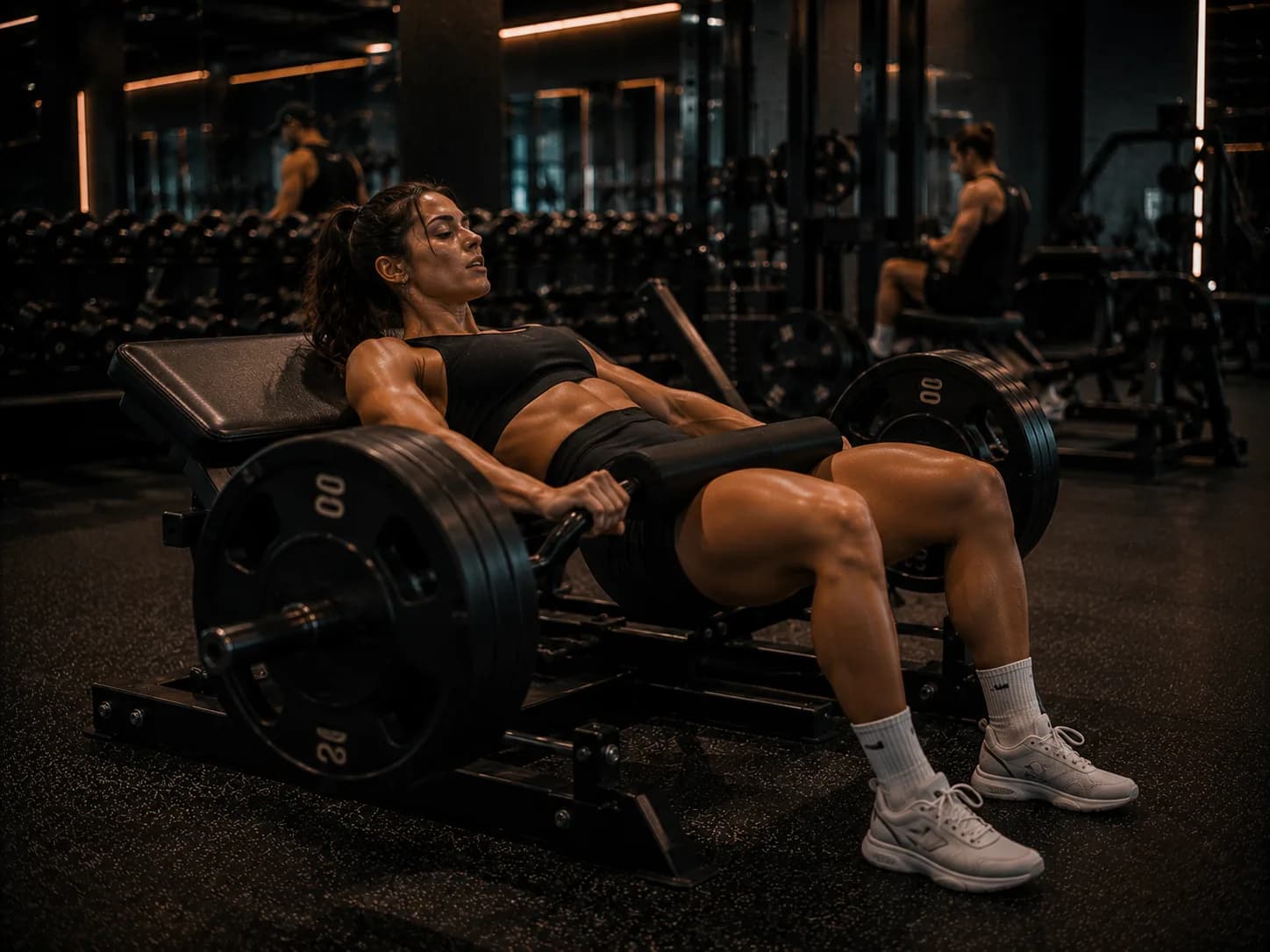
The hip thrust is one of the most effective glute exercises available. EMG research from Dr Bret Contreras shows it outperforms squats, deadlifts and lunges for maximum glute activation. But execution matters, and the setup you train on either supports the movement or limits it. A plate-loaded hip thrust machine solves the barbell version's biggest practical problems: the load sits in the same position every rep, setup takes seconds and small weight jumps are easy.
This guide covers the biomechanics behind hip thrusts, the differences between barbell and machine variations, the setup at Inception Gym, and how to programme hip thrusts for posterior chain development.
The science
The glutes (gluteus maximus, medius and minimus) are the largest muscle group in the body. They extend the hip, abduct the leg and stabilise the pelvis through most movement patterns. Despite their size and importance they are chronically undertrained in most programmes.
The reason hip thrusts outperform squats and deadlifts for glute activation comes down to where peak resistance sits on the strength curve.
In a squat or deadlift the glutes work hardest in the bottom position, when the hip is maximally flexed. By the time you reach the top and the hips extend fully, the load moment arm shortens and glute activation drops off. The exercise is hardest where the glute is in a shortened position.
Hip thrusts reverse this. The load is heaviest at the top of the movement, when the hip is fully extended. That is where the gluteus maximus is strongest, so the training stimulus lands in the extended-hip position where glutes are most recruited.
EMG studies show hip thrust variations produce gluteus maximus activation of around 75 to 100% of maximum voluntary contraction, compared to 40 to 60% in squats and 55 to 75% in conventional deadlifts. If glute development is your primary goal, hip thrusts are not optional. They are the cornerstone.
Barbell hip thrusts: effective but awkward
The barbell hip thrust is the original and remains effective. Anyone who has done it regularly knows the practical limitations.
Rolling a loaded barbell into position while seated on the floor, padding it across the hip crease, then driving to full extension takes setup effort. The bar pad protects the hip bones but creates an imprecise loading position that shifts between sets.
Stability also gets harder with heavy loads. At submaximal weight the barbell stays put. As weight climbs the bar tends to roll forward and back, so you end up managing bar position on top of executing hip extension. That splits attention and can compromise both safety and technique.
For beginners and intermediates at modest loads the limitations are manageable. For advanced lifters using heavy loads they get serious enough to limit training quality.
Hip thrust machines: solving the practical problems
A dedicated hip thrust machine fixes the barbell's practical limitations without losing the biomechanical advantages of the movement.
At Inception Gym, the hip thrust setup includes a plate-loaded hip thrust machine and a dedicated Bret Contreras glute bench with wedges. That gives members access to both specialised machine loading and the traditional setup refined by the researcher who popularised the exercise.
The plate-loaded hip thrust machine
A plate-loaded hip thrust machine has a fixed resistance arm that loads directly through the hip extension vector. You position your upper back against a padded support with the loaded arm resting across your hips. The movement is constrained to pure hip extension, so bar stability is no longer a variable.
The benefits:
Consistent loading position: the resistance arm contacts the hips in the same place every rep. No bar rolling.
Easier loading and unloading: adding or removing plates is straightforward. No lifting a loaded barbell off the floor before each set.
Precise progressive overload: small plate increments allow precise adjustments. Going from 60kg to 62.5kg is trivial.
Reduced setup time: getting into position takes seconds, not the extended setup of a properly padded barbell hip thrust.
For training partners or solo sessions running multiple sets at different weights, the machine's efficiency keeps training flow.
The Bret Contreras glute bench and wedges
For members who prefer the barbell variation or want to train the hip thrust in its original form, the dedicated glute bench is a better setup than a standard flat bench.
The Contreras glute bench is built for hip thrusts: the height, padding and angle put the upper back in the right position. The wedges fix foot placement so the shin angle is correct at the top. Together these accessories take most of the awkwardness out of improvised barbell hip thrusts.
Using a dedicated glute bench with barbell loading keeps the freedom to adjust load precisely with standard plates while providing a more comfortable and technically consistent setup than a flat bench.
Technique
Whether you use the machine or the barbell setup, the cues are similar.
Setup
Position your upper back against the support with the bench edge at about shoulder-blade level. Feet flat on the floor, hip-width apart, shins roughly vertical when your hips are at full extension. If your shins are angled forward or backward at the top, adjust your foot position.
The loaded resistance (bar or machine arm) sits in the hip crease, not on the lower abdomen or thighs. Use proper padding for barbell variations.
The movement
Start with hips lowered toward the floor, stretching the glutes. Drive through your heels to extend the hips upward. At the top, your hips should form a straight line from knees to shoulders, shins roughly vertical. Do not hyperextend the lower back by hiking the hips too high.
Squeeze the glutes at the top. That is not just a cue, it is the peak contraction that produces the strongest hypertrophic signal.
Lower under control through the same range. A brief pause at the bottom, keeping tension in the glutes rather than fully relaxing, keeps the muscle loaded across the set.
Common technique errors
Lumbar hyperextension at the top: shifts load to the lower back and creates spinal stress. Drive the hips to parallel, not as high as possible. Target a neutral spine.
Pushing through the toes rather than the heels: loads the quads instead of the glutes. Drive through the heels and feel the load in the posterior chain.
Rushing the eccentric: the lowering phase often gets rushed. A 2-3 second descent with control keeps tension and increases stimulus.
Feet too far forward or back: if the feet sit too far from the hips, the shin angle at the top is too steep and hamstrings take over. Too close and the knee angle becomes acute, limiting extension.
Programming
The hip thrust is one part of a complete lower body programme. Used alongside squat patterns (squats, leg press), hinge patterns (deadlifts, Romanian deadlifts) and leg isolation work, it covers the posterior chain.
Frequency
Glutes tolerate moderate frequency. Two sessions of direct hip thrust work per week is a common starting point. Because the movement is low in systemic fatigue compared to heavy squats or deadlifts, recovery is generally faster.
Volume and intensity
For hypertrophy, sets of 8 to 15 reps taken close to failure work well. Unlike deadlifts, where heavy loading is necessary to push close to failure, hip thrusts produce strong glute activation across a broad rep range. Higher rep sets (15 to 20) with shorter rest also work and are less demanding on the lumbar spine.
A practical weekly structure:
- Session 1: 4 sets of 8-10 reps, plate-loaded machine, heavy with full control
- Session 2: 3 sets of 12-15 reps, glute bench with barbell or machine, moderate load with emphasis on squeeze and time under tension
Combinations
Hip thrusts pair well with squat patterns in the same session. Squats load the glutes in the flexed position, hip thrusts load them in the extended position, so pairing them covers the full range.
A squat followed by hip thrusts (or vice versa) within a lower body session is a well-established bodybuilding approach for glute development.
Nutrition
Posterior chain development, like any hypertrophy, needs protein, calories and recovery. If glute development is your goal and you are not seeing the results your training effort warrants, nutrition is often the missing variable.
Inception Nutrition provides PhD-led coaching built on your body composition data and goals. The complimentary body composition scans available to all members give you the baseline and tracking data to assess whether your programme is producing the muscle mass changes you expect.
For supplementation support, the on-site Supplement Solutions store carries Inception Labs products with member pricing, including creatine (strong evidence for strength and power on hip thrust work) and pre-workout for high-intensity posterior chain sessions.
The most underused asset in lower body training
Despite the research on glute activation and the practical benefits of dedicated glute equipment, many members still skip hip thrusts. Squats and deadlifts are familiar and visible. Hip thrusts ask for a slightly different setup and a small technique investment.
The return is significant. No other exercise loads the glute through the fully extended position with this much isolation and progressive load capacity.
If your lower body programme does not include regular hip thrust work, adding it is one of the highest-value changes you can make for posterior chain development.
---
The hip thrust machine and Bret Contreras glute bench are two of the 92 pieces of equipment on the floor at Inception Gym. [View all equipment](/facilities/equipment) or [start with a free trial](/memberships/free-trial) to try the setup yourself.