Training · Strength
Free weights vs machines: which builds more muscle
Free weights vs machines: the pros, cons, and science of each. Which combination builds the most muscle at Inception Gym Christchurch.
By Inception Gym · 23 May 2026
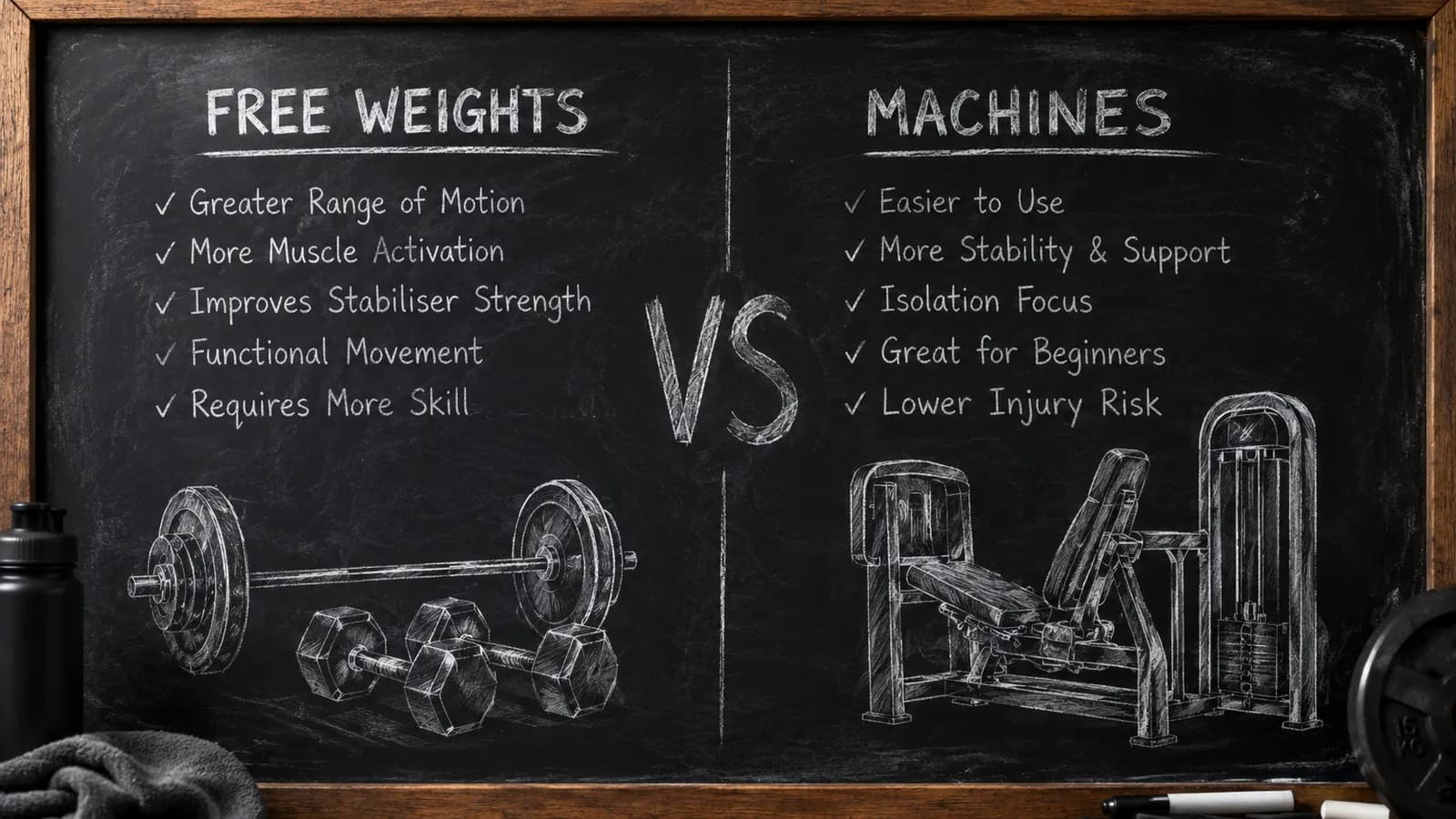
Walk into almost any commercial gym and you'll hear the same debate playing out in whispered tones between the squat rack and the cable station. Free weights build "real" muscle, one camp says. Machines are safer and more effective for isolation, the other says. Both sides have a point. Neither is entirely right.
Free weights vs machines is one of the most common questions we get at Inception Gym, and the honest answer isn't the one most people expect. When training volume and effort are matched, research finds similar muscle growth from both. The real question is a toolkit question: which tool does which job best, and how do you combine them.
Here's the breakdown.
What free weights are
Free weights are any resistance training implement that moves freely through space. Barbells, dumbbells, kettlebells, and trap bars. The weight isn't guided by a fixed track or pivot, which means your muscles must work to control the load in multiple dimensions at once.
The classic free weight movements are the squat, deadlift, bench press, overhead press, barbell row, and their dumbbell equivalents. They've been the foundation of strength and muscle-building programmes for over a century. They work.
What machines are
Machines are resistance training equipment with a fixed movement path. Pin-loaded machines (you select a weight stack with a pin) and plate-loaded machines (you load weight plates onto a specific loading post). Some machines move on a single axis. Others, like cable machines, allow more movement variability while still providing a guided line of resistance.
Common examples: leg press, lat pulldown, chest press machine, leg extension, leg curl, seated row, pec deck.
The case for free weights
Free weights have earned their reputation. Here's what the evidence says they do well.
Coordination and neuromuscular demand
When you perform a barbell squat, your body isn't just working your quads, hamstrings, and glutes. It's recruiting stabilising muscles through your hips, core, and upper back to keep the bar path controlled. The neuromuscular demand is higher than most machine equivalents, which means your nervous system is getting a training stimulus beyond pure muscle hypertrophy.
Over time, that builds functional strength that transfers to real-world movement patterns, sport, and daily life.
Hormonal response
Heavy compound free weight movements, particularly squats and deadlifts, produce a significant acute hormonal response. Studies have shown elevated post-exercise testosterone and growth hormone following heavy multi-joint loading. The long-term implications are still debated, but there's a strong argument that training the body's largest muscle groups with demanding compound movements creates a systemically favourable environment for muscle growth.
Range of motion and individuality
Free weights let you move through a range of motion that suits your individual biomechanics. A tall lifter with long femurs squats differently to a shorter lifter. With a barbell, both can find a stance and depth that works for their structure. Many machines are built around an average body that doesn't match everyone who sits in them.
Versatility
A set of dumbbells and a barbell can be used for hundreds of different exercises. Free weight versatility is unmatched for someone who wants to vary their training stimulus without needing dozens of machines.
The case for machines
If free weights were simply superior in every way, no serious gym would invest in machines. The fact that high-level strength athletes, bodybuilders, and sports performance coaches all use machines extensively tells you something.
Isolation without compensation
Machines isolate target muscles far more effectively than free weights. Consider the leg extension versus the barbell squat. The squat is a brilliant compound movement, but it trains the quads alongside the hamstrings, glutes, and dozens of stabilisers. If you specifically need more quad development, the leg extension delivers targeted loading that the squat can't replicate.
That matters for muscle hypertrophy, particularly in lagging body parts. If your chest isn't developing as fast as your shoulders, a machine chest press or pec deck lets you load the pecs in relative isolation without the triceps and anterior deltoids taking over.
Safety and fatigue management
As you approach muscular failure, free weights become increasingly dangerous. A failed barbell bench press can end with the bar on your throat unless you have a spotter or safety pins set correctly. A failed rep on a plate-loaded chest press machine is just a failed rep.
The ability to train closer to failure safely matters. Research on hypertrophy consistently shows proximity to failure is a key driver of muscle growth. Machines let you push harder with less risk.
Learning curve
Free weight movements have a significant technical learning curve. The squat, deadlift, and barbell press all need months of practice before they can be loaded heavily enough to provide a strong training stimulus. For a beginner, spending their first six months learning form while using sub-maximal loads is a real inefficiency.
Machines let a beginner train with significant load immediately in a safe, guided environment. The lat pulldown teaches back-dominant pulling before the technique is ready for heavy barbell rows. The leg press builds lower body strength while the squat pattern is being developed.
Constant tension and time under load
Many machines, particularly cable-based and plate-loaded designs, maintain resistance throughout the entire range of motion. A dumbbell curl gives peak tension at the mid-point but loses tension at the top and bottom. A cable curl keeps tension throughout. For pure hypertrophy, maintaining tension across the full range of motion is an advantage.
What the research actually says
The research on free weights vs machines for muscle hypertrophy is more nuanced than most online debate suggests.
Several studies comparing matched free weight and machine protocols find similar hypertrophy outcomes when volume and effort are equated. The muscle doesn't know whether the resistance is coming from a barbell or a guided track. It only knows it's being challenged.
Where free weights consistently outperform machines is in transfer to strength performance and neuromuscular coordination. Where machines have an advantage is achieving higher proximity to failure safely, which may allow for better hypertrophy stimulus when applied correctly.
The honest summary: for pure muscle growth, well-programmed combinations of both produce better results than either alone. For transferable strength and athletic performance, free weights carry more weight in the programme. For injury rehabilitation, body part isolation, and late-set intensification, machines are often the better tool.
The right approach: combine both
Elite bodybuilders don't choose between free weights and machines. They use compound free weight movements as the foundation and machines as targeted tools to address specific body parts, extend sets safely, and accumulate volume.
A well-structured programme might look like this:
Foundation: compound free weight movements
- Barbell squat or Romanian deadlift for posterior chain
- Barbell or dumbbell bench press for chest and shoulders
- Bent-over row or dumbbell row for back thickness
- Overhead press for shoulder development
These movements build the most muscle mass per unit of time and create the neuromuscular foundation everything else sits on.
Targeted volume: machine and cable isolation
- Leg extension and leg curl to directly target quads and hamstrings
- Cable crossover or pec deck for chest isolation with constant tension
- Lat pulldown and cable row for back width and detail
- Lateral raise machine or cable lateral raises for shoulder width
These movements let you push specific body parts harder, closer to failure, more safely.
Smart sequencing
Compound free weight movements early in the session when your nervous system is fresh and your technique is sharpest. Machine and isolation work later in the session when accumulated fatigue makes heavy free weight work less productive and riskier.
What Inception Gym offers
Inception Gym stocks 71 machine variants across 92 individual pieces, 43 of them plate-loaded, alongside a full free weight area with dumbbells up to 70kg. The depth of equipment is deliberate. The goal was to build a facility where any training methodology works without compromise.
The plate-loaded machines are particularly valued by members who want the feel of progressive loading without the balance demands of free weights, and by those returning from injury who need to rebuild strength in a controlled pattern before returning to compound lifts.
Serious free weight capacity plus a deep machine inventory means you never have to choose. Your programme can be built around what your body actually needs, not around what equipment happens to be available.
Practical recommendations
If you're a beginner. Start with a mix of compound machine movements (leg press, lat pulldown, chest press machine) while developing free weight technique with lighter loads. The machines let you load appropriately and get a proper training stimulus while you develop the movement patterns.
If you're intermediate. Your programme should have compound free weight movements as the primary stimulus and machine work as accessory volume. Prioritise getting your squat, hinge, push, and pull patterns strong with free weights, then use machines to address weak points.
If you're advanced. You already know this. Periodise free weight intensity, use machines to extend sets beyond failure safely, and treat isolation work as the finishing layer, not the foundation.
If you're training around an injury. Machines are often the smarter short-term choice. They let you maintain strength and volume in a controlled range of motion while the injury heals, and reduce the stabilisation demand that might aggravate the problem.
Tracking progress
Whether you lean towards free weights or machines, progress requires tracking. Body composition scans, free for every Inception member, show you muscle mass changes over time, which gives you real data on whether your current approach is working. Scale weight alone is a notoriously unreliable proxy for muscle gain.
If you want a structured programme built around your specific goals, the team at Inception Nutrition runs PhD-led coaching that integrates training and nutrition into a coherent plan. Knowing what you're lifting and what your body is doing with that training is the most direct path to consistent results.
The bottom line
Free weights build foundational strength, recruit stabilisers, and transfer to real-world performance. Machines allow safe intensification, effective isolation, and consistent loading through the range of motion. Both are essential. Neither is sufficient on its own.
The question isn't free weights vs machines. The question is how to use each intelligently within a programme designed around your goals.
At Inception, you have access to both in the depth you need to do exactly that. Book a free trial and explore the full range, or view membership options to get started.
The debate ends the moment you stop choosing sides and start using everything available to you.