Nutrition · Supplements
Collagen whey protein: why this dual-action formula is worth it
Collagen whey protein combines muscle recovery with joint and skin support. Who benefits most and why the Inception Labs formula does more than standard protein.
By Inception Gym · 19 April 2025
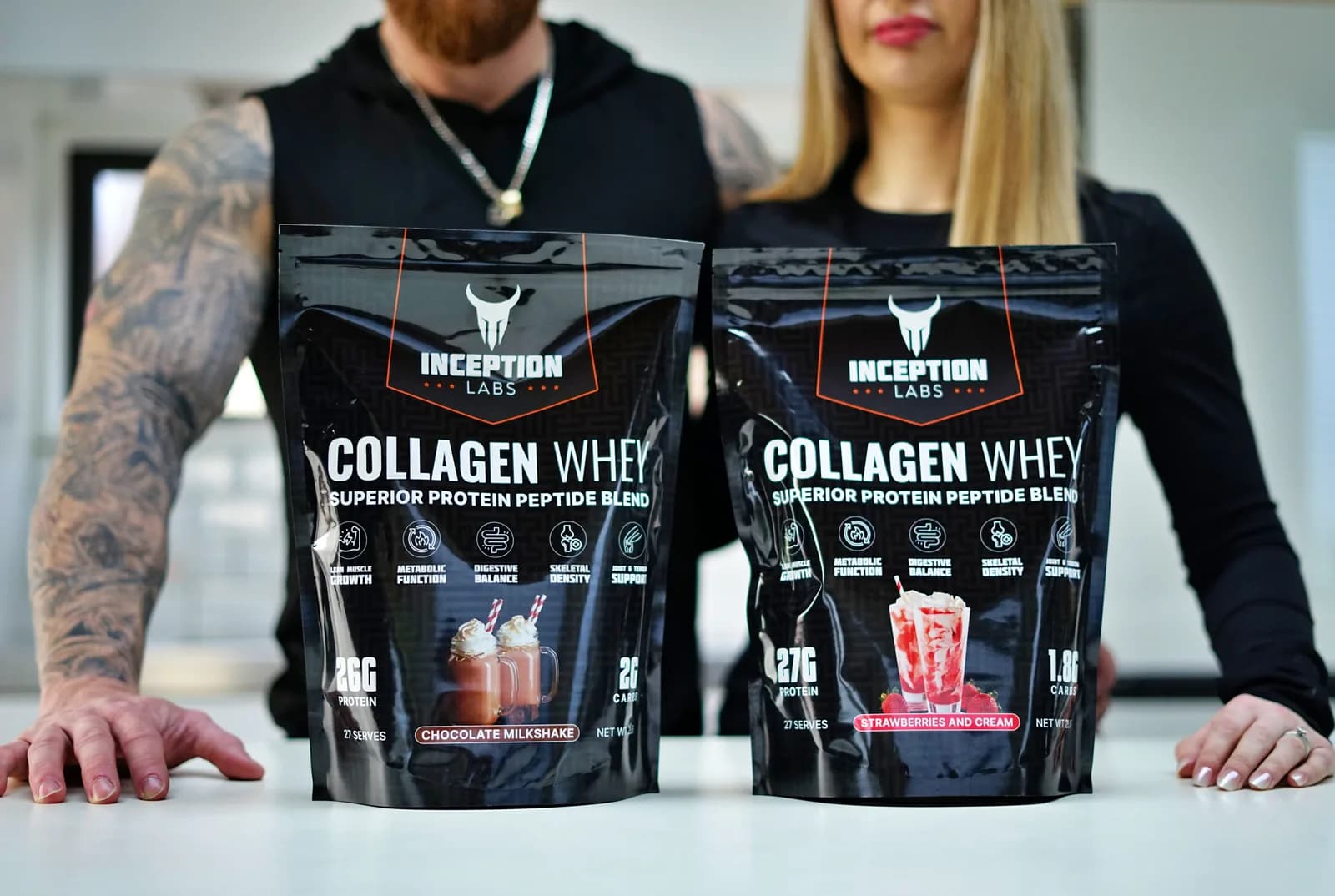
Protein supplements have been a gym staple for decades. Whey isolate, casein, plant-based blends: the category is well understood and the core product, quality whey protein, does what it promises. A growing number of people who train consistently are asking a more specific question: what else can my protein supplement do.
Collagen whey blends answer this by combining two distinct proteins with complementary mechanisms. The result is a supplement that supports muscle recovery (the job protein has always done) while supporting joint health, connective tissue integrity, and skin structure. For people who train hard and want to stay doing so long-term, that secondary benefit is not a marketing addition. It's the point.
This guide covers how collagen whey protein works, who benefits most, what the research says about collagen supplementation for active people, and why the Inception Labs formula takes a different approach to standard protein supplements.
The two proteins and what they do
Whey isolate: the muscle recovery standard
Whey protein isolate is derived from milk during the cheese-making process. It contains a complete amino acid profile with high concentrations of leucine, the branched-chain amino acid that triggers muscle protein synthesis through the mTOR pathway. Whey isolate is rapidly digested and absorbed, which makes it particularly effective post-workout when muscle tissue is acutely receptive to amino acids.
Whey isolate is also low in lactose and fat, making it well-tolerated by people with lactose sensitivity and suitable for lean mass building without unnecessary caloric addition.
The muscle recovery function of whey isolate is well established. Meta-analyses consistently show post-exercise whey protein supplementation increases lean muscle mass and strength gains compared to matched training without protein supplementation.
Bovine collagen: connective tissue support
Collagen is the most abundant protein in the human body. It forms the structural matrix of tendons, ligaments, cartilage, skin, and bone. There are multiple collagen types, but type I and type III are most relevant to athletic performance and joint health.
The body produces collagen on its own, but production declines with age, beginning as early as the mid-20s. The decline is associated with increased tendon stiffness, reduced cartilage thickness, and the joint discomfort many active people begin to notice in their 30s and 40s.
Bovine collagen supplements provide hydrolysed collagen peptides: pre-digested collagen broken into smaller peptides and absorbed efficiently. Research into collagen supplementation for joint health has developed significantly over the past decade.
Key findings:
Tendon and ligament support. A study in the American Journal of Clinical Nutrition found that collagen supplementation combined with exercise significantly increased collagen synthesis in tendons compared to exercise alone. The implication is that collagen supplementation may help tendons and ligaments adapt to training loads more effectively.
Joint pain reduction. Multiple randomised controlled trials have found hydrolysed collagen supplementation reduces joint pain and stiffness in active individuals and athletes. The effect is most pronounced with consistent supplementation over 12 weeks or more.
Skin structure. Collagen supplementation has well-documented effects on skin elasticity and hydration, reflecting its role in the extracellular matrix that gives skin its structure.
Why the combination matters
Standard whey protein addresses muscle recovery. Standard collagen addresses connective tissue. A collagen whey blend addresses both at once, which matters for anyone who trains consistently over years rather than months.
Hard training damages muscle fibres (which recover and grow) but also creates cumulative stress on tendons, ligaments, and cartilage. Connective tissues have limited blood supply compared to muscle, which means they receive fewer nutrients and recover more slowly. A training programme that outpaces connective tissue recovery leads to overuse injuries: tendinitis, joint inflammation, stress fractures, and the grinding discomfort that many experienced lifters manage as background noise.
Supporting connective tissue recovery with collagen supplementation isn't about masking injury symptoms. It's about providing the raw materials for the structural repairs training demands. Muscle recovery and connective tissue recovery addressed together is a more complete approach than addressing only one.
Who benefits most
High-volume trainers
People who train 4 to 6 times a week subject their joints and connective tissues to substantial cumulative load. The higher the training frequency and intensity, the more important connective tissue support becomes. Collagen supplementation provides a consistent substrate for the repair processes that run between sessions.
People over 35
Endogenous collagen production declines from the mid-20s and the rate of decline increases with age. By the early to mid-30s, the gap between collagen production and the connective tissue demand of regular training becomes more significant. Supplementation helps close that gap.
For lifters training seriously through their 30s and 40s, joint support is usually the reason collagen supplementation stays in the routine long-term, even when muscle recovery is already covered by other protein sources.
Post-injury and injury-prone individuals
If you're training around an existing tendon, ligament, or joint injury, providing optimal collagen synthesis substrate is a practical support strategy. It doesn't replace medical treatment or appropriate programme modifications, but it ensures the nutritional environment for connective tissue repair is as favourable as possible.
Anyone wanting skin and hair benefits from their protein
Collagen's effects on skin elasticity and hair structure are well documented. For members who want their supplementation budget to cover multiple health outcomes, a collagen whey blend delivers skin and hair benefits without needing a separate collagen supplement.
The Inception Labs Collagen Whey Protein formula
Inception Labs Collagen Whey Protein is available on-site at the Supplement Solutions store inside Inception Gym. The formula combines whey isolate with hydrolysed bovine collagen in a single serve, developed by the same team that runs the gym.
RRP is $109.00. Members pay $89.00, a $20 saving per tub. For members who use protein supplements regularly, that saving over a year adds up.
The formulation approach at Inception Labs reflects the clinical dosing philosophy applied across the range: ingredients at doses the research supports as effective, not at token doses included for label decoration. If collagen peptides appear on the ingredient list, they appear at a dose consistent with the research showing joint and connective tissue benefits.
You can also buy Inception Labs products directly through inception-labs.com, though the member pricing on-site at the Supplement Solutions store gives real savings for active members.
Timing and usage
Whey isolate is rapidly absorbed, making post-workout timing effective for muscle protein synthesis. Collagen peptides also benefit from proximity to exercise: vitamin C enhances collagen synthesis, so pairing collagen supplementation with a vitamin C source (fruit juice, a vitamin C supplement) is worth considering.
For practical purposes, a post-workout shake using Inception Labs Collagen Whey covers both the immediate muscle recovery window and the collagen synthesis demand created by training stress. A single serve straight after training is the simplest and most evidence-supported approach.
Building a complete supplement protocol
No supplement, however good, operates on its own. Collagen whey protein works best as part of a nutrition and supplementation strategy built around your specific training goals, body composition, and recovery demands.
Inception Gym's free body composition scans give you the lean mass and fat mass data that makes personalised nutrition planning meaningful. Combined with Inception Nutrition's PhD-led coaching, your supplementation choices can be matched to what your body actually needs based on measurable data rather than guesswork.
The on-site Supplement Solutions store means you can get advice from staff who understand the products and the training context. This isn't a generic supplement retailer; it's a store staffed by people who train and can discuss your specific goals.
The bottom line
Standard whey protein remains an effective tool for post-workout muscle recovery. Collagen whey protein does the same job while adding meaningful connective tissue, joint, and skin support that becomes more valuable as training volume increases and training age extends.
For anyone who trains consistently, plans to continue doing so long-term, and has started to notice that joints and tendons need as much support as muscles do, a collagen whey blend is a more complete investment than standard whey alone.
At member pricing, Inception Labs Collagen Whey Protein delivers both functions at a cost that's lower than buying two separate supplements.
---
Browse the full Inception Labs range and see how member savings offset your membership costs. [View membership options](/memberships/options) or [learn about the Supplement Solutions store](/facilities/supplement-store).