Equipment · Chest
Every chest machine at Inception Gym: a training guide
From flat presses to cable crossovers, every chest machine at Inception Gym Christchurch and how to use each one for results.
By Inception Gym · 28 June 2025
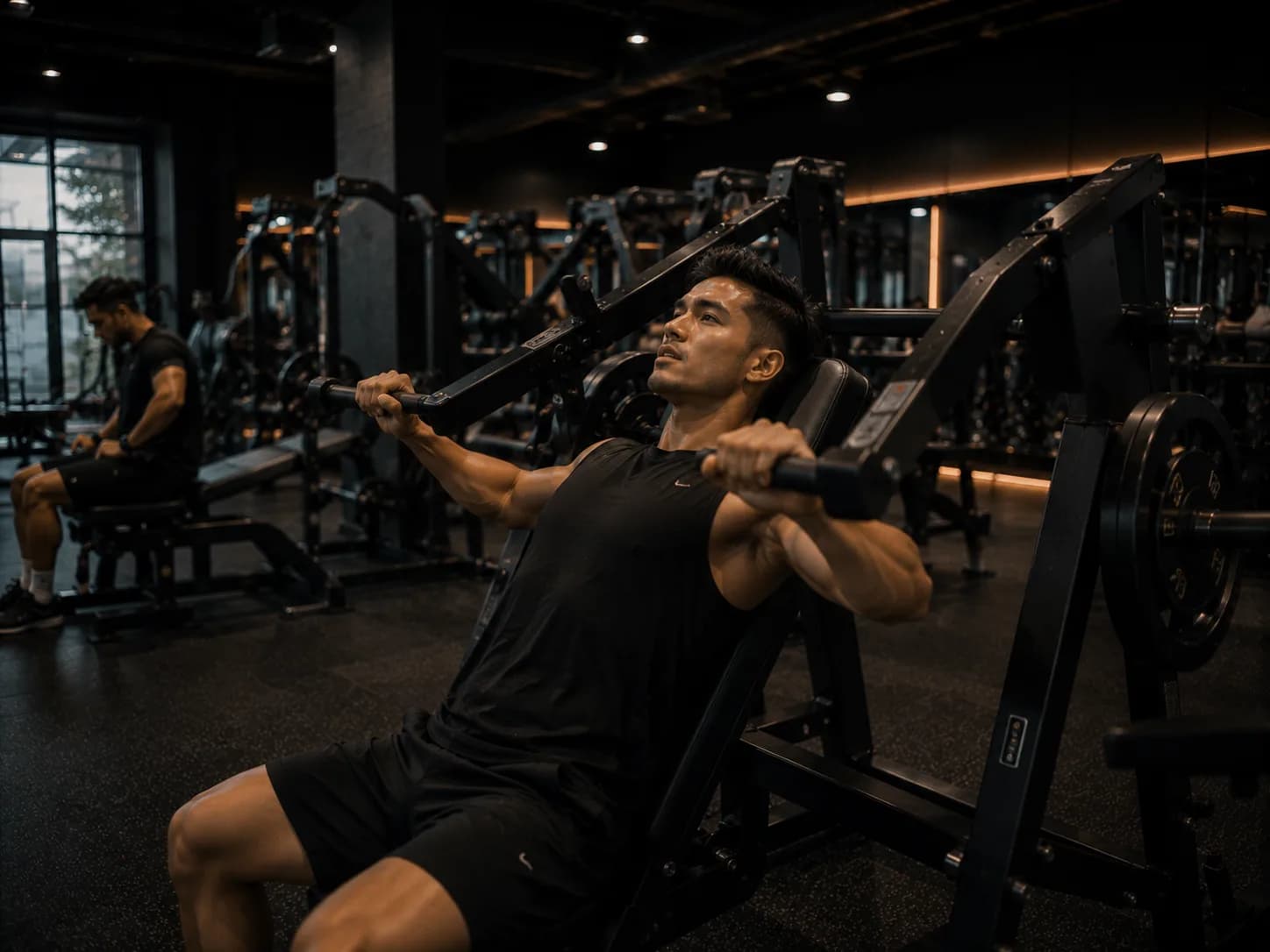
Inception Gym Christchurch runs a full chest line-up: plate-loaded flat and incline presses, pin-loaded seated presses, a decline press, an assisted dip machine, a pec deck, and a cable crossover station with low, mid, and high pulleys. They sit within a floor of 92 machines, 43 of them plate-loaded. This guide covers what each chest machine targets, how to use it, and how to programme it.
Why machine-based chest training works
For decades, the bench press was treated as the only chest exercise worth talking about. Barbell, dumbbell, and that was largely the conversation. The science of hypertrophy has moved on, and so has our understanding of what actually drives chest muscle growth.
The pectoralis major responds best to training across a full range of motion, with loading at the stretched position, across multiple angles, and with enough volume to create the stimulus for adaptation. No single exercise does all of that. A well-rounded chest programme mixes free weight pressing with machine work to cover every angle and maximise the growth signal.
At Inception Gym Christchurch, the chest machines cover flat, incline, decline, and fly movements in both plate-loaded and cable configurations, so a complete multi-angle programme is possible without waiting on a single bench.
Chest anatomy
A quick anatomy primer so you train with intention rather than going through motions.
Pectoralis major (sternal head). The large lower portion of the chest, responsible for most chest mass. Best stimulated by flat and slight decline pressing and cable work in the mid-range.
Pectoralis major (clavicular head). The upper portion of the chest, running from the clavicle. Most effectively targeted by incline pressing and upward cable movements. Often under-developed because flat pressing alone neglects it.
Pectoralis minor. Sits under the pec major, not directly visible but important for shoulder stability and posture.
Serratus anterior. Often neglected. Runs along the ribcage and protracts the shoulder blade. Exercises that involve full shoulder protraction at the end of a press (machine presses with a full lockout) help develop this muscle.
These distinctions tell you why varying chest angles isn't variety for variety's sake. Different angles shift tension between portions of the muscle that can't all be maximally trained from one position.
Flat chest press machines
Plate-loaded flat chest press
Often the best starting point for a chest session. With no stack ceiling, you can load it to match your real pressing capacity and keep adding load over time as you get stronger.
Targets. Sternal head of the pec major primarily, with anterior deltoid and tricep involvement.
How to use it. Set the seat so when you grip the handles, your hands are at roughly mid-chest height. Retract your shoulder blades and hold that retraction throughout. Press to a full lockout without losing tension on the chest, then control the descent to a full stretch.
Programming. Use this as your primary chest exercise on days you're not doing barbell bench press. 4 sets of 6 to 10 reps with progressive load works well.
Seated chest press (pin-loaded)
Ideal for higher-volume work, drop sets, and training close to failure where fast weight adjustments help.
Targets. Same primary muscles as the flat press, with a slightly more upright torso angle on most machines shifting emphasis toward the upper sternal and clavicular portions.
Programming. Sets of 12 to 20 reps as a second or third exercise. Also useful for extended set techniques like mechanical drop sets.
Incline chest press machines
Plate-loaded incline press
Upper chest is where many gym members fall short. The clavicular head of the pec major needs incline pressing, and the plate-loaded version lets you load it as heavily as your strength warrants.
Targets. Clavicular (upper) head of pec major, with greater anterior deltoid contribution than flat pressing.
How to use it. The incline angle is usually fixed at 30 to 45 degrees. Set the seat height so your hands grip at upper chest or lower clavicle height. Press in a straight line without letting your elbows flare excessively, which would shift too much load to the front delts.
Programming. If your upper chest is a weak point, do this first while your nervous system is fresh. 3 to 4 sets of 8 to 12 reps.
Seated incline press (pin-loaded)
Same incline pressing pattern with faster adjustments. Useful when training with a partner who uses different weights.
Decline chest press and dips
Decline chest press machine
The decline angle shifts emphasis to the sternal and lower portions of the pec major, and often lets lifters move more weight than flat or incline positions thanks to the mechanical advantage.
Targets. Lower sternal fibres of the pec major.
Programming. The decline press completes a three-angle pressing approach (incline, flat, decline). Not every session needs all three, but including decline work keeps the lower chest from lagging.
Assisted dip machine
The dip is one of the best lower chest exercises around. On the assisted dip machine, a counterweight partly supports your bodyweight, making it accessible at any current strength level.
Targets. Lower pec major, triceps, anterior deltoid.
How to use it. Lean forward slightly to shift emphasis toward the chest rather than the triceps. Descend until you feel a stretch in the chest, then press back up. The forward lean is the key cue; an upright torso turns this primarily into a tricep exercise.
Programming. Can be a finisher or a primary exercise. Vary the assistance level to target different rep ranges.
Fly machines and pec deck
Pec deck
The pec deck is one of the most underrated machines on any gym floor. Unlike pressing, it isolates the pec major without significant tricep or deltoid contribution, so you can train the chest directly to fatigue.
Targets. Pec major across the full range, with emphasis on adduction (bringing the arms across the body).
How to use it. Set the pad position so your elbows and upper arms are at shoulder height. The movement is an arc, not a press. Lead with the elbows (or forearms, depending on machine design) and squeeze the chest at the contracted position. Don't let the elbows drift behind your torso, which stresses the shoulder joint.
Programming. Excellent as a final exercise or pre-exhaustion technique. 3 sets of 12 to 20 reps. The burn at higher rep ranges is the direct chest stimulus working.
Cable fly (low, mid, and high pulley)
The cable crossover station lets you do fly movements from multiple angles by adjusting the pulley position. One of the most versatile chest tools in the gym.
Low pulley fly. Targets the upper and clavicular portions of the pec. Great for building the upper chest shelf.
Mid pulley fly. Targets the mid sternal region. Closest to the traditional dumbbell fly pattern.
High pulley fly. Targets the lower sternal and lower chest. The cable provides continuous tension throughout the arc, unlike dumbbells, which lose tension at the top.
How to use it. The chest fly is an arc, not a press. Keep a slight bend in the elbows and hold that bend throughout. The movement comes entirely from the shoulders. Feel the stretch at the start and the squeeze at the finish.
Programming. Cable flies are great for adding volume and variety without adding joint stress. They work particularly well as finishers or in supersets with pressing.
Programming a chest session
Effective chest sessions usually include:
- One heavy pressing movement (plate-loaded flat or incline press): 4 sets of 6 to 10 reps
- One complementary pressing movement (different angle): 3 sets of 8 to 12 reps
- One fly or crossover (isolation, full range): 3 sets of 12 to 20 reps
That three-exercise structure hits the chest from multiple angles, balances mechanical and metabolic stress, and keeps session length manageable.
Example session A (upper emphasis).
- Plate-loaded incline press: 4 x 8
- Flat chest press machine: 3 x 10
- Low cable fly: 3 x 15
Example session B (overall development).
- Plate-loaded flat press: 4 x 8
- Pec deck: 3 x 12
- High cable fly: 3 x 15
Rotate between the two structures across training weeks to keep the stimulus fresh and hit all portions of the chest.
Common chest training mistakes
Flat pressing only. If you only ever flat press, your upper chest will lag and your physique will show it. Include incline work every week.
Not training close to failure. Chest machines are safe environments to take sets close to muscular failure. Finishing sets with 5 reps left in the tank doesn't provide enough stimulus for growth. Aim for 1 to 3 reps remaining at the end of a set.
Rushing the eccentric. The lowering phase is where the muscle is most under tension at a stretched length, and research suggests that's a powerful driver of hypertrophy. Take 2 to 3 seconds to lower the weight on pressing.
Skipping fly patterns. Presses and flies are different movements working the chest differently. Presses involve elbow flexion and extension; flies are pure shoulder adduction. Both have a role. If you only press, you miss the stimulus that isolates the chest through its primary function.
Nutrition
Growing any muscle group needs adequate protein and a caloric environment that supports muscle protein synthesis. Members can use the Supplement Solutions store on-site, with the full Inception Labs range at member pricing.
For personalised nutrition, Inception Nutrition runs PhD-led coaching that builds a plan around your body composition data, your training, and your lifestyle.
See the equipment
If you want to see and use the full chest setup before committing to a membership, the free trial gives you 24 hours of full access. Come in during any session, try the plate-loaded presses, the pec deck, the cable crossover, and find the setup that works for your goals.
The complete picture
Chest training done well is pressing from multiple angles, fly work for isolation, and training consistently close to failure with progressively increasing loads. The right equipment makes that straightforward.
At Inception Gym Christchurch, every chest exercise you need is on the floor, in multiple configurations, with both plate-loaded and pin-loaded options.