Equipment · Cardio
Cardio equipment at Inception Gym: treadmills to Jacob's Ladder
Every cardio machine at Inception Gym Christchurch. Treadmills, Assault runners, StairMaster, Power Mills, Ski Erg, Jacob's Ladder, and bikes.
By Inception Gym · 17 May 2025
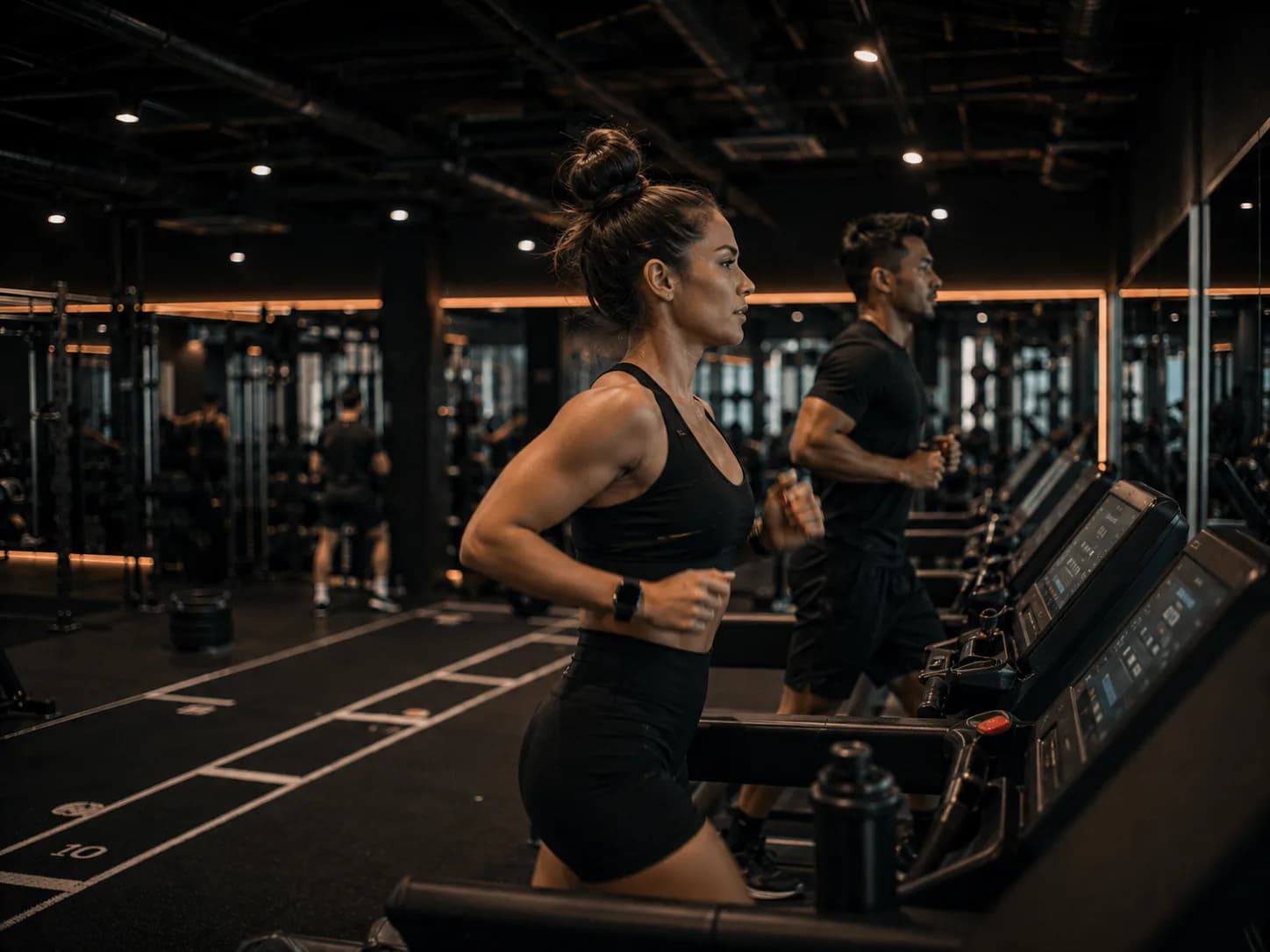
Cardio at Inception Gym
Most gym cardio floors look the same: rows of treadmills, a few bikes, maybe a cross-trainer. Functional, but limited. The cardio floor at Inception Gym Christchurch, at Tower Junction in Addington, runs wider: motorised treadmills, Assault Runners, StairMaster and Power Mill stair climbers, a Ski Erg, Jacob's Ladder, and upright, recumbent, and Assault bikes. That selection includes machines you won't find in most Christchurch gyms; tools that challenge your cardiovascular system in different ways and train different energy systems, movement patterns, and muscle groups.
This guide covers every cardio machine we have, what it does, how to use it, and when to pick it over the alternatives.
Whether you're building an aerobic base for health and longevity, burning fat, training for sport, or using cardio as active recovery between lifting sessions, there's a machine for it.
Why cardio variety matters
A quick note on why variety in cardio equipment produces better outcomes than one machine used repeatedly.
Different movement patterns. The treadmill trains forward locomotion. Jacob's Ladder trains a climbing pattern. The Ski Erg trains upper body pulling. The StairMaster trains step-up patterns. Each uses different muscles, joints, and coordination. Using one machine means your cardiorespiratory fitness is partly built around a specific movement skill rather than broad fitness.
Injury prevention. Repeating the same movement thousands of times creates overuse injury risk. Varying cardio machines spreads mechanical stress across different joints and tissues.
Variety equals adherence. Sessions that involve different stimuli, challenges, and machines are more engaging. Engagement matters for the consistency that drives long-term results.
Metabolic variety. Different machines challenge the aerobic system, the anaerobic system, and the lactate threshold differently. Rotating produces more complete cardiovascular development.
Treadmills
Treadmills remain the most straightforward cardio tool. You walk, jog, or run at a controlled pace and incline. The appeal is familiarity, programmability, and the wide range of intensities they support.
LISS. A 30 to 60 minute walk at 4 to 6 km/h on an incline of 10 to 15% (the incline walk method) produces real cardiovascular and caloric work without the joint impact of running. Particularly useful for members who want fat loss benefits without the recovery cost of high-impact work.
HIIT. Interval runs (alternating sprint speed and recovery walk or jog) are time-efficient for cardiovascular conditioning. A 20-minute session of 30-second sprints with 90-second recovery gives a serious training stimulus in a short time.
Programming. Incline walking is highly sustainable and easy on the joints. Works as daily active recovery or as a dedicated cardio session. Running intervals should usually be limited to 2 to 3 sessions per week to manage impact load.
Assault runners (non-motorised treadmills)
The Assault Runner looks like a treadmill but works differently. No motor. The belt moves because you drive it with your feet.
Why this matters. On a motorised treadmill, you're keeping pace with a belt that's already moving. On an Assault Runner, you're generating all the belt movement yourself. You control the pace at every instant, and the demand on your legs, glutes, and cardiovascular system is significantly higher than an equivalent speed on a motorised treadmill.
How it trains you. The effort to drive the belt at speed is substantially greater than motorised running. Research shows non-motorised treadmills increase oxygen consumption, heart rate, and calorie expenditure compared to motorised running at the same speed. They also produce greater posterior chain (glutes and hamstrings) activation because you actively push back to drive the belt.
Best for. Short sprint intervals. The Assault Runner excels at very high-intensity efforts of 10 to 30 seconds. Set a target speed, drive hard, recover. Natural pace regulation (it slows the moment you ease up) makes it ideal for true max-effort sprint work.
Programming. 10 to 20 seconds all-out, 40 to 50 seconds recovery, 8 to 15 rounds. A demanding session. Two per week is plenty for most members.
StairMaster and Power Mills
StairMaster
The StairMaster simulates continuous stair climbing using a rotating step mechanism. One of the most effective tools for combining cardiovascular conditioning with lower body work.
What it trains. Glutes, quads, calves under continuous light load, plus the cardiovascular and aerobic system. Because the steps are continuous, there's no recovery within the movement: every step requires active glute and quad engagement.
Why it's effective for physique goals. Unlike treadmill running, which has significant joint impact, stair climbing is low-impact but high-demand. You can sustain a pace that keeps your heart rate in the fat-burning zone (around 65 to 75% of max heart rate) for 20 to 45 minutes while also working glutes and quads.
Programming. 20 to 45 minute sessions at a moderate, sustainable pace. Start at a speed where you can still hold a conversation (the talk test) and build from there.
Power Mills
The Power Mill is a self-powered stair climber with actual rotating steps rather than a paddle mechanism. The mechanical demand is higher and the movement is closer to real stair climbing.
Best for. Members who want the most authentic stair-climbing experience and higher cardiovascular demand than a standard StairMaster.
Ski Erg
The Ski Erg is one of the most under-used cardio machines in most gyms and one of the most effective. It trains the upper body cardiovascular system through a double-arm pull movement.
What it trains. The pull-down engages lats, triceps, core, and hip flexors in a coordinated pattern. The cardiovascular demand is significant because pulling with both arms simultaneously involves large muscle groups that other cardio machines rarely use.
Why it's valuable. Most cardio machines primarily or exclusively train the lower body. The Ski Erg gives you real upper body cardiovascular conditioning that's essentially unavailable elsewhere. For mixed athletes, fighters, or anyone wanting complete fitness, upper body aerobic capacity matters.
LISS. 20 to 30 minute moderate-pace sessions develop upper body aerobic capacity and work the lats and core as a bonus.
HIIT. 10-stroke all-out efforts followed by 50 to 90 seconds of recovery, 8 to 12 rounds. The upper body fatigue is unique and challenges even well-conditioned athletes.
Programming. Good on rest days from lower body training, where you want cardiovascular work without more leg fatigue.
Jacob's Ladder
Jacob's Ladder is a self-powered climbing machine that replicates the movement of climbing a ladder. It sits at about 40 degrees and moves only as fast as you climb.
What it trains. The climbing pattern engages arms, lats, core, quads, and calves at once. A true full-body cardiovascular machine. The alternating arm-leg coordination pattern is unique among gym cardio equipment.
Why it stands out. No buttons, no screens, no pace settings. Entirely self-paced. Climb faster and it responds faster. Slow down and it slows. The immediate feedback loop makes it one of the most honest pieces of cardio equipment in the gym; nowhere to hide.
The metabolic demand is high. Multiple large muscle groups working at once in an alternating pattern means the oxygen demand of even moderate-effort Jacob's Ladder is significant. Many users find it harder than expected.
LISS. A sustainable pace for 15 to 20 minutes. The novelty of the movement pattern keeps it mentally engaging.
HIIT. Max effort for 20 to 30 seconds, active rest for 60 to 90 seconds. Because of the full-body demand, recovery between intervals usually needs more time than sprint intervals on a treadmill.
Programming. If you've never used Jacob's Ladder, start with a short session to learn the movement pattern. It takes a minute to find the rhythm. Once you have it, the session feels more natural.
Bikes
Upright bike
Seated cycling in a position that mimics road cycling geometry. Low-impact and accessible for most fitness levels and ages.
Best for. LISS cardio, active recovery, members with lower leg or hip injuries that prevent running.
Programming. 30 to 45 minute sessions at a moderate pace. The upright position engages the core more than the recumbent bike and gives a more natural cycling posture for most people.
Recumbent bike
The recumbent bike puts the rider in a reclined, supported position with the legs extended forward. Dramatically reduces stress on the lower back and hips.
Best for. Members with back issues, hip problems, or returning from lower body injuries. Also useful for longer, lower-intensity sessions where seat comfort matters.
Assault bike (air bike)
The Assault Bike combines simultaneous arm and leg cycling through a push-pull arm mechanism. Resistance comes from a large fan, so there's no ceiling on how hard you can work.
What it trains. Upper and lower body together. At max effort, arguably the most metabolically demanding piece of cardio equipment in the gym.
HIIT. The 20-10 protocol (20 seconds max effort, 10 seconds rest) originated on the Assault Bike and remains one of the most demanding HIIT formats around. Start with 8 to 10 rounds. 20 rounds is elite fitness territory.
LISS. At low effort, the Assault Bike is gentle and can run for extended periods as active recovery.
LISS vs HIIT
LISS (low-intensity steady state). Sustained effort at 60 to 70% max heart rate for 20 to 60 minutes. Builds aerobic base, improves fat oxidation at rest and during exercise, easy to recover from, can be done daily.
HIIT (high-intensity interval training). Alternating near-maximum effort with recovery. Sessions are typically 15 to 25 minutes. Produces greater cardiovascular adaptation per unit of time than LISS. Needs more recovery between sessions.
Which is better? Both have a role. LISS works for daily active recovery, fat loss alongside appropriate nutrition, building aerobic capacity without impairing strength recovery. HIIT is more time-efficient, produces greater metabolic adaptations, and is appropriate 2 to 3 times per week maximum.
The machines at Inception Gym support both approaches across every equipment type. The key is matching the machine to the goal for that session.
Cardio and nutrition
Cardiovascular training, particularly at higher intensities, increases energy expenditure and places extra demands on nutrition and recovery. Members doing significant cardio volume benefit from adequate carbohydrate intake around training and consistent protein for muscle maintenance.
The on-site Supplement Solutions store has the Inception Labs range at member pricing. For structured nutrition guidance, Inception Nutrition runs PhD-led coaching that integrates your body composition data with a personalised approach.
Try the cardio floor
The breadth of cardio equipment at Inception Gym is best understood in person. The free trial lets you work through the machines, try Jacob's Ladder, test the Assault Runner, and find the combination that works.
When you're ready to train consistently, membership options cover both approaches to commitment: the open-term plan stays flexible with 28 days' cancellation notice, or a 12 or 24-month plan locks in our lowest weekly rate. No joining fee on any plan.