Equipment · Machines
Cable crossover exercises: 15 moves that cover the whole body
15 cable crossover exercises for every muscle group, with technique tips and programming notes, using the cable stations at Inception Gym Christchurch.
By Inception Gym · 7 February 2026
Why the cable machine is the most versatile piece in the gym
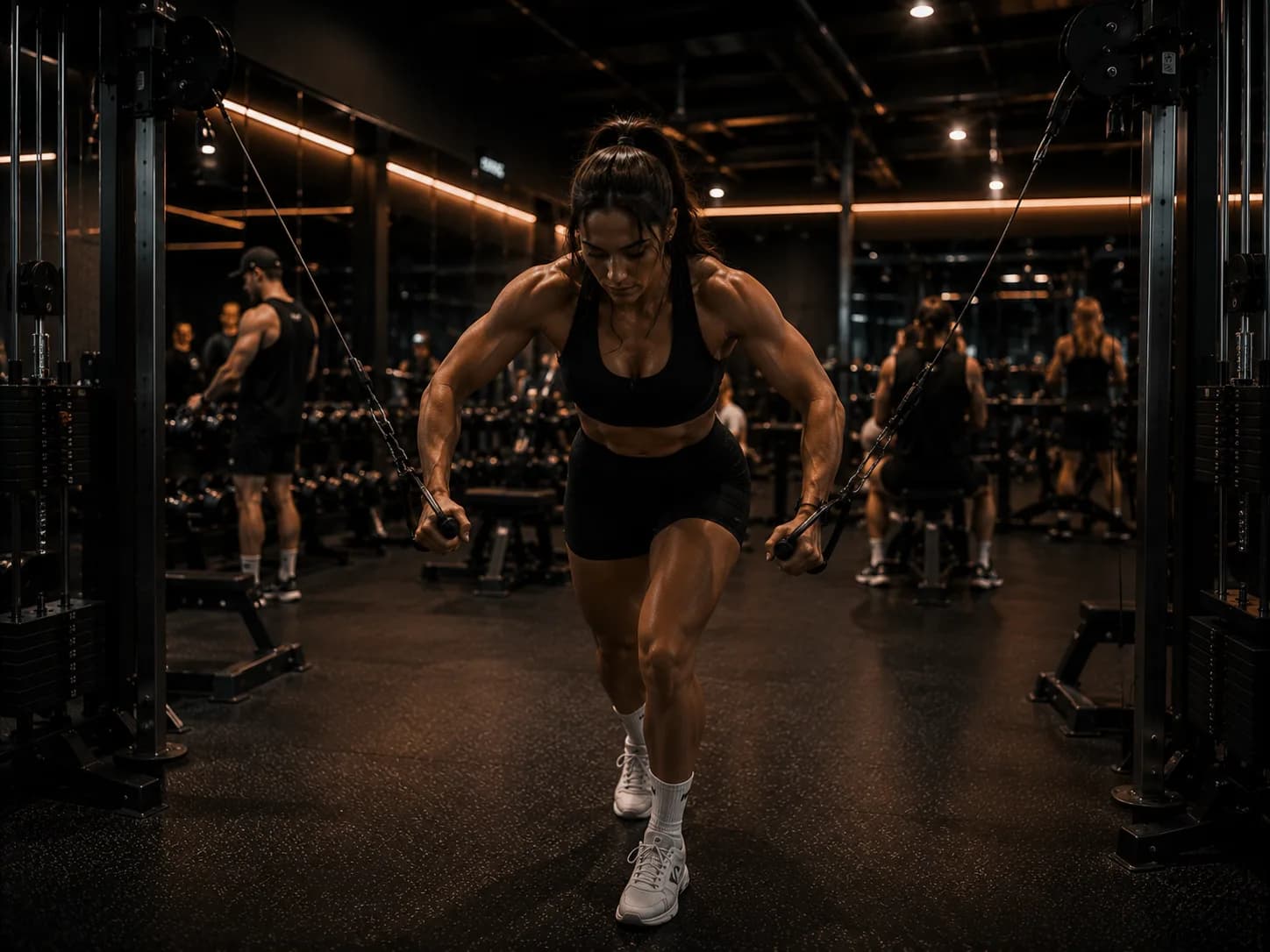
If you had to pick one piece of equipment to train every muscle in your body, the cable crossover would be the answer. The adjustable pulley lets you set resistance at any height (low, mid, high), use any attachment (rope, bar, handle, ankle strap), and create an almost unlimited number of exercises by changing angle, body position, and movement pattern.
Unlike dumbbells or barbells where gravity dictates the direction of resistance (always down), cables allow resistance in any direction. That means you can load a muscle from angles free weights can't replicate.
At Inception Gym Christchurch, the cable setup includes a floor-to-ceiling dual-cable crossover and a dual-pulley functional trainer, part of a 92-machine floor. There's rarely a wait for cable work, even during peak hours, and every station has adjustable pulleys with a full range of attachments.
This guide covers 15 cable exercises, organised by muscle group, with technique notes and programming tips.
Chest: cable fly variations
1. Low cable fly (upper chest)
Set the pulleys to the lowest position. Stand in the centre of the cable station, take one handle in each hand, and bring both arms upward and inward in a wide arc, crossing at the top at about eye height.
Why it works. The upward angle directly loads the clavicular (upper) chest head, which is poorly served by flat pressing alone. The cable maintains tension through the entire movement arc, unlike dumbbells which lose tension at the top.
Technique tip. Keep a consistent bend in the elbows throughout. The movement is the same arc as a hug. Pause and squeeze at the top.
Programming. 3 sets of 12 to 15 reps. Excellent for upper chest detail work after heavy pressing.
2. Mid cable fly (mid-chest)
Set the pulleys to approximately shoulder height. Stand in the centre, step slightly forward, and bring both handles together in front of your chest with arms roughly horizontal.
Why it works. Targets the sternal head of the pec major through the mid-range. The constant cable tension provides a different stimulus from a dumbbell fly.
Programming. 3 sets of 12 to 15 reps. Great as a finishing exercise or in a superset with a pressing movement.
3. High cable fly (lower chest)
Set both pulleys high (above your head). Step forward, hinge slightly at the hips, and bring both handles downward and inward, crossing at hip height.
Why it works. The downward motion under resistance targets the lower sternal and lower chest fibres. Most chest training emphasises the flat and upper portions; the high cable fly ensures the lower chest receives direct stimulus.
Programming. 3 sets of 15 reps. This angle is frequently neglected and can create a more defined lower chest line.
Back and pulling: cable rows and pullovers
4. Seated cable row (close grip)
Set the pulley low. Sit on the floor or bench facing the stack. Use a close neutral grip V-bar attachment. Pull the handles to your lower chest, drawing your elbows back past your torso. Squeeze the shoulder blades together at the end of each rep.
Why it works. Constant tension through the full range, including the important stretched position at arm extension. Targets the rhomboids, mid-traps, and mid-back.
Technique tip. Do not round the lower back at the starting position. Maintain a neutral spine throughout.
Programming. 4 sets of 10 to 12 reps. A primary back thickness exercise.
5. Wide-grip cable row
Same setup as the seated row but using a straight bar attachment with a wider, pronated grip. The wider grip changes the elbow path, shifting emphasis to the upper back and rear deltoids.
Programming. 3 sets of 12 reps. Rotate between close and wide grip across training sessions.
6. Single-arm cable row (standing)
Set the pulley low. Stand side-on or facing the stack. Hold a single handle and row with one arm at a time, allowing the working side's shoulder to rotate slightly forward at the start and back at the contraction.
Why it works. Single-arm training ensures the dominant side cannot compensate for the weaker side. The rotation through the thoracic spine adds a functional element missing from bilateral rowing.
Programming. 3 sets of 10 to 12 reps per side.
7. Cable straight-arm pulldown
Set the pulley high. Stand facing the stack, arms extended overhead. Pull a straight bar or rope down to your thighs using only your shoulder joints, keeping your elbows straight throughout.
Why it works. The straight-arm pulldown isolates the lats without bicep involvement. It is also an excellent exercise for learning the lat engagement pattern before performing lat pulldowns.
Technique tip. Initiate with the lats depressing the shoulder blades. If you feel this primarily in the triceps, you are likely pushing rather than pulling from the lats.
Programming. 3 sets of 12 to 15 reps. Excellent as a lat warm-up or finishing exercise.
Shoulders: cable raises and face pulls
8. Cable lateral raise
Set the pulley to the lowest position. Stand side-on to the cable stack with the handle in your far hand. Raise your arm out to the side to shoulder height, keeping a slight bend in the elbow throughout.
Why it works. The horizontal cable pull provides continuous tension through the entire range of the lateral raise, including the starting position where a dumbbell provides essentially zero resistance.
Technique tip. Control the descent over 2 to 3 seconds. The eccentric phase is where a significant portion of the muscle growth stimulus occurs.
Programming. 4 sets of 15 to 20 reps per side. This is one of the best lateral delt exercises available.
9. Cable face pull
Set the pulley to approximately face height. Use a rope attachment. Grip both ends with an overhand grip. Pull the rope toward your face, allowing your hands to separate as they approach your temples. At the end of the movement, your elbows should be above shoulder height and your hands beside your head.
Why it works. The face pull trains the rear deltoids and external rotators, which are among the most commonly neglected muscles in typical gym programmes. It is also a critical exercise for shoulder health, counteracting the internal rotation that heavy pressing creates.
Technique tip. Focus on driving the elbows up and back, not just pulling the rope toward your face.
Programming. 4 sets of 20 reps. Include in every upper body session.
10. Cable front raise
Set the pulley to the lowest position. Stand facing away from the stack, holding a handle in one hand. Raise your arm forward and upward to shoulder height.
Why it works. Targets the anterior deltoid. The cable provides tension at the bottom position where a dumbbell front raise has near-zero resistance.
Programming. 3 sets of 15 reps. The anterior delt already receives significant work from pressing movements, so direct front raise work should be done in moderation.
Arms: bicep and tricep cable exercises
11. Cable bicep curl (straight bar or EZ bar)
Set the pulley low. Stand facing the stack, grip the bar with an underhand grip, and curl to shoulder height. The cable maintains tension at both the bottom (stretched position) and the top (contracted position), unlike a barbell or dumbbell.
Why it works. Continuous tension throughout the range is a key advantage of cable curls over free weight curls. Research suggests training the bicep at its stretched position (arm extended) with load produces superior hypertrophy.
Technique tip. Pause briefly at full arm extension at the bottom of each rep to ensure you are starting from full stretch.
Programming. 3 to 4 sets of 12 to 15 reps. Excellent as part of a bicep finishing sequence.
12. Cable hammer curl (rope attachment)
Set the pulley low. Use a rope attachment and curl with a neutral grip (palms facing each other throughout). At the top, you can pull the rope ends apart slightly for additional brachialis contraction.
Why it works. The neutral grip targets the brachialis and brachioradialis, adding arm thickness and pushing the bicep peak upward. Many lifters neglect neutral-grip curl variations.
Programming. 3 sets of 12 reps.
13. Overhead cable tricep extension
Set the pulley low. Stand facing away from the stack, grip a rope attachment overhead, and extend your arms forward overhead. Keep your elbows pointing forward throughout.
Why it works. The overhead position is the only way to fully stretch and load the long head of the tricep. This head is the largest portion of the tricep and requires overhead extension for full development.
Technique tip. The movement ends at full elbow extension, not at 90 degrees. Drive to a fully straight arm at the top.
Programming. 3 to 4 sets of 12 to 15 reps. Include in every tricep session.
14. Cable tricep pushdown (rope)
Set the pulley high. Hold the rope with both hands. Keeping your elbows tucked to your sides, push the rope downward to full extension, flaring the handles apart at the bottom for maximum lateral head contraction.
Why it works. The rope pushdown is the most effective pushdown variation due to the flare at the bottom. The separation of the hands at full extension creates an intense lateral head contraction that a bar pushdown cannot replicate.
Programming. 3 to 4 sets of 12 to 15 reps. One of the most reliable tricep builders available.
Legs and core: cable exercises for the lower body
15. Cable pull-through (glutes and hamstrings)
Set the pulley low. Face away from the stack, reach through your legs to grip the rope handle, and stand upright by driving your hips forward. The movement is a hip hinge: push your hips back on the descent and drive them forward on the ascent.
Why it works. The cable pull-through loads the glutes and hamstrings through a hip hinge pattern with constant cable tension. It is a safer and more accessible alternative to the Romanian deadlift for members learning the hip hinge movement pattern.
Technique tip. The movement comes entirely from the hips. Your torso should remain relatively stiff throughout. Do not bend the knees excessively.
Programming. 3 sets of 15 reps. Excellent for glute and hamstring development as part of a lower body session.
Programming cable exercises
Cable exercises play different roles depending on where they sit in a session.
As warm-up or activation. Light cable work at the start of a session primes specific muscles. Cable lateral raises before shoulder pressing wake up the lateral delt. Face pulls before any upper body pressing improve shoulder positioning and rear delt recruitment.
As primary exercises. Heavy rowing and chest fly variations can serve as primary exercises when loaded appropriately and programmed with enough volume.
As accessory or finishing exercises. Lighter cable isolation work at the end of a session maximises volume without adding much recovery cost. The pump from high-rep cable work is a real physiological signal, not just cosmetic.
In supersets. Cables make supersets practical because there's no loading or unloading. Pairing a pushdown with a curl, or a face pull with a lateral raise, doubles session density without extending the time.
Getting the most from Inception Gym's cable stations
Inception Gym runs multiple cable stations across its 800sqm facility, including a floor-to-ceiling dual-cable crossover and a dual-pulley functional trainer, so you'll rarely wait for cable work, even during busy periods.
All cable stations have a full range of attachments: straight bars, EZ bars, D-handles, rope attachments, V-bars, and ankle straps for lower body work.
If you want guidance on building a cable-based programme or understanding the full range of movements available, our team is on site during staffed hours, Monday to Saturday, and happy to talk training.
Nutrition
Training variety from cables is only part of the equation. Recovery and growth need adequate protein and overall nutrition.
The on-site Supplement Solutions store carries the full Inception Labs range at member pricing, including Collagen Whey Protein for recovery and Valor Pre-Workout for cable-heavy sessions. Members save up to 40% year-round.
For personalised nutrition and supplementation, Inception Nutrition builds a protocol around your goals, your body composition scans (free for all Inception members), and your training programme.
Start training at Inception Gym
To see the full cable setup and the rest of the equipment, visit the facilities and equipment page. Or try it in person with our free trial, which gives you 24 hours of full gym access at no cost.
When you're ready to join, view membership options and find the plan that fits your goals and budget.