Equipment · Back
Back training at Inception Gym: every machine, what it does
Lat pulldowns, rows, pullovers, hyperextensions. Every back machine at Inception Gym Christchurch, with programming notes for a thicker, wider back.
By Inception Gym · 20 September 2025
Building a back worth having
The back is the hardest muscle group to train well. Unlike the chest or arms, which you can see in a mirror while training, the back needs a strong mind-muscle connection to engage properly. It also involves more muscles than any other body part, from the lower lumbar to the base of the skull.
When people talk about training back, they usually mean three goals: width (the lat spread), thickness (mid-back depth), and lower back strength. Each needs different exercises, different machines, different movement patterns.
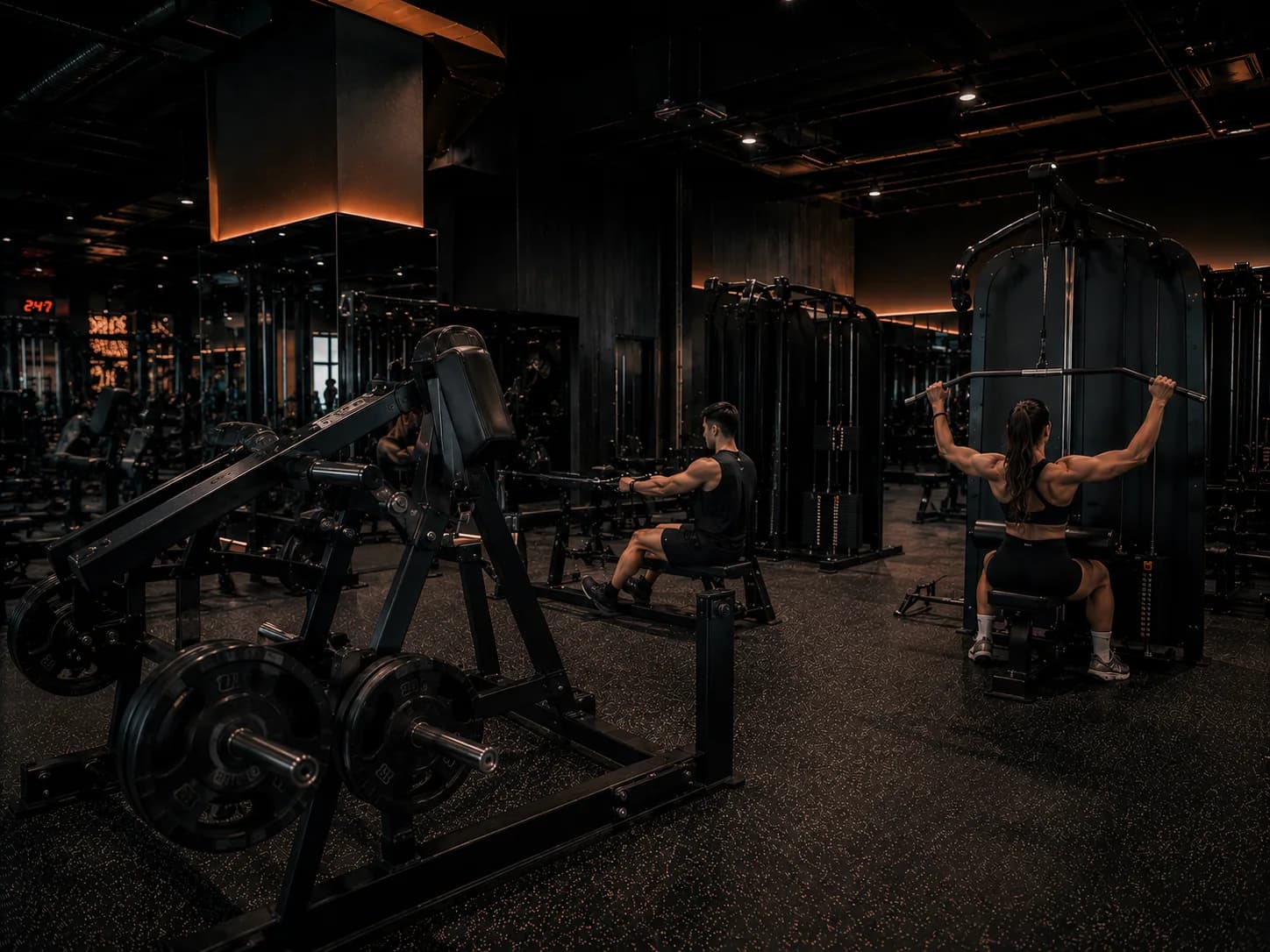
At Inception Gym Christchurch, the back machine selection covers all three: plate-loaded and cable pulldowns, multiple row stations, a pullover machine, and a 45-degree hyperextension, drawn from a floor of 92 machines with 43 plate-loaded. This guide walks each machine, what it builds, and how to use it.
Anatomy of the back
Knowing which muscles you're training helps you choose exercises with intent.
Latissimus dorsi. The large wing-shaped muscle that builds width. Pulls the arm down and toward the body. Best trained with vertical pulling (pulldowns) and some rows.
Rhomboids and middle trapezius. Mid-back muscles responsible for thickness. Draw the shoulder blades together. Best trained with horizontal pulling (rows).
Lower trapezius. Depresses and retracts the shoulder blade. Contributes to posture and shoulder health. Trained through full-range rowing where the elbows drive past the torso.
Teres major. Sometimes called the lat's helper. Runs alongside the lat and contributes to the same pulling patterns.
Erector spinae. Column of muscle running along the spine. Handles spinal extension and posture under load. Trained with hyperextensions and good mornings.
Rear deltoids. Not technically back muscles, but trained in the same pulling patterns. Contribute to upper back width.
Vertical pulling: lat pulldown machines
Plate-loaded lat pulldown
A primary back builder. With no weight stack ceiling, you can keep loading it as your strength climbs over months and years.
Targets. Latissimus dorsi primarily, with teres major and rear delts contributing. Biceps and brachialis assist on elbow flexion.
How to use it. Shoulder-width or slightly wider grip. Start the rep by depressing your shoulder blades downward (think shoulders away from ears before you bend your elbows). Pull the bar to your upper chest with the torso slightly reclined. Control the return to full arm extension to stretch the lats.
The common mistake. Pulling with the biceps and arms rather than starting with the lats and shoulder blades. If you feel it primarily in your biceps, the lats aren't initiating.
Programming. 3 to 4 sets of 8 to 12 reps. Works as the first or second exercise in a back session.
Seated lat pulldown (cable, wide grip)
The cable lat pulldown gives constant tension through the full range, which the plate-loaded version doesn't always match. Both have merit.
Grip variations at Inception Gym.
- Wide pronated grip: max lat width focus
- Neutral grip (V-bar or parallel handles): slightly more range of motion for some lifters
- Supinated underhand grip: shifts load toward the lower lats and biceps
Programming. Rotate grips every few weeks to keep the stimulus fresh and hit different portions of the lat.
Single-arm lat pulldown (cable)
Training one arm at a time forces the working lat to do all the work, so the stronger side can't carry the weaker.
Targets. Unilateral lat development; corrects side-to-side imbalances.
Programming. Useful periodically, especially if you notice one shoulder sitting lower or one side of the back being more developed.
Horizontal pulling: row machines
Plate-loaded seated row
The seated row is the primary exercise for back thickness. Horizontal pulling targets the rhomboids, middle trapezius, and teres major, which build a thick, 3D mid-back.
Targets. Rhomboids, middle trapezius, teres major, lower lat. Rear delts and biceps assist.
How to use it. Sit upright with the chest against the pad. Drive your elbows back past the torso, squeezing the shoulder blades together at the end of the rep. Hold the contraction briefly, then control the return. Don't let momentum or torso swing take over.
The squeeze matters. Plenty of lifters rush rows without fully retracting the scapulae. That last inch of retraction is where the mid-back gets peak contraction. Don't skip it.
Programming. 3 to 4 sets of 8 to 12 reps. Pairs well with lat pulldowns for the width and thickness combination.
Plate-loaded T-bar row
A classic mass-building exercise. Allows heavy loading in a free-weight feel with some support through the chest pad.
Targets. Mid and lower lat, rhomboids, trapezius. More lat involvement than a straight-arm row thanks to the hip-hinge position.
How to use it. Stand over the bar, knees slightly bent. Keep your back flat and hinge at the hips so the torso sits at roughly 45 to 60 degrees from horizontal. Pull the handles to your lower chest, leading with the elbows. Control the descent.
Programming. Slots in well as a second or third exercise. 3 sets of 8 to 12 reps.
Cable seated row (low pulley)
Constant tension throughout the rep, unlike most plate-loaded rows that lose tension at full arm extension. Complementary rather than redundant.
Attachments.
- Close neutral grip: max range of motion, strong mid-back emphasis
- Wide pronated bar: broader lat recruitment
- Single handle: unilateral work
Programming. Great for higher rep ranges (12 to 20) as a finisher or volume builder.
One-arm dumbbell row (with the incline bench)
Not a machine exercise, but available on the incline benches and one of the most effective single-joint back exercises in the gym. The free weight allows a bigger range of motion than many machines.
Pullover machine
The pullover is an under-rated back builder that plenty of gym members walk past without knowing what it does.
Targets. Primarily the lats through a unique overhead stretch position. Also hits the long head of the triceps and serratus anterior.
Why it's worth using. The pullover loads the lats in a stretched position (arms overhead) that almost no other machine replicates. Given the evidence that loading at long muscle lengths drives hypertrophy, it provides a stimulus that's distinct from all pulling movements.
How to use it. Sit with your elbows on the pads and arms overhead. Pull your elbows down and toward your hips in an arc. You should feel a deep stretch in the lats at the top and a strong contraction at the bottom.
Programming. 3 sets of 12 to 15 reps. Strong complement to rowing and pulldown work because it hits the lat through a different range.
Lower back: hyperextensions and good mornings
45-degree hyperextension bench
A foundational exercise for lower back strength, glute development, and spinal health. Trains the erector spinae, glutes, and hamstrings in a hip-hinge pattern.
Targets. Erector spinae (primary), glutes and hamstrings (secondary).
How to use it. Position your hips at the pad so you can hinge freely. Start with bodyweight, add a plate or dumbbell once 15 to 20 reps feel comfortable. Lower the torso until you feel a stretch in the lower back, then extend back to neutral. Don't hyperextend past horizontal.
Programming. Often neglected because it doesn't look impressive. That's a mistake. A strong posterior chain is the foundation for lower body training, deadlifting, and spinal health. 3 sets of 12 to 20 reps at the end of a back or leg session.
Reverse hyper machine (where available)
The reverse hyper loads the lower back and glutes in a way the standard hyperextension can't, and decompresses the spine at the same time. If one's on the floor when you visit, it's worth learning.
Programming a complete back session
Back training works best when you pair vertical and horizontal pulling, cover both width and thickness, and include some lower back work.
Sample back session.
- Plate-loaded lat pulldown: 4 sets of 6 to 10 reps
- Plate-loaded seated row: 4 sets of 8 to 12 reps
- Pullover machine: 3 sets of 12 to 15 reps
- Cable row (close grip): 3 sets of 15 to 20 reps
- Hyperextension: 3 sets of 15 reps
That covers width (pulldown, pullover), thickness (rows), and lower back integrity (hyperextension).
Training frequency. The back responds well to being trained twice per week because of its size and variety. One session can prioritise width (more pulldown volume), the other thickness (more row volume).
The mind-muscle connection
More than any other muscle group, the back needs deliberate effort to feel properly. Plenty of lifters spend years on back training without fully engaging the lats, defaulting to bicep-dominant pulling instead.
A practical tip: on your first set of any pulling movement, use a weight lighter than your working set and focus on initiating with your shoulder blade and lat. Feel the lat expand and contract. Once that connection is there, go up to your working weight.
If you consistently struggle with lat engagement, a short session with one of our personal trainers to review your movement pattern will sort it faster than years of trial and error.
Fuelling back training
The back involves more muscle mass than any other body part. A full back session is metabolically demanding and needs adequate protein, carbohydrate, and recovery to produce results.
The on-site Supplement Solutions store carries the full Inception Labs range, including creatine monohydrate for strength and recovery, and Collagen Whey Protein for muscle repair. Members save up to 40% year-round.
For a structured approach to nutrition that supports training, Inception Nutrition runs PhD-led coaching built around your goals and body composition data.
Try it yourself
The back machine selection at Inception Gym is best experienced in person. The free trial gives you 24 hours of full access to test every machine, find your setup, and see what a properly equipped back training environment looks like.
If you're ready to train at the gym with the most equipment depth in Christchurch, 92 machines across 71 variants, explore membership options and get started. There is no joining fee on any plan: stay flexible on the open-term rate with 28 days' cancellation notice, or take a lower weekly rate on a 12 or 24-month commitment.