Equipment · Arms
Arm training machines: the bicep and tricep guide
Every arm machine at Inception Gym Christchurch, what it does, and how to fit machine work alongside dumbbells and cables for full arm development.
By Inception Gym · 24 January 2026
Why arm machines belong in your programme
The arms are one of the most visible muscle groups on the body and one of the most commonly under-trained for direct work. Many lifters assume compound pressing and pulling cover the biceps and triceps. They do contribute, but direct arm work gives a different stimulus and meaningfully better arm development.
The case for machine-based arm training comes down to tension and safety. Free weight arm exercises like the barbell curl or dumbbell kickback have awkward resistance curves. The barbell curl has near-zero resistance at the bottom and top of the movement. A well-designed arm machine holds tension across the full range, which means more total mechanical tension per set.
At Inception Gym Christchurch in Addington, the arm lineup covers a preacher curl machine, a seated bicep curl machine, cable stations with a full attachment set for curls, pushdowns and overhead extensions, a Smith machine for close-grip pressing, and dumbbells up to 70kg. That sits inside a floor of 92 machines, 43 of them plate-loaded. This guide walks each arm option, what it builds, and how to mix machines with free weights.
Bicep anatomy
The biceps brachii has two heads: the long head (outer portion, builds the peak) and the short head (inner portion, builds width). Both flex the elbow and supinate the forearm.
Brachialis. Sits under the bicep. When developed, it pushes the bicep up and adds thickness. Responds best to neutral or pronated grip curling.
Brachioradialis. The forearm muscle that helps with elbow flexion at a neutral grip. Built with hammer curl variations.
For full arm development, you need work that hits the long head (supinated grip, shoulder-width or wider), the short head (closer grip, slightly internally rotated), and the brachialis (neutral or pronated grip).
Tricep anatomy
The triceps brachii has three heads: long, lateral, and medial.
Long head. Largest of the three, running down the back of the upper arm. The only head that crosses the shoulder joint, so it's most involved when the arm is overhead (overhead extensions). Responds to arms-elevated work.
Lateral head. Most visible from the side, forms the horseshoe on the outer tricep. Best targeted with close-grip pressing and pushdowns.
Medial head. Innermost head, often called the workhorse. Active in nearly every tricep exercise and hard to isolate on its own.
Effective tricep training hits all three, which means pushdowns (lateral and medial) and overhead extensions (long head).
Bicep machines
Preacher curl machine
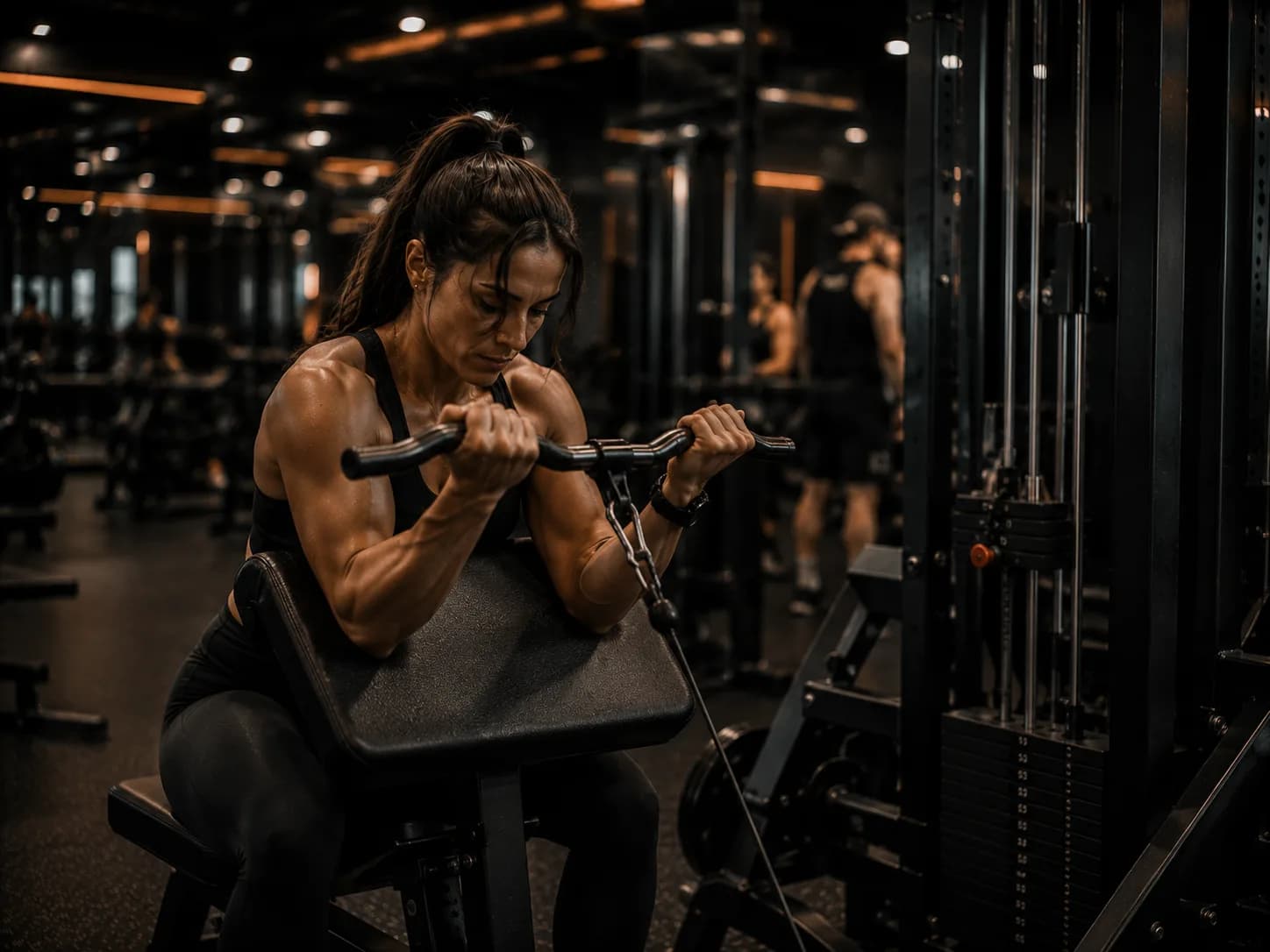
The preacher curl is one of the best bicep isolation tools in the gym. The pad locks the upper arm at an angle that stops shoulder recruitment and keeps tension on the bicep at both the bottom and top of the rep.
Targets. Bicep brachii, with extra emphasis on the lower bicep and the brachialis when you use a neutral or slightly pronated grip.
Why the preacher position matters. Fixing the upper arm against the pad kills the ability to swing the torso or shrug the shoulders to assist the lift. The bicep does all the work. It also loads the bicep at a stretched position at the bottom, which research increasingly links to better hypertrophy.
How to use it. Adjust the seat so when you grip the handles, your upper arms rest flat on the pad and the crease of your elbow lines up with the edge of the pad. Curl through the full range and control the descent. Eccentric phase 2 to 3 seconds.
Programming. 3 to 4 sets of 10 to 12 reps. Don't rush. The slow eccentric is the point.
Seated bicep curl machine
The seated curl gives a guided arc with constant cam tension throughout the rep. The arm hangs more vertically than on the preacher, which shifts the resistance curve.
Targets. Biceps brachii, emphasising the mid-range and peak contraction.
Programming. Slots in well as a second bicep exercise after the preacher curl. 3 sets of 12 to 15 reps.
Cable bicep curl (low pulley)
The cable low pulley curl gives you continuous tension dumbbells can't match. At the top of a dumbbell curl, resistance drops to near zero because the weight is right above the elbow. The cable keeps horizontal tension throughout.
Variations.
- Straight bar: standard supinated grip, hits both heads
- EZ bar: slightly supinated, easier on the wrists
- Rope: hands separate and supinate at the top for a stronger peak contraction
- Single handle: unilateral, removes strong-side compensation
Programming. Great as a finisher or in supersets. 3 sets of 12 to 20 reps.
Concentration curl (dumbbells)
Not a machine, but worth mentioning because the dumbbell rack at Inception Gym goes up to 70kg. That makes heavy concentration curls realistic for advanced lifters chasing peak.
Targets. Long head of the bicep in particular, which sets the height of the peak.
Tricep machines
Tricep pushdown (cable, high pulley)
The pushdown is the most common cable tricep exercise and one of the most effective. The high pulley extends the elbow against resistance pulling upward, which loads the tricep through a clean extension pattern.
Targets. All three heads, with slightly more lateral and medial involvement depending on the attachment.
Attachments.
- Straight bar: standard, pronated grip
- EZ bar: slightly supinated at the bottom, easier on the wrists
- Rope: wrists rotate and flare at the bottom for max contraction and more lateral head
- V-bar: similar to straight bar with a friendlier wrist angle
- Single handle: unilateral
How to use it. Face the cable, elbows tucked. Elbows stay fixed; only the forearm moves. Push down to full extension and feel the tricep contract hard. Control the return to about 90 degrees of elbow flexion.
Programming. 3 to 4 sets of 12 to 15 reps. Rope pushdowns with a full flare at the bottom are particularly good for the lateral head.
Overhead tricep extension (machine or cable)
Overhead changes the game for triceps. With the arms overhead, the long head is fully stretched, and research suggests that position produces meaningfully better long head growth than pushdown-only training.
Targets. Long head of the tricep.
How to use it (cable version). Set the pulley low and use a rope. Face away from the stack, grip the rope overhead, and extend forward and overhead. Keep your elbows pointing forward, not flaring wide, and extend to a straight-arm position.
Why it matters. If your triceps look flat from behind, you're probably not training the long head enough. Overhead extension work fills in the back of the arm in a way pushdowns can't.
Programming. 3 to 4 sets of 10 to 15 reps.
Tricep kickback (machine or cable)
The kickback isolates the lateral and medial heads in a hip-hinge position. The machine or cable version beats the dumbbell version because it keeps tension at the contracted end of the range, where the dumbbell version drops it.
Programming. 3 sets of 12 to 15 reps. Works well as a final tricep exercise.
Close-grip bench press (barbell or Smith machine)
Not a machine exercise, but a staple of tricep training. A shoulder-width or slightly narrower grip on a barbell bench press shifts emphasis from the chest to the triceps. The Smith machine version at Inception Gym is a safe alternative that keeps the bar path locked.
Targets. All three tricep heads, and it takes heavier loading than any isolation exercise.
Programming. If close-grip pressing is in your session, do it first while you're fresh. 4 sets of 6 to 10 reps.
Machines and free weights together
A common question: do machines replace free weights for arm training? No. They sit alongside each other.
Free weights are good for.
- Natural wrist and elbow rotation through the rep
- More stabiliser recruitment
- Movements like dumbbell hammer curls for brachialis and brachioradialis that machines don't replicate as cleanly
Machines are good for.
- Constant or increasing tension through the full range
- Pushing sets close to failure without form breaking down from instability
- Fixed paths so you can focus on contraction rather than balance
A good arm programme uses both. Heavy barbell or dumbbell curls for strength and neural drive; machine and cable curls for volume, constant tension, and finishing work.
Programming arm training
Sample arm session (biceps and triceps together).
- Close-grip bench press (triceps first, while fresh): 4 sets of 8 reps
- Preacher curl machine: 4 sets of 10 reps
- Overhead cable tricep extension: 3 sets of 12 reps
- Cable bicep curl (rope): 3 sets of 15 reps
- Tricep pushdown (rope): 3 sets of 15 reps
- Seated bicep curl machine: 3 sets of 15 reps
Arms as a session vs accessory work.
Many members train arms as a standalone session once a week and add arm volume to the end of chest or back days. Both work. Total weekly volume matters more than how it's split.
Weekly volume targets.
- Biceps: 10 to 20 sets per week for most gym members
- Triceps: 10 to 20 sets per week (heavy pressing already provides significant tricep volume)
Nutrition and arm growth
Building visible arm mass needs enough protein to support muscle protein synthesis and enough calories to support growth. Biceps and triceps are relatively small muscles and won't grow in isolation from overall nutritional support.
Members at Inception Gym can use the on-site Supplement Solutions store with the full Inception Labs range at member pricing. Creapure-sourced Inception Labs Creatine Monohydrate is one of the best-supported supplements for strength on curls and presses. Member price $50, saving $20 on the RRP.
For a personalised approach, Inception Nutrition runs PhD-led coaching that builds a supplement and nutrition protocol around your training and body composition data.
Try the arm setup at Inception Gym
The arm machine selection is best experienced in person. Our free trial gives you 24 hours of full access: preacher curl machine, every cable attachment, and the full 70kg dumbbell rack.
For the full equipment inventory and membership options, see the facilities page or compare membership plans.